
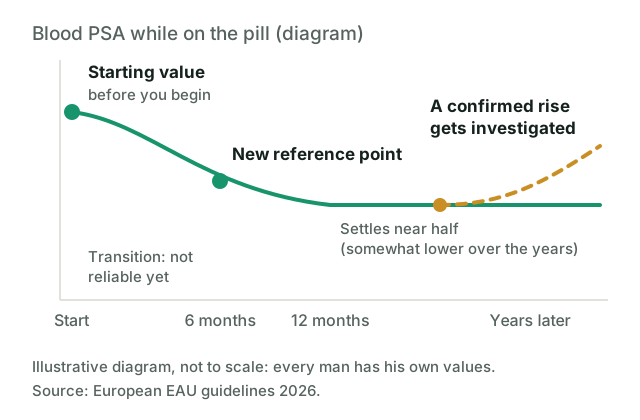
In short: finasteride and dutasteride lower PSA, prostate-specific antigen, by about half [1, 2]. Most of the effect shows up between 6 and 12 months of treatment [2]. That's why, if you take one of these pills, your result is read multiplied by two, as a guide [3]. More important than a single number is how it moves: ideally, you have a PSA before you start, a new reference value at six months, and any confirmed rise from there gets investigated [2]. And simplest of all: always tell them you take the pill.
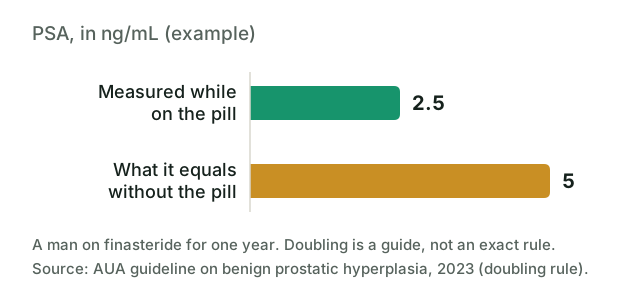
Imagine you've been taking finasteride for your prostate for a year. At a checkup, they order a PSA and it comes back at 2.5. The doctor, who doesn't know you take the pill, tells you you're perfectly fine. But since the pill cut your PSA in half, that 2.5 is equivalent to a 5. And a 5 is already a number that calls for taking a closer look. The pill didn't create any problem: it just turned down the volume on the alarm, and whoever didn't know was left with half the story.
What is PSA and what is it for?
PSA, or prostate-specific antigen, is a substance made by the cells of the prostate and measured with a blood test. It's the main test when looking for possible prostate cancer [1].
It works like an early alarm. Just as women get Pap smears or mammograms to catch some cancers in time, we men have PSA to keep an eye on the prostate. It's not a diagnosis: it doesn't say "you have cancer." What it does is warn you that something is worth checking.
Two things are worth being clear about:
- PSA belongs to the prostate, not to cancer. It goes up when something is happening in the prostate, and that something can be an enlarged prostate, inflammation (prostatitis), or other causes that aren't cancer [1].
- Having a large prostate is not having cancer. They're two different things; I explain it in Can an enlarged prostate turn into cancer?.
How much do finasteride and dutasteride lower PSA?
By about half [1, 2]. Not overnight: PSA goes down little by little, and most of the effect shows up between 6 and 12 months of treatment [2].
Why does it go down? Not because of anything shady. Finasteride and dutasteride mainly shrink the glandular part of the prostate, which is exactly the part that makes PSA [3]. Less prostate producing it, less PSA in the blood. It's the natural result of the medication doing its job. If you want to understand how they work, I explain it in Can you shrink the prostate without surgery? Finasteride and dutasteride.
Free PSA, another measurement that is sometimes ordered, also drops by half, so the ratio between free and total PSA doesn't change [3].
Why do you have to multiply PSA by two if you take finasteride?
Because that's how it's compared with what it would be without the pill. The American guideline says to double the measured value to monitor both the prostate and the possibility of cancer [3], and the European one calls for correcting it before deciding whether more tests are needed [1].
Think of a fire alarm. If a fire is starting, the alarm goes off to warn you. Finasteride and dutasteride turn its volume down by half. And here's the delicate part: turning down the alarm doesn't put out the fire. If there's a fire, it's still there. The only thing that changed is that you hear it less now. The point is never to silence the alarm: it's to know it's going off, even if it's going off quietly.
Is multiplying PSA by two always enough?
As a guide, yes; as an exact rule, no. Doubling PSA from six months of treatment onward is the accepted approach, but some studies suggest it may fall short [4]:
| How much PSA dropped (median) | When | Medication |
|---|---|---|
| About 55% | At one year | Finasteride and dutasteride |
| 57% | At 4 years | Finasteride |
| 66% | At 4 years | Dutasteride |
Data from different studies, pooled in a 2021 review [4].
In other words, over the years PSA can drop a bit more than half, and multiplying by two could leave the number somewhat short. That's why, more than the number on any given day, what matters is how it moves over time.
Why is it worth measuring PSA before starting finasteride?
Because that's your true number, the one the pill hasn't touched yet. It's called your baseline or starting value.
During the first 6 to 12 months, PSA goes down little by little: it's in transition, halfway there, and not entirely reliable to interpret. The European guideline recommends setting a new reference value at six months of treatment [2]. From then on, you know where your PSA settled on the pill, and it can be monitored.
In men who take these pills, the European guideline recommends measuring PSA periodically if their life expectancy is more than ten years and if finding a cancer would change their treatment [2]. Just like a mammogram or a Pap smear: it's not a one-time thing.
What does it mean if PSA rises while you take finasteride?
That it needs to be investigated, even if the number still looks normal. If you've been on the pill with a low, stable PSA and it suddenly starts to rise, that rise is a warning sign.
- The European guideline calls for investigating any confirmed rise in PSA while taking these pills [2].
- A review on prostate cancer prevention puts it this way: any confirmed rise from the lowest point PSA reached on the pill should be considered a sign that a cancer could be developing [5].
- Some researchers have proposed that a rise of 0.3 ng/mL from that lowest point could be used as an alternative to doubling the value [4].
"Confirmed" is the key word: a single high result is repeated before drawing conclusions, as you'll see below.
What happens if your doctor doesn't know you take finasteride?
That's the real danger. The pill isn't the villain of this story: the villain is silence. The problem arises when no one knows you take the medication and the number is read raw, without adjusting it.
A study of more than 80,000 US veterans with prostate cancer found that in those who took finasteride or dutasteride, more time passed between the first high PSA (already adjusted) and the diagnosis: a median of 3.6 years, compared with 1.4 years in those who didn't take them [6]. It's an observational study, which shows an association and doesn't prove cause. Even before that, researchers worried that this special way of reading PSA wasn't well known by all doctors and could delay diagnoses [5], and the study's authors conclude that it needs to be made better known [6].
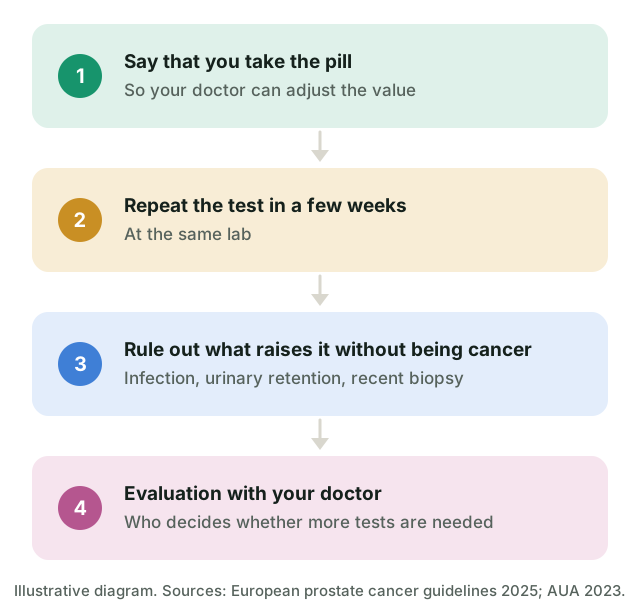
Your job is simple and very powerful: always say that you take finasteride or dutasteride, at every test and with every doctor. If you take the capsule that combines dutasteride and tamsulosin, it counts too: it contains dutasteride.
If your PSA comes back high while taking finasteride, is it cancer?
Not necessarily. Remember that PSA belongs to the prostate, not to cancer: it goes up when something is happening in the prostate, and that something can be many things [1]. That's why an abnormal value isn't interpreted on its own: it's adjusted, repeated, and evaluated together with everything else.
Before you get alarmed, it's worth knowing what else can move PSA [1]:
- A urinary tract infection with fever can raise it a great deal.
- Acute urinary retention (when you suddenly can't urinate) raises it moderately.
- A recent prostate biopsy.
That's why, when PSA comes back moderately high, the European guideline suggests repeating it a few weeks later, at the same lab: in a third of men with a PSA below 10, the second result differs by more than 1 ng/mL [1].
If you want to learn more about when to get a PSA test and how to read it in general, I explain it in PSA test: when to get it and how to read the result.
When should you see a doctor about PSA if you take finasteride or dutasteride?
Talk to your doctor if:
- you're about to start the pill and don't have a recent PSA: ask for one before you start;
- you've reached six months on the pill: it's a good time for your new reference value;
- your PSA rises from the lowest point it reached on the pill and the rise is confirmed when repeated, even if it still looks "normal";
- a doctor tells you your PSA is fine without knowing you take the pill.
If you have questions about your PSA, talk them over with your doctor before changing or stopping your treatment.
Key takeaways
- Finasteride and dutasteride lower PSA by about half; most of the effect shows up between 6 and 12 months.
- If you take them, your PSA is read multiplied by two, as a guide; over the years it can drop a bit more.
- Ideally: a PSA before you start and a new reference value at six months.
- Any confirmed rise while you take the pill gets investigated, even if the number looks normal.
- Always tell them you take the pill: the danger isn't the medication, it's that no one knows.
Frequently asked questions
If I take the capsule that combines tamsulosin and dutasteride, does my PSA also go down? Yes: it contains dutasteride, which lowers PSA by about half [1, 2]. Tell them you take it, just as if it were dutasteride alone.
Does free PSA also need to be multiplied? Free PSA also drops by half, so the ratio between free and total PSA doesn't change, and that ratio isn't corrected [3].
I've been on the pill for two months and my PSA has already dropped. Should I multiply it by two now? It's not reliable yet: PSA is still going down, and most of the effect shows up between 6 and 12 months [2]. That's why the new reference value is taken at six months.