
In short: finasteride and dutasteride block an enzyme, 5-alpha reductase, that converts testosterone into a more potent hormone: dihydrotestosterone, or DHT [1, 2]. DHT is the prostate's main fuel [3]. When DHT goes down, the cells in the glandular part die off little by little and the prostate shrinks [1]. They don't lower testosterone: they act on DHT. And the idea came from a true story: some children in the Dominican Republic who were born with a defect in that enzyme and, as adults, had a very small prostate [4].
You have been told that finasteride or dutasteride "shrink" the prostate. But how do they do it? What do they have that makes an organ get smaller? The answer starts in a village in the Caribbean, with a group of children who changed what we know about the prostate.
What is DHT and why does it make the prostate grow?
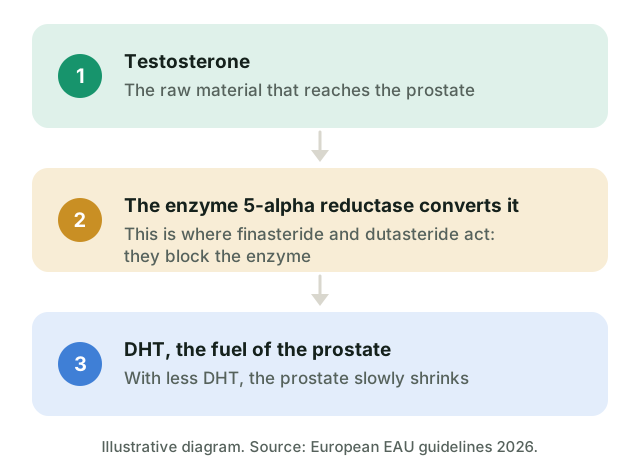
All men produce testosterone, the male hormone. But testosterone on its own is not what stimulates the prostate the most. The body transforms it, with the help of an enzyme called 5-alpha reductase, into another, more potent hormone: dihydrotestosterone, which, so we don't trip over the word, we call DHT [2].
An enzyme is like a tool the body has for turning one substance into another. And DHT is the real fuel: it is the main male hormone inside the prostate [3]. A curious fact: over the years, testosterone in the blood goes down, but DHT inside the prostate stays the same [3]. I explain why the prostate grows over the years in Why does the prostate grow with age?.
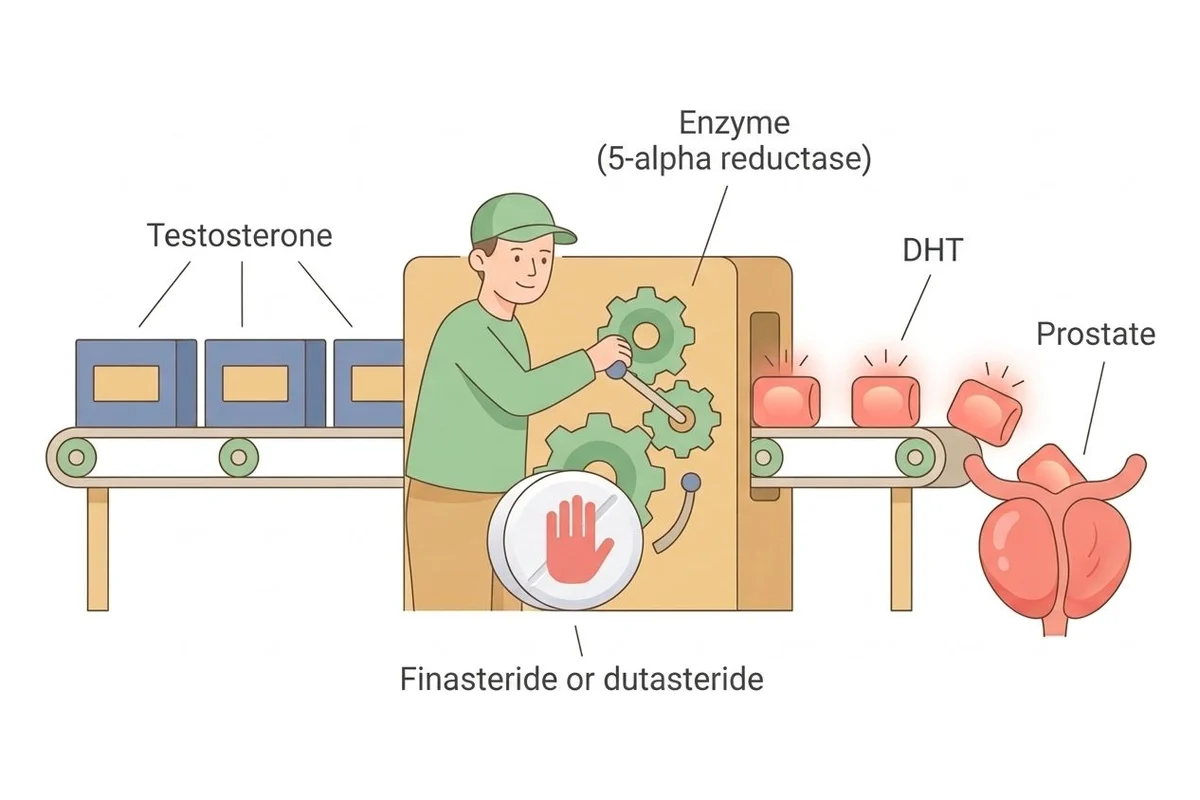
Think of a factory:
- testosterone is the raw material coming in;
- the enzyme is the worker who processes it;
- DHT is the finished product, ready to make the prostate grow.
Who are the Guevedoces and what do they have to do with finasteride?
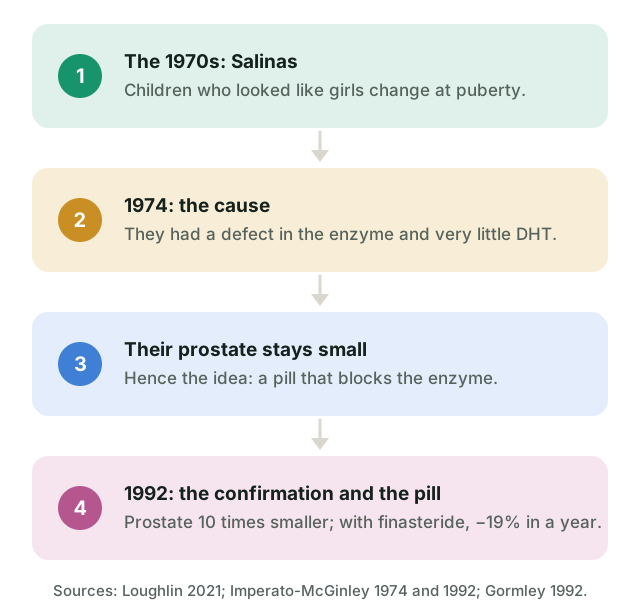
To understand these pills, you have to go back to the 1970s, to Salinas, a village in the southwest of the Dominican Republic [4]. Babies were born there whom everyone assumed were girls: they looked like girls and were raised as girls [4]. But when they reached puberty, around age twelve, their bodies changed: they developed muscles, and their testicles and penis grew [4]. Genetically, they had always been male.
The people of the village even gave them a name: the "Guevedoces," which comes from a local expression that means "testicles at twelve."
A case like that does not go unnoticed. In 1974, a group of researchers published the cause in the journal Science: these children had a defect in 5-alpha reductase, so their bodies made very little DHT [5]. Before birth, that shortage of DHT kept their external genitals from fully forming as male [5]. It is an inherited condition: it appears when the child receives the altered gene from both parents [5].
What happens to the prostate of the Guevedoces?
It stays small. From the first studies it was seen that, although they became masculine at puberty, their prostate remained small [4].
Imagine the researchers' faces when they understood this. They had found, in a small Caribbean village, the key that switches off prostate growth. And they thought: "If being born with this enzyme almost switched off leaves the prostate small, let's make a pill that blocks it on purpose." Finasteride was born from those discoveries [4].
Years later, in 1992, the same researchers confirmed it with ultrasound: the prostate of these men, now adults, was about ten times smaller than that of men their own age, and their PSA was so low it could not be measured [6]. With very little DHT, the prostate barely grows [6].
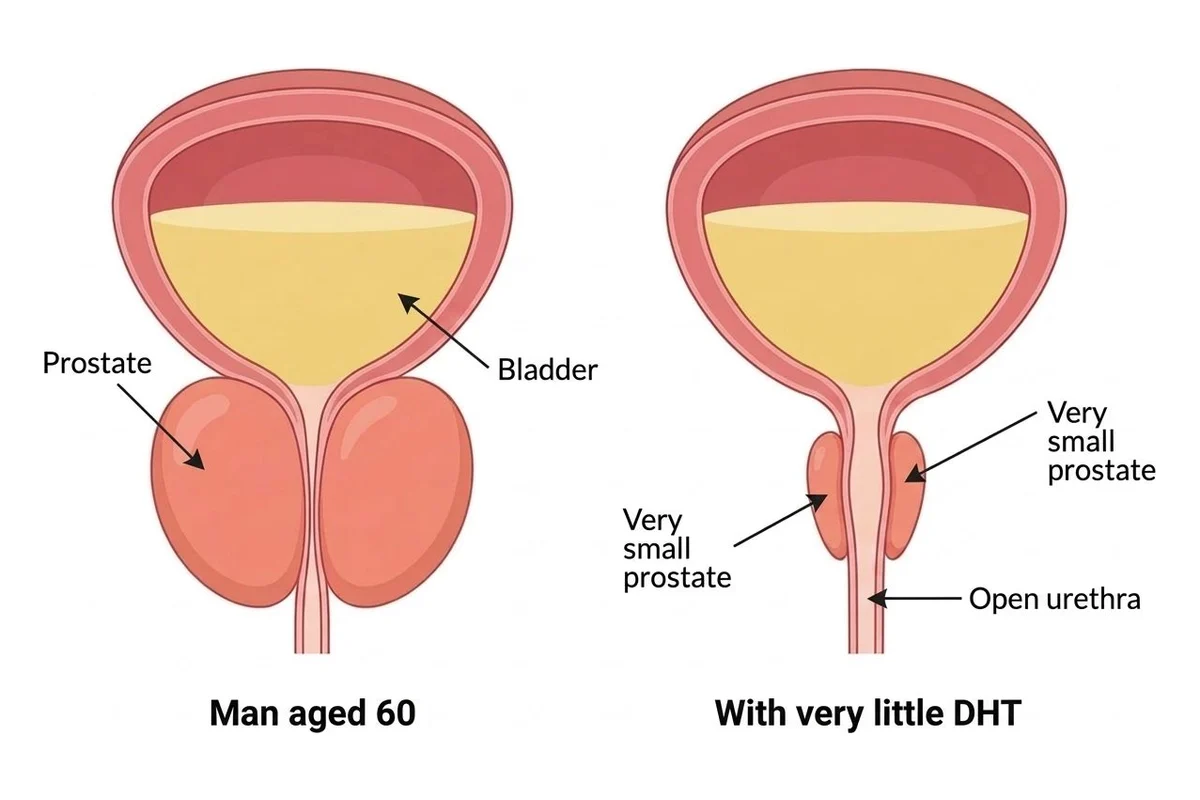
In these individuals, neither benign prostate enlargement nor prostate cancer has been described [7]. But they are few people, studied in few papers: that does not prove they are protected, and it does not mean the pill prevents cancer either.
That same year a large study of finasteride was published: in 895 men with an enlarged prostate, one year of 5 mg a day shrank the prostate by 19% [8].
How do finasteride and dutasteride work in the prostate?
They do on purpose what nature did in the Guevedoces: they switch off the factory worker. They block 5-alpha reductase, DHT goes down, and without their fuel the cells in the glandular part of the prostate die off in a programmed way [1]. That is why the prostate shrinks little by little.
They don't do anything strange or magical. And since the change is slow, they take months: between 6 and 12 months, the prostate shrinks by 18% to 28% and PSA falls by roughly half [1]. I explain how long they take and what happens if you stop them in How long do finasteride and dutasteride take to work, and what happens if you stop?.
What is the difference between how finasteride and dutasteride work?
The enzyme comes in two versions, type 1 and type 2 [2]. Type 2 is the one that predominates in the prostate and genitals; type 1 is found in many tissues and predominates in the oil glands of the skin [3, 7].
| Finasteride | Dutasteride | |
|---|---|---|
| What it blocks | Type 2 of the enzyme | Types 1 and 2 |
| How much it lowers DHT in the blood | About 70% | About 95% |
| How much it lowers DHT inside the prostate | 85% to 90% | 85% to 90% |
Source: European EAU guideline [1].
Inside the prostate, both lower DHT by almost the same amount [1]. If you want to know which one is the better choice, I compare them in Can the prostate shrink without surgery? Finasteride and dutasteride.
Do finasteride or dutasteride lower testosterone?
No. It is one of the most common misconceptions: "those pills lower your testosterone." That is not so. Finasteride and dutasteride don't block testosterone; they block its conversion to DHT. Testosterone in the blood does not go down.
In fact, some studies show it goes up a little. But when all the studies are pooled, that increase was neither consistent nor clear [9], and it doesn't translate into anything you will feel: it won't give you more energy or anything like that. The important point is simple: the medication works on DHT, not on your testosterone.
Why is finasteride also used for hair loss?
Because DHT is also involved in baldness. Finasteride has been used both for the prostate and for male-pattern hair loss [3]; for hair, a lower dose of 1 mg is used [4]. It is the same hormonal story behind it: in men with the enzyme deficiency, baldness has not been described [2].
Here I am talking about the prostate. If you take it for your hair, the dose and what is expected from it are different.
What does this mean for you if you take finasteride or dutasteride?
Understanding how they work explains almost everything else:
- They take months, because shrinking an organ takes time.
- They lower PSA by roughly half [1]. Always mention that you take them when your PSA is measured. I explain it in Finasteride, dutasteride, and PSA.
- They help when the prostate is large, because what they do is shrink it. With a prostate smaller than 40 mL, finasteride might work no better than a placebo [1].
- If you stop them, DHT comes back and the prostate grows again; I explain it in How long do finasteride and dutasteride take to work, and what happens if you stop?.
Key takeaways
- Testosterone is converted into DHT by an enzyme, 5-alpha reductase; DHT is the prostate's fuel.
- Finasteride and dutasteride block that enzyme: DHT goes down and the prostate shrinks little by little.
- The idea came from the Guevedoces, Dominican children who were born with a defect in the enzyme and who, as adults, had a prostate about ten times smaller.
- They don't lower testosterone: they act on DHT.
- Finasteride blocks mainly type 2 of the enzyme and dutasteride blocks both, but inside the prostate they lower DHT almost equally.
Frequently asked questions
Is finasteride a hormone? No. It is a medication that blocks an enzyme. It doesn't give you hormones or take away your testosterone: it keeps testosterone from being converted into DHT [1, 9].
Do the Guevedoces have any prostate problems? Their prostate stays very small [6], and neither benign prostate enlargement nor prostate cancer has been described in them [7], although they are few people and there are few studies. That small prostate was the clue that led to the creation of finasteride [4].
Does the finasteride for hair work for the prostate? It is the same medication, but the 1 mg version for hair is a lower dose [4]. The dose studied for the prostate was 5 mg a day [8]; don't change it on your own.