
In short: as the years go by, almost every man develops prostatic hyperplasia, meaning more cells in the prostate, and in many men this makes the gland grow. It's part of aging, not something you did wrong. It requires male hormones, especially one called DHT, and inflammation and metabolism seem to play a part. A large prostate doesn't always cause symptoms, and this benign growth is not cancer, although the two can coexist.
If you've been told your prostate is enlarged, or you're simply at the age where you start to wonder, the first thing worth knowing is that you're in good company. The second is that understanding why it happens goes a long way toward taking the fear out of it.
How common is it for the prostate to grow?
Very common. The strongest data come from autopsy studies, in which the prostates of many men were examined under the microscope:
| Age | Men with hyperplasia seen under the microscope |
|---|---|
| 31 to 40 | 8% [1] |
| 51 to 60 | 50% [1] |
| 60 | 60% [2] |
| 80 | 80% [2] |
Put another way: at 60, about 6 in 10 men; at 80, about 8 in 10.
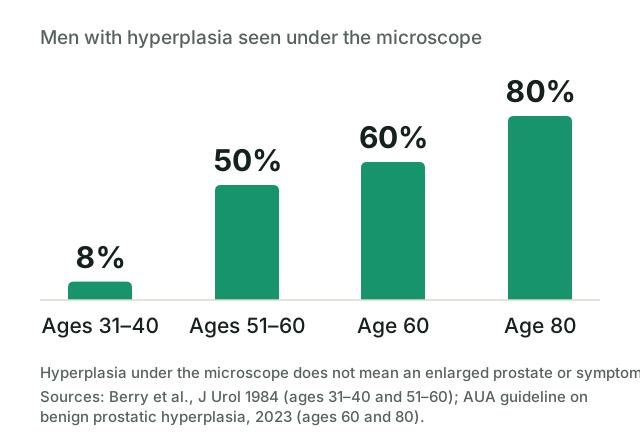
And it doesn't start all at once. By analyzing how this tissue grows, researchers estimated that the process probably begins before age 30 [1]. It progresses over decades, so slowly that you don't notice. That's why at 60 or 70 it seems as if the prostate grew "all of a sudden," when in fact it had been growing for a long time.
For reference: a young adult's prostate weighs about 20 grams, and that weight stays stable with age unless hyperplasia appears [1].
It's like other parts of the body that change over the years: the skin loses elasticity, eyesight changes, bones become more fragile. The prostate grows.
Prostate enlargement and hyperplasia: similar, but not the same
You've probably heard both terms. They're used almost as synonyms, but they don't mean the same thing:
- Prostate enlargement is about size: what the doctor feels during the exam or what is measured on an ultrasound.
- Benign prostatic hyperplasia is what's seen under the microscope when a tissue sample is analyzed: more cells than there should be [2]. The European guidelines reserve the term for that pattern seen under the microscope [3].
Imagine a garden. Plants can grow in two ways:
- Each plant gets bigger. Its leaves and branches spread out, but they're still the same plants. That's hypertrophy, and it's what happens in your muscles when you lift weights: each cell gets larger, but no new cells are born.
- New plants sprout. There are more plants in the same space. That's hyperplasia: a larger number of cells.
In the prostate, the second one happens [2].
The figures in the table above are for hyperplasia seen under the microscope, not for enlarged prostates. In practice, many doctors talk about "prostate enlargement" because that's what can be measured in a living person; hyperplasia, strictly speaking, can only be confirmed under the microscope.
A large prostate doesn't always cause symptoms
A growing prostate doesn't mean you'll have symptoms, much less that you'll need surgery.
Picture the prostate as a ball wrapped around a tube. The tube is the urethra, the channel urine flows out through.
- If the ball grows outward, where there's nothing to squeeze, it can grow a lot without you feeling anything. Urine flows normally.
- If it grows inward, toward the tube, it squeezes it. That's when symptoms begin: a weak stream, straining to start urinating, getting up several times at night.
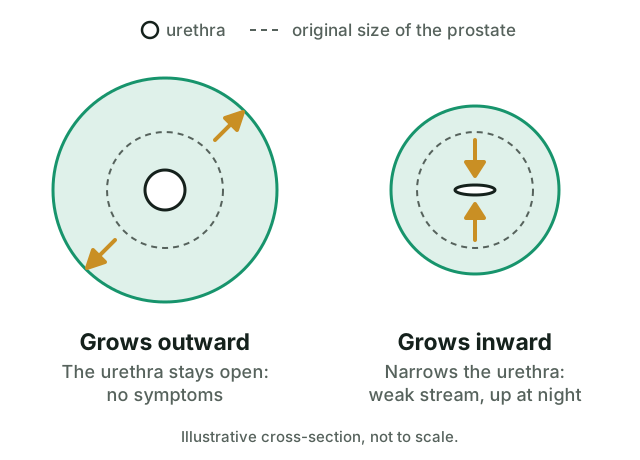
The guidelines put it this way: not every man with hyperplasia develops an enlarged prostate, and not every enlarged prostate blocks the flow of urine [2]. In addition, when the growth begins and how fast it progresses vary a great deal from one man to another [2]. That's why some men have a large prostate and never feel a thing, while others with similar growth have significant symptoms.
And the other way around: not every urinary symptom comes from the prostate. A growing number of studies show that many of these symptoms have nothing to do with it; the bladder, for example, can also cause them [3]. That's why it's worth having a doctor evaluate it instead of assuming.
Testosterone and the prostate: a paradox
Here's something that doesn't seem to add up. For years, testosterone was thought to make the prostate grow. But with age, testosterone goes down, and yet the prostate grows more. How is that possible?
Why testosterone got the blame. Without working testicles, the prostate doesn't develop hyperplasia. Men castrated before puberty have atrophic prostates, meaning small and undeveloped [2]. It seemed obvious: no testosterone, no growth.
Why it's not that simple. Testosterone drops little by little over the years, by about 1 to 2% per year [4]. An 80-year-old has considerably less than a 30-year-old, and yet his prostate is more often larger.
The answer lies in DHT. Testosterone acts on the prostate mainly through dihydrotestosterone, or DHT [2]. Testosterone reaches the prostate through the bloodstream and, once inside its cells, an enzyme called 5-alpha reductase converts it into DHT [2]. DHT binds more strongly to its receptor and is considered a more potent androgen [2]. Think of testosterone as an ingredient and DHT as the finished product.
One finding that fits: in a study that followed men for years, DHT in the blood did not decline with age the way testosterone did [4]. This is a likely explanation for why the prostate keeps growing even as testosterone falls.
There's another idea that helps explain why having more testosterone doesn't mean having a larger prostate. According to the so-called saturation model, the prostate's receptor becomes saturated when blood testosterone reaches 150–200 ng/dL; above that level, extra testosterone has little effect inside the prostate [5]. It's a model proposed while studying testosterone treatment, not a law, and it doesn't apply below that level, where testosterone does matter.
Inflammation and prostate growth
Hormones allow the prostate to grow, but they're not the whole story. Chronic inflammation of the prostate also seems to play a part in the onset and progression of hyperplasia [3].
One study reviewed the biopsies of 4,109 men who were taking part in a large prostate cancer prevention trial and whose biopsy showed no cancer. Nearly 8 in 10 (78%) had chronic inflammation in the prostate [6]. Two important caveats: these were not men picked at random from the general population, and over that four-year follow-up, inflammation on its own was not associated with new symptoms appearing or with symptoms getting worse; only the most intense inflammation showed a link [6].
Think of inflammation as a constant state of alert in the tissue. What triggers it? Often we don't know. In fact, the American guidelines list the role of inflammation among the questions science has not yet answered [2].
Metabolic syndrome and prostate growth
Metabolic syndrome is defined, according to the criteria used in these studies, by at least three of these factors: high blood pressure, high fasting blood sugar, high triglycerides, a waist of 102 cm or more, and low "good" cholesterol (HDL) [7].
What does it have to do with the prostate? Two systematic reviews of studies in men with urinary symptoms or prostate enlargement found that those with metabolic syndrome have, on average, a somewhat larger prostate: between 1.8 and 4.4 mL more [7,8]. It's a real difference, but a small one.
As for symptoms, the results don't agree: one of the reviews found no difference [8], and the other did find more moderate and severe symptoms in those with metabolic syndrome [7].
The European guidelines note that urinary symptoms are associated with factors that can be changed, such as metabolic syndrome, and that this makes them a possible target for prevention [3]. Taking care of your weight, blood sugar, and blood pressure is worth it for your overall health; its effect on the prostate is still being studied [2].
In short: hormones make it possible, and inflammation and metabolism seem to add to it.
What we still don't know about prostate growth
It would be dishonest to present this as a settled matter. The American Urological Association guideline describes hyperplasia as the likely result of several factors whose exact cause is unknown [2], and it acknowledges huge gaps in knowledge, including the role of inflammation, metabolic disorders, obesity, and environmental factors [2]. What we know today explains a good part of the picture, but not all of it.
When should you see a doctor about an enlarged prostate?
Because the growth is so slow, many symptoms creep in without you noticing, or you chalk them up to "age." Ask yourself these questions:
- Do you have trouble starting to urinate, or do you have to strain?
- Is your stream weaker than before?
- Do you wake up at night to urinate? Once, twice, three times?
- Do you feel urgency, that sudden need to go that you can't hold?
Having some urinary symptom is very common in older men, although it's often mild or not very bothersome [3]. Being common doesn't mean you have to put up with it. The guidelines recommend that every man with urinary symptoms be formally evaluated before any treatment is decided on [3], so if you notice them, bring them up with your doctor.
One situation can't wait: being completely unable to urinate. This is acute urinary retention, in which the bladder fills up, it hurts, and nothing comes out [3]. It needs immediate medical attention.
And the good news is that it's not a choice between "putting up with it or having surgery":
- Watchful waiting is a valid option for many men whose symptoms don't bother them [3].
- Lifestyle changes and self-care. They're very underrated, but there's evidence that they reduce symptoms and their progression [3].
- Medications, when needed.
- Surgery, which isn't for everyone.
Key takeaways
- Prostatic hyperplasia is nearly universal with age. It's expected, and it's not your fault.
- Several things play a part: hormones (especially DHT), and probably inflammation and metabolism. Some questions remain unanswered.
- A large prostate doesn't always cause symptoms, and not all symptoms need surgery.
- You have options: from watchful waiting and lifestyle changes to medications or surgery.
Worried that the growth could be cancer? I explain it in Can an enlarged prostate turn into cancer?.
Frequently asked questions
Does having a large prostate mean I'll need surgery? Not necessarily. Not every large prostate blocks urine flow or causes symptoms, and for those who do have symptoms there are options before surgery, such as watchful waiting, lifestyle changes, or medication.
If my testosterone is low, will my prostate stop growing? Not necessarily. The prostate mainly uses DHT, which is made from testosterone, and above a certain level, having more or less testosterone in the blood changes little of what happens inside the prostate. That's why it can keep growing even as your testosterone drops with age.
At what age does the prostate start to grow? Under the microscope, hyperplasia is uncommon before age 40 (about 8% between 31 and 40) and becomes very common after 50. The process probably starts before age 30, but it progresses very slowly.