
In short: some trials found that fenugreek improved sexual desire and function in healthy men [1, 2], and when the studies were pooled, sexual function questionnaires pointed in its favor, although with few studies [3]. But there are few studies, they are small and short, and the company selling the product was often involved [3]. In another one, the men did not notice any change [4]. The sexual improvement does not always go hand in hand with testosterone [3], and the trials were done in healthy men, not in men with erectile dysfunction [1, 2].
Fenugreek shows up in many "for men" supplements that promise more desire and better performance. Before spending money on them, it is worth knowing what the studies found.
Why is fenugreek sold for sexual desire?
Fenugreek (Trigonella foenum-graecum) is a plant. Its extracts are sold for men's health, with promises about testosterone, sexual function, body composition, and physical performance [3]. They are sold as supplements, and the products are not all the same: "fenugreek" is not a single product [3].
What did the studies find about fenugreek and sexual desire?
There are three trials in men worth knowing about. In all three, one group took the extract and another a placebo (a pill with no medication), and no one knew which one they got.
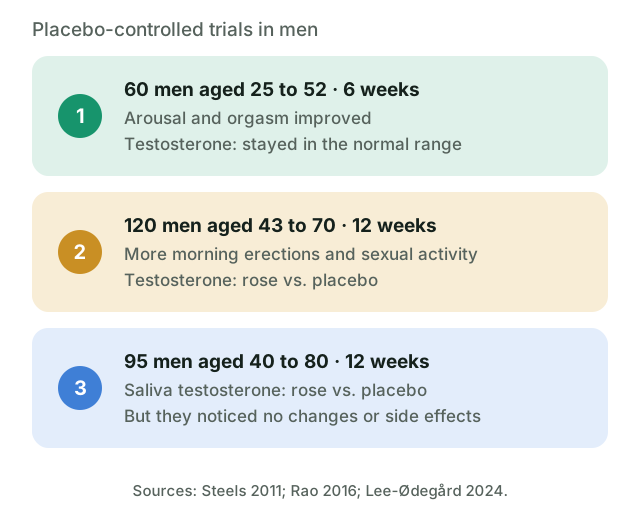
- 60 healthy men aged 25 to 52, without erectile dysfunction. They took 600 mg a day of a fenugreek extract with minerals for 6 weeks. The physical aspects of sexual desire improved overall, especially arousal and orgasm [1]. They also reported more satisfaction with their strength, energy, and well-being, but their mood and sleep did not change [1]. Testosterone stayed within the normal range [1].
- 120 healthy men aged 43 to 70. They took 600 mg a day of the same commercial extract as the previous study for 12 weeks. They had more morning erections and more sexual activity [2], their symptoms on an aging male symptoms questionnaire (AMS) went down, and their total and free testosterone went up compared with placebo [2].
- 95 men aged 40 to 80. They took three different doses of another extract, with added nutrients, for 12 weeks and answered a sexual desire questionnaire [4]. Their saliva testosterone rose compared with placebo, but they did not notice any changes or side effects [4].
A 2026 meta-analysis (a study that pools the results of many trials) brought these and other studies together. Sexual function questionnaires pointed in favor of fenugreek, although with few studies [3], and the total score on the aging male symptoms questionnaire improved by about 4.6 points [3]. But the part of that questionnaire that measures sexual symptoms did not show a clear change [3].
Does fenugreek improve sexual desire because it raises testosterone?
Not necessarily. In the study of 120 men, sexual function and testosterone improved at the same time [2, 3]. But in the study of 60 men, which used fenugreek with minerals, sexual function improved without a clear rise in testosterone [1, 3]. And in the study of 95 men, the opposite happened: saliva testosterone went up, but they did not notice any changes [4]. The authors of the meta-analysis conclude that improvement in symptoms and changes in testosterone do not always go together [3], and that these questionnaires do not allow anyone to say the effect is due to testosterone [3].
As for testosterone itself, the same meta-analysis found a small increase in total testosterone, with no stable effect on free testosterone, and rated the certainty of the evidence as very low [3]. I explain it in Fenugreek and testosterone: what the science says.
Does fenugreek work for erectile dysfunction?
There is no evidence that it does. The trials were done in healthy men: the study of 60 men included only men without erectile dysfunction [1], and the study of 120 men included healthy middle-aged and older men [2]. The fact that their morning erections increased does not mean it works for someone who already has erection problems.
The studies also do not answer whether it helps men whose low testosterone has been confirmed by their doctor [3].
How reliable are the studies on fenugreek and sexual desire?
Not very, for several reasons:
- They are few, small, and short [3].
- The company that makes or sells the product was often involved [3].
- The products are not the same: the two favorable trials tested the same commercial extract (one with minerals), and the third used another, with added nutrients [1, 2, 4].
- The results do not agree: two trials found improvement, and in another the men did not notice any changes [1, 2, 4].
In short: there are signals in its favor, but not solid proof.
Does fenugreek improve male fertility?
We do not know. Even if it raises testosterone a little, that does not mean it improves semen quality or fertility [3]. In laboratory and animal experiments there are results in both directions, and they cannot be applied directly to people [3].
Is it safe to take fenugreek for sexual desire?
In the trials in men there were no serious side effects, but they were short, so we do not know what happens when it is taken for a long time [3]. In addition, it can interact with warfarin and cause bleeding [5], and together with diabetes medications it can lower blood sugar too much [6]. I explain this in detail in Is fenugreek safe? Side effects and interactions.
If you notice less sexual desire or have erection problems, do not settle for a supplement alone: talk to your doctor to look for the cause.
When should you see a doctor about low sexual desire or erection problems?
Talk to your doctor if:
- you notice your sexual desire has dropped and it worries you;
- you have trouble getting or keeping an erection;
- you want to take fenugreek and you take anticoagulants or diabetes medications;
- you are trying to have children and you are worried about your fertility.
Key takeaways
- Two trials in healthy men found more desire and better sexual function with fenugreek; in another, the men did not notice any changes.
- The sexual improvement does not always go hand in hand with testosterone.
- The trials were done in healthy men, not in men with erectile dysfunction or confirmed low testosterone.
- The studies are few, small, short, and often involved the company: there are signals in its favor, not solid proof.
Frequently asked questions
How long does fenugreek take to have an effect on sexual desire? In the trials, the results were measured at 6 and 12 weeks [1, 2].
What dose of fenugreek was used in the studies? Two trials used 600 mg a day of standardized extracts [1, 2]; each product is different, so the dose of one does not apply to another [3].
Does fenugreek work like sildenafil (Viagra)? We do not know: these trials compared it with a placebo, not with erection medications, and they were not done in men with erectile dysfunction [1, 2].