
In short: maybe a little, but it is not certain. Three meta-analyses found a small increase in total testosterone [1, 2, 3]. The most recent one, from 2026, brought together 13 trials: it found a small increase in total testosterone, no stable effect on free testosterone, and rated the certainty of the evidence as very low [3]. Its authors conclude that the evidence does not support marketing it as something that raises testosterone [3]. It does not replace any hormone treatment.
Almost every time "natural" testosterone supplements are checked with serious studies, the story is the same: lots of promises and little evidence. To know whether something works, it is not enough that it worked great for someone; you need studies in real people, compared with a placebo. Fenugreek is one of the few that did show something measurable [4]. This is what they found.
What is fenugreek, and where does it come from?
Fenugreek (Trigonella foenum-graecum) is a plant that has been used for thousands of years. Seeds have been found in Egyptian tombs more than 4,000 years old; India's Ayurvedic medicine described it as a tonic for strength and vitality; Pliny the Elder mentioned it as a remedy for vigor, and gladiators supposedly took it to build muscle. Later, Arab traders carried it all around the Mediterranean.
Today it is sold as capsules, powder, or extracts. In the United States (FDA) and in Mexico (COFEPRIS) it is considered a dietary supplement, not a medication. That means quality, concentration, and purity can vary a lot from one brand to another. A long history does not guarantee an effect: that is what studies are for.
How is fenugreek supposed to raise testosterone?
There are two theories, and both come mainly from laboratory studies:
- Diosgenin. Fenugreek contains diosgenin, a plant steroid [2] whose shape resembles steroid hormones. In test tubes, it has been thought that it might serve as a starting piece for making hormones such as testosterone. But there is no solid evidence that the human body turns it into testosterone.
- Aromatase. This is the enzyme that converts testosterone into estrogens. It has been proposed that fenugreek slows it down, which would leave more testosterone available. Again, this has been seen mainly in the lab.
Going from the test tube to the human body is not automatic. The trials in people were not designed to test these mechanisms [3]. What we can see is the result: whether testosterone goes up or not.
What did the meta-analyses find about fenugreek and testosterone?
A meta-analysis pools the results of several trials to reach a more solid conclusion. There are three on fenugreek and testosterone.
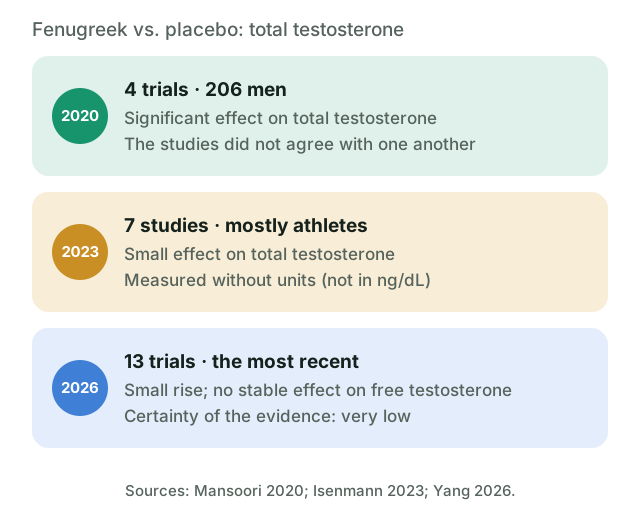
The first, from 2020. It reviewed 29 articles, but only 4 trials were good enough for the final analysis, with 206 men [1]. The rest were left out because they had no placebo group, were not clinical trials, did not measure testosterone in a standardized way, lasted less than 4 weeks, had incomplete data, or had undisclosed conflicts of interest. The included trials were single-blind (participants did not know whether they were taking fenugreek or placebo) and placebo-controlled (an identical capsule without the active ingredient). The result: fenugreek had a significant effect on total testosterone [1]. But the studies did not agree with one another: in some the increase was larger and in others smaller.
The second, from 2023. It brought together 7 studies, mostly in male athletes, and found a small effect on total testosterone [2].
The third, from 2026, the most recent. It brought together 13 trials in adult men; 6 provided total testosterone data [3]. It found:
- a small increase in total testosterone [3];
- no stable effect on free testosterone [3];
- that no study had a low risk of bias [3];
- that the company making or selling the product was often involved [3];
- and it rated the certainty of the evidence as very low [3].
How much does fenugreek raise testosterone?
Only a little, and it cannot be translated into an exact number. The 2023 and 2026 meta-analyses expressed the result as a standardized difference, a unitless statistical measure used to pool studies that measured testosterone in different ways [2, 3]. That is why it cannot be converted to ng/dL, which is how it appears on your lab results [3].
For reference, in an adult man total testosterone is usually considered normal between 300 and 1,000 ng/dL, although it changes with age, weight, sleep, stress, exercise, and time of day. With such a small effect, there is no reason to expect it to change your results in any important way.
How reliable is the evidence on fenugreek and testosterone?
Not very. The most recent study says it clearly: the certainty is very low [3]. The reasons:
- the studies are few, small, and short [3];
- none had a low risk of bias [3];
- the company behind the product was often involved [3];
- the studies used different extracts, doses, and preparations, so "fenugreek" is not a single product [3].
Among the herbs studied, a review of 32 trials of 13 herbs found that fenugreek and ashwagandha were the ones that showed an effect on testosterone [4]. That same review notes that only 6 of the 32 studies had a low risk of bias and that most were done in young, healthy men [4].
Who might fenugreek help with testosterone?
It has been proposed that it would help more in men with testosterone at the low end of normal, some extra weight, or slightly high blood sugar, on the idea that improving blood sugar and weight might improve the environment in which testosterone works. This is a possibility, not something proven: the studies do not answer whether it helps men with confirmed low testosterone [3]. In healthy men, who are the ones it has been studied in most, the increase was small [3].
If you think your testosterone is low, the diagnosis is made from your symptoms, a physical exam, and tests that show it is clearly and repeatedly low, not from your response to a supplement [3].
What else does fenugreek do in the body?
Fenugreek has not only been studied for testosterone. Here is what is known, in short:
- Blood sugar. This is its most studied effect: when 29 trials were pooled, it lowered fasting glucose by about 17 mg/dL [5]; the effect was seen mainly in people with diabetes, in low-quality studies [6]. I explain it in Fenugreek for diabetes: does it really lower blood sugar?.
- Cholesterol, triglycerides, and blood pressure. In 12 trials it lowered total cholesterol by 9.4 mg/dL and triglycerides by 13.8, and raised HDL by 3.5 [7]; systolic blood pressure fell by about 3.5 mmHg [8]. I explain it in Fenugreek for cholesterol, triglycerides, and blood pressure.
- Sexual desire. Some trials in healthy men found improvements, but in another the men did not notice any change [9], and the improvement does not always go hand in hand with testosterone [3]. I explain it in Fenugreek and sexual desire in men.
- Gym. In men who train, a little more bench press strength and somewhat less fat in one analysis, though not in another, with no clear gain in muscle; there are few small trials [2, 3]. I explain it in Fenugreek at the gym.
Is it safe to take fenugreek for testosterone?
In the trials in men there were no serious side effects, but they were short: we do not know what happens when it is taken for a long time [3]. It can interact with warfarin and cause bleeding [10], and together with diabetes medications it can lower blood sugar too much [11]. People who are allergic to chickpeas or peanuts may also react to fenugreek [10]. I explain it in Is fenugreek safe? Side effects and interactions.
Fenugreek is not hormone therapy, it does not replace any medical treatment, and it does not replace exercise, sleep, or a good diet.
When should you see a doctor about testosterone?
Talk to your doctor if:
- you have symptoms that worry you and want to know whether your testosterone is low;
- you have already been diagnosed with low testosterone: fenugreek does not replace treatment;
- you want to take fenugreek and you take anticoagulants or diabetes medications.
Key takeaways
- Three meta-analyses found a small and uncertain increase in total testosterone.
- The most recent one (2026) found no stable effect on free testosterone and rated the certainty as very low.
- The increase cannot be translated into ng/dL: it was measured on a unitless statistical scale.
- It does not replace any hormone treatment; if you think your testosterone is low, the right step is to measure it.
Frequently asked questions
Does fenugreek help if my testosterone is low? The studies do not answer whether it helps men with confirmed low testosterone [3]. If that is your case, talk to your doctor.
Is fenugreek better than other testosterone supplements? In a review of 13 herbs, fenugreek and ashwagandha were the ones that showed an effect [4], but the evidence is still weak [3].
How long did the studies last? Most lasted 8 to 12 weeks; we do not know what happens after that [3].