
In short: the prostate has a huge number of blood vessels, and that is why it bleeds during surgery. Finasteride and dutasteride, besides shrinking it, reduce those vessels. In the most common prostate surgery, transurethral resection of the prostate (TURP), which is done from the inside, through the tube urine flows out of, an analysis of 30 studies found that taking them beforehand reduces bleeding, the drop in hemoglobin (which measures how much blood you have), and the chance of needing a transfusion, which fell by about two-thirds [1]. Two weeks of treatment already show an effect [1]. The guidelines still see it as an option to consider, not as routine [2, 3]. And when the prostate bleeds into the urine, once other causes have been ruled out, these same pills can help stop it [3].
If you are going to have prostate surgery, there is a question worth its weight in gold that almost nobody asks: "Is there anything I can take beforehand to make the surgery safer?" The answer may be a pill you already know.
Why does the prostate bleed so much during surgery?
The prostate is an organ with a rich blood supply: it is full of blood vessels, many of them small and fragile. When it is operated on, it bleeds. And the more a surgery bleeds, the more complicated everything gets: the bleeding blocks the surgeon's view, makes the operation longer, and increases complications [1].
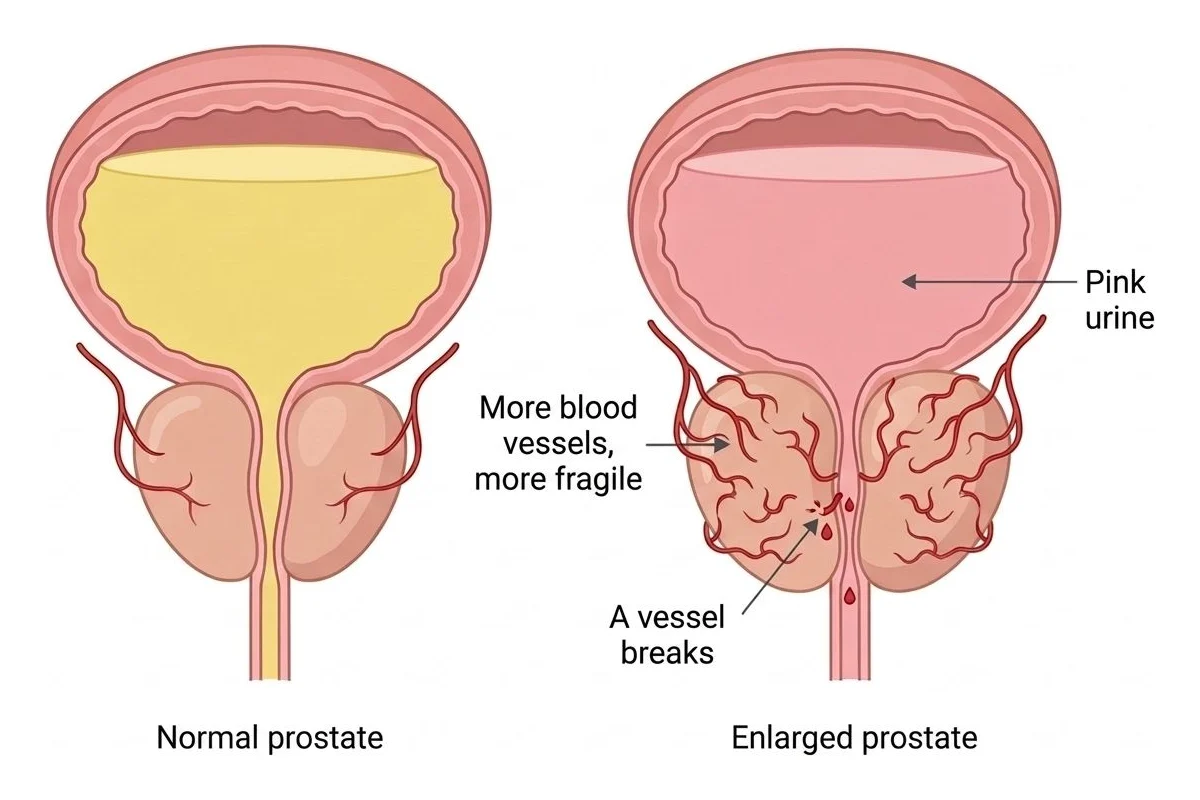
When a lot of blood is lost, a transfusion may be needed, that is, receiving blood from a donor. Today, in prostate surgery done from the inside, transfusion is already uncommon: it is needed in 2 to 7 out of every 100 men operated on [1]. But when it is needed, it is a procedure with its own risks [1].
How do finasteride and dutasteride reduce prostate bleeding?
First, a couple of words. Testosterone is the male hormone. Inside the prostate, an enzyme (a kind of tool the body uses to turn one substance into another) called 5-alpha reductase converts it into another, more potent hormone: DHT, or dihydrotestosterone. DHT is the fuel that makes the prostate grow. Finasteride and dutasteride block that enzyme, and that is why the prostate gradually shrinks. I explain it in depth in How do finasteride and dutasteride work?.
DHT also stimulates a substance called VEGF, which tells the body to form new blood vessels [1]. When DHT goes down, VEGF goes down, and the prostate is left with fewer small vessels [1]. Put simply, the pill "dries it out" a little: it reaches the operating room with fewer fragile vessels waiting to break.
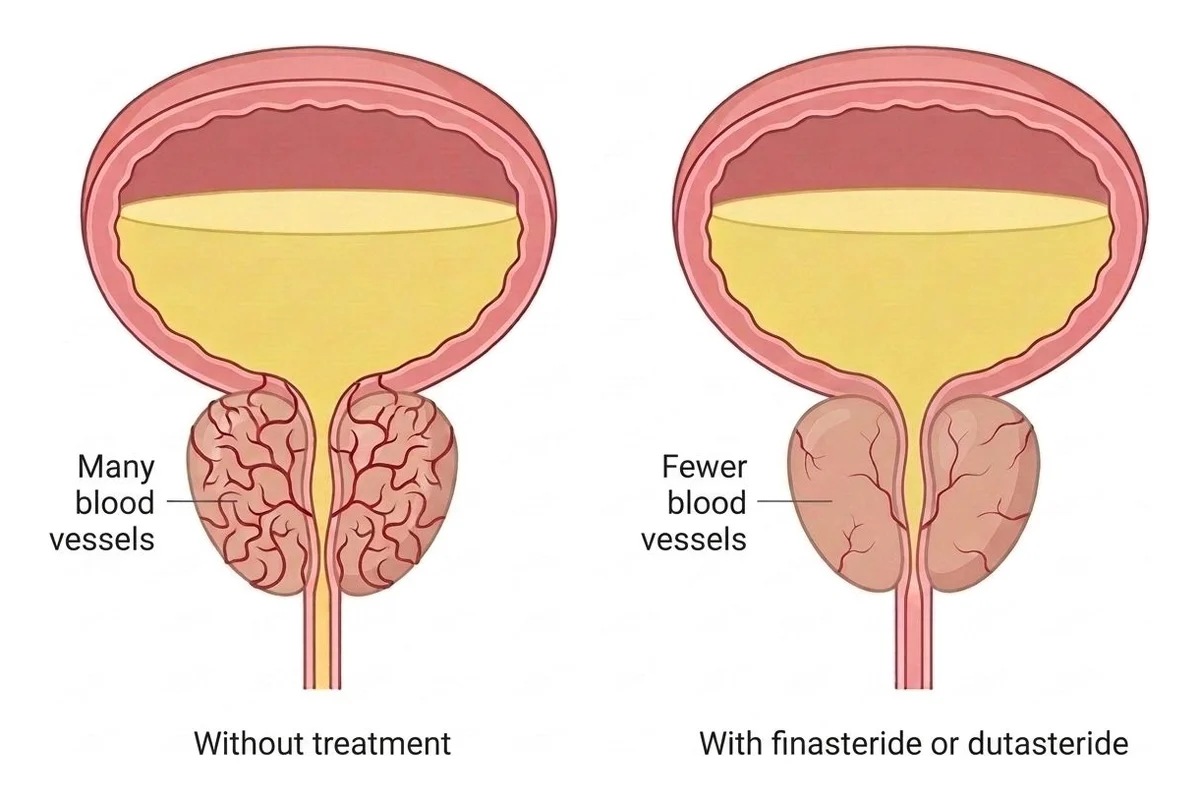
How much do finasteride and dutasteride reduce bleeding in prostate surgery?
The best answer comes from a 2026 meta-analysis, a study that pools the results of many trials to reach a stronger conclusion. It brought together 30 randomized trials (studies in which chance decides who gets the medication and who does not) with 2,974 men who had TURP: some took finasteride or dutasteride before surgery and others did not take it or received a placebo (a pill with no medication) [1].
Hemoglobin is, in a few words, what measures how much good blood you have circulating; it is measured in grams per deciliter (g/dL). When someone is "low on blood" or anemic, it is because their hemoglobin has dropped.
Those who took the medication, on average:
- Bled less: about 83 milliliters (mL) less during the operation, roughly a third of a cup [1].
- Their hemoglobin dropped less: the next day, the drop was 0.9 g/dL smaller [1].
- Needed fewer transfusions: the chance of needing blood fell by about two-thirds [1].
- Their surgery was a little shorter: about 3.5 minutes less, and about 2 liters less of the fluid used to rinse the bladder during the operation [1].
A smaller drop in hemoglobin means the surgery took less blood from the body. One important caveat: the trials were very different from one another in dose, length of treatment, and prostate size, so these figures are an approximate average [1].
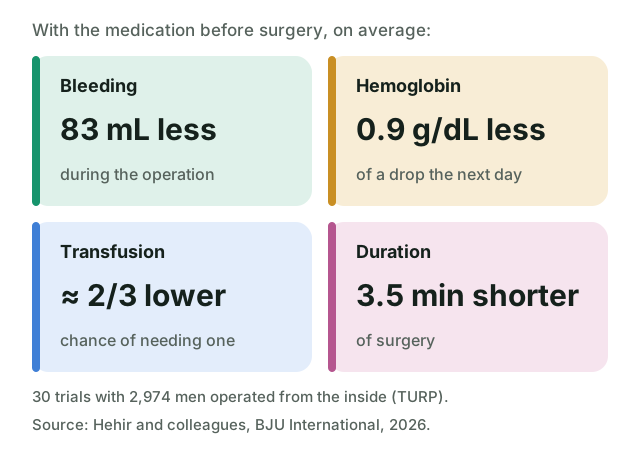
The transfusion result is the most striking: of the men who would have needed blood without the pill, about two out of three avoid it. But remember that transfusion is already uncommon in this surgery [1], so in absolute numbers the difference is smaller than it sounds.
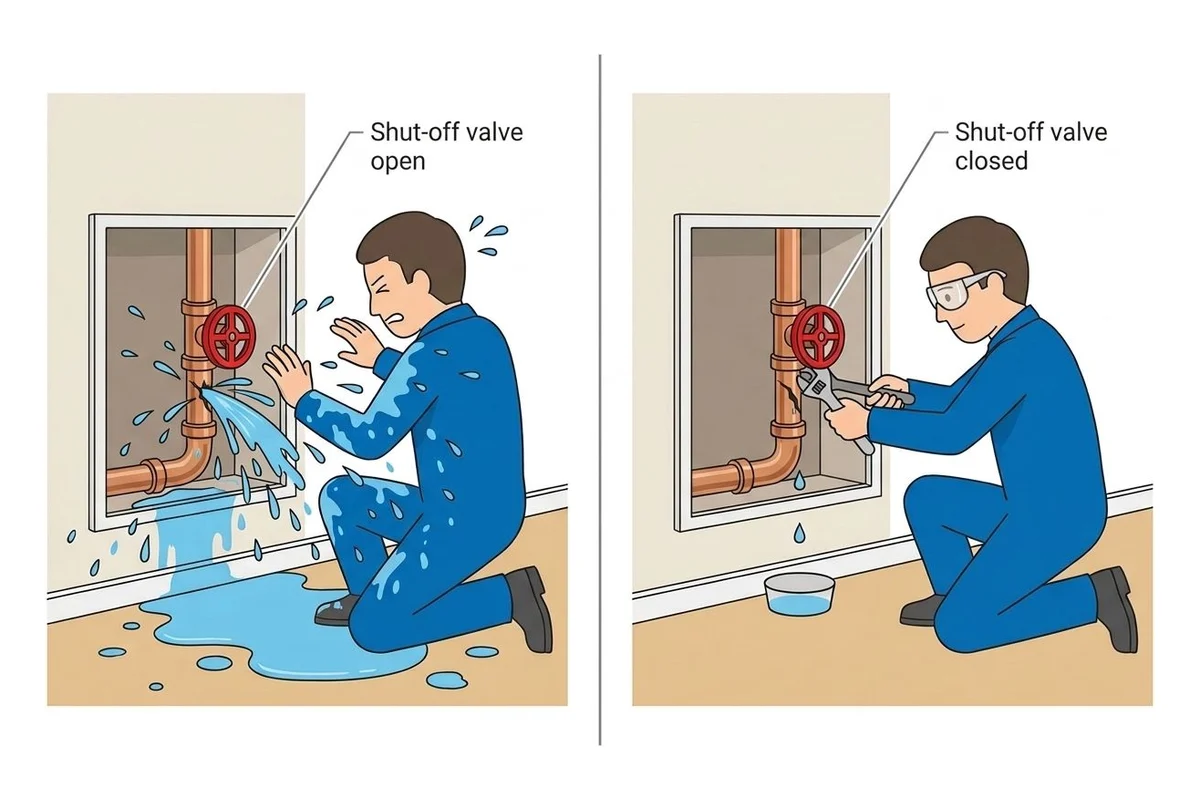
The shut-off valve: a simple way to understand it
Imagine they are going to open a wall to fix a broken pipe, which would be your prostate. If the plumber opens it with the water at full blast, everything splashes, he cannot see a thing, he struggles, and it takes forever. Taking the medication before surgery is like closing the house's shut-off valve before he arrives: the pipe is still broken and has to be fixed, that does not change, but now he works almost dry, sees clearly, and finishes faster and more safely.
How long before prostate surgery should finasteride or dutasteride be taken?
The effect comes quickly. With two weeks of treatment or less, the prostate's vessels and the bleeding during the operation had already gone down [1]. In the trials, the time ranged from 1 to 12 weeks, and the most common was taking it 2 to 4 weeks beforehand [1].
The ideal dose and duration are not yet defined [1]. No difference was found between finasteride and dutasteride for this either [1]; if you want to know how they differ, I explain it in Finasteride or dutasteride? Differences and which is better.
This contrasts with their use for prostate symptoms, where they take months to be noticed. To reduce bleeding, on the other hand, a few weeks are enough.
Do finasteride and dutasteride help in all prostate surgeries?
It pays to be precise here. All of these studies were done in one type of surgery: transurethral resection of the prostate, or TURP. It is the most common prostate operation; it is done from the inside, through the urethra (the tube urine flows out of), with no cuts on the outside. That is where the strongest evidence is [1].
Does that mean they do not help in other techniques, such as laser ones? Not necessarily. They probably help too, because the mechanism is the same. But for those other techniques there are not yet studies that prove it with the same strength. If you want to know when the prostate is operated on, I explain it in When is prostate surgery needed?.
What do the guidelines say about finasteride before prostate surgery?
The guidelines are more cautious than the 2026 meta-analysis:
- The European guideline (EAU) says that finasteride might reduce bleeding in surgery done from the inside, probably because of its effect on the prostate's vessels, although the evidence that the effect is important is mixed [2].
- The American guideline (AUA), based on the opinion of its experts, says they can be considered to reduce bleeding and the need for transfusion [3]. It acknowledges that not all studies found a difference and that their short-term use before TURP is not considered routine [3].
That is why it is not something given to every man who is going to have surgery: it is one more tool your doctor can consider with you.
Does taking finasteride or dutasteride for a few weeks before surgery have side effects?
It can, even if only for a short time. The most common side effects of these pills have to do with sex life: lower desire and erection problems [1, 2]. In the few studies that measured them before TURP (4 studies, 391 men), these effects were more frequent with the medication; in those that followed patients up, they went away 3 months after stopping it [1]. These are limited data, so they should be taken with caution [1].
The American guideline asks that you and your doctor consider those effects before deciding [3]. Another practical detail: these pills lower PSA (prostate-specific antigen, a blood test for the prostate), so always mention that you take one. I explain it in Finasteride, dutasteride, and PSA.
Do finasteride or dutasteride help when there is blood in the urine from the prostate?
Yes, they can help. Sometimes the enlarged prostate bleeds and the urine comes out red or pink. Before anything else, other causes have to be ruled out, because blood in the urine can come from other places, such as the bladder or the kidney, and some of those causes are serious.
Once they have been ruled out and the bleeding that will not stop probably comes from the prostate, the American guideline, based on the opinion of its experts, notes that these pills can be an effective alternative [3]. The reason is the same as before: finasteride slows VEGF and reduces the prostate's vessels [3]. In follow-up studies, many men with prostate bleeding bled less or stopped bleeding with finasteride, and the bleeding was less likely to come back; a study that followed patients forward in time confirmed it [3].
If the bleeding persists despite the medication, the next step is usually to remove the prostate tissue that is bleeding [3].
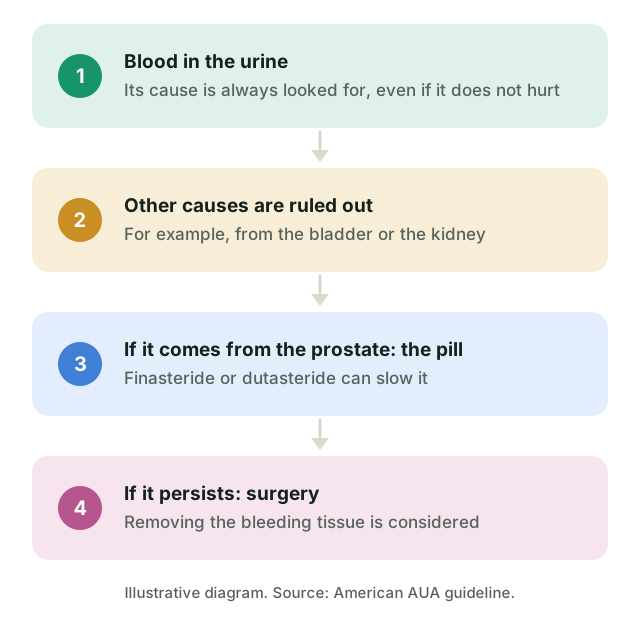
I explain it in detail in Blood in the urine from the prostate.
If I am having surgery, did I take finasteride for nothing?
Not at all. Notice the nice detail: even when the pill "was not enough" to avoid surgery, as far as the operation is concerned it never worked against you. It shrank your prostate while it could and, unlike other prostate medications such as tamsulosin, when taken for more than a year they lower the risk of ending up with a catheter or in the operating room [2]. And when it was no longer enough, it helped you reach the operation in better shape. You can see everything they do in Can the prostate be shrunk without surgery? Finasteride and dutasteride.
When should you see a doctor if you are having prostate surgery or see blood in your urine?
Talk to your doctor if:
- you are going to have prostate surgery and want to know whether taking the pill beforehand makes sense for you;
- you take anticoagulants (medications that make the blood thinner) and you are going to have surgery or you have blood in your urine;
- you already take finasteride or dutasteride and you are going to have surgery (let them know).
Do not wait if you see blood in your urine, even just once and even if it does not hurt: its cause always needs to be looked for. And seek care right away if you pass clots or cannot urinate.
Key takeaways
- The prostate has a huge number of blood vessels; finasteride and dutasteride reduce them.
- Taken before TURP, they reduce bleeding, the drop in hemoglobin, and the chance of transfusion, which fell by about two-thirds.
- A few weeks are enough: the effect is already seen with two weeks.
- The strongest evidence is for TURP; the guidelines see it as an option, not as routine.
- When the prostate bleeds into the urine, once other causes are ruled out, they can help stop it.
Frequently asked questions
Can I start finasteride on my own before surgery? No. It is a decision made with your doctor, taking side effects into account [3].
Does finasteride help before laser prostate surgery? Probably, because the mechanism is the same, but the strongest studies are on TURP [1].
Is finasteride or dutasteride better before surgery? In the analysis of 30 trials there was no difference between them for this [1].