
In short: blood in the urine should never be ignored: it always has to be checked, because it can come from the kidneys, the ureters, the bladder or the prostate, and sometimes the cause is a tumor [1]. An enlarged prostate can bleed because it has more blood vessels, and more fragile ones. Only after other causes have been ruled out can the bleeding be attributed to the prostate. In that case, some prostate medications can help reduce it [2], and if the bleeding continues, the next step is surgery [2].
Imagine going to the bathroom and seeing blood in your urine. It would frighten anyone. And although it always has to be investigated, in some cases the source is the prostate.
I saw blood in my urine: what should I do?
Get medical care so it can be checked, even if the blood has already gone away.
In medicine this is called hematuria, and the most important thing is this: blood in the urine should never be ignored. You always have to find out where it is coming from.
Why such insistence? Because sometimes the cause is cancer. In an international study of almost 11,000 people referred to the hospital for suspected urinary tract cancer, most of them for blood in the urine, about 28 out of every 100 were estimated to have cancer, mainly of the bladder [1]. And blood visible to the naked eye was the sign most strongly linked to cancer [1]. This does not mean that most cases are cancer, but it does mean it should never be let slide.
Where can blood in the urine come from?
Blood can come from any part of the urinary tract:
- the kidneys;
- the ureters, the tubes that carry urine from the kidneys to the bladder;
- the bladder;
- and also the prostate.
Sometimes the bleeding is so slight that it is only detected on a urine test: microscopic blood is defined as 3 or more red blood cells per high-power field of the microscope, in a single sample [3]. Other times it is visible: the urine comes out pink, reddish or even with small clots.
Why does an enlarged prostate bleed?
The prostate sits just below the bladder and surrounds the urethra, the tube urine flows out through. Over the years it tends to grow.
When the prostate grows, it is not only the tissue that increases: the number of blood vessels supplying it also increases. And those vessels can become more fragile. Over time, some small vessels can break and bleed into the urine.
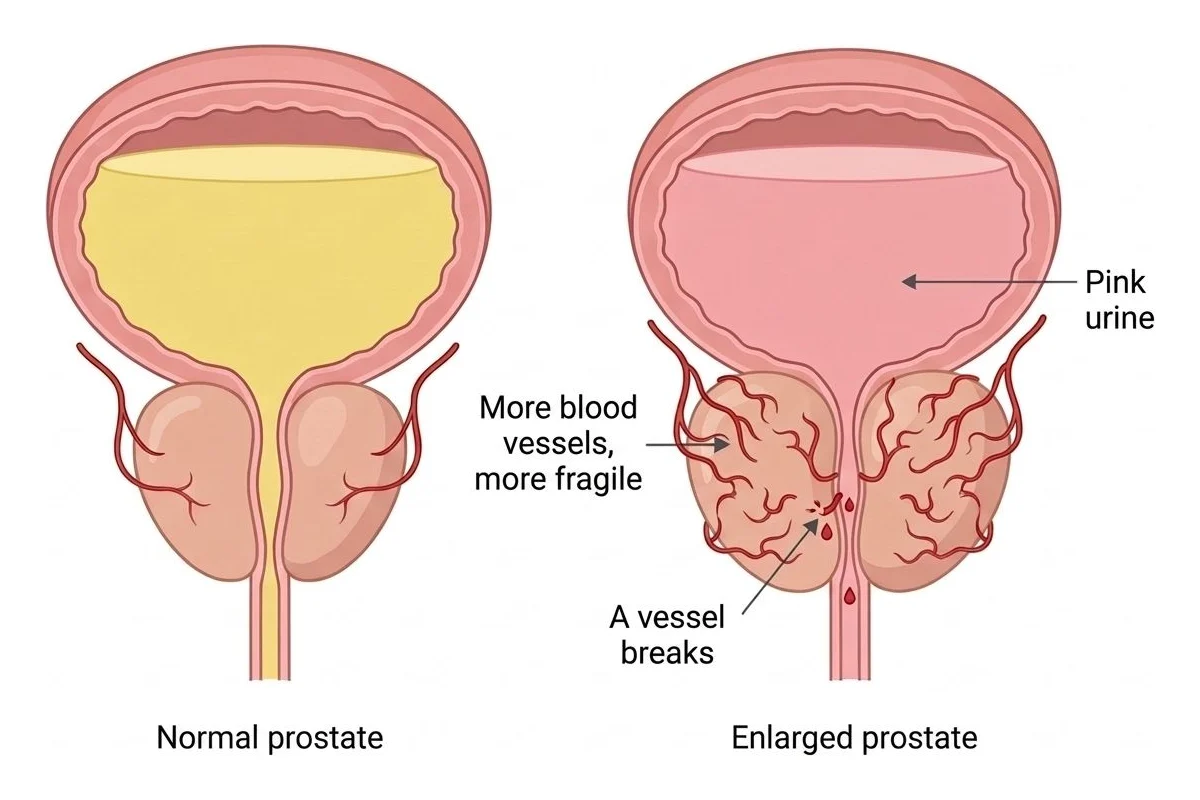
This bleeding is usually intermittent: it appears for a few days, goes away and comes back weeks or months later. The fact that it goes away on its own does not mean it can be forgotten.
How is blood in the urine evaluated?
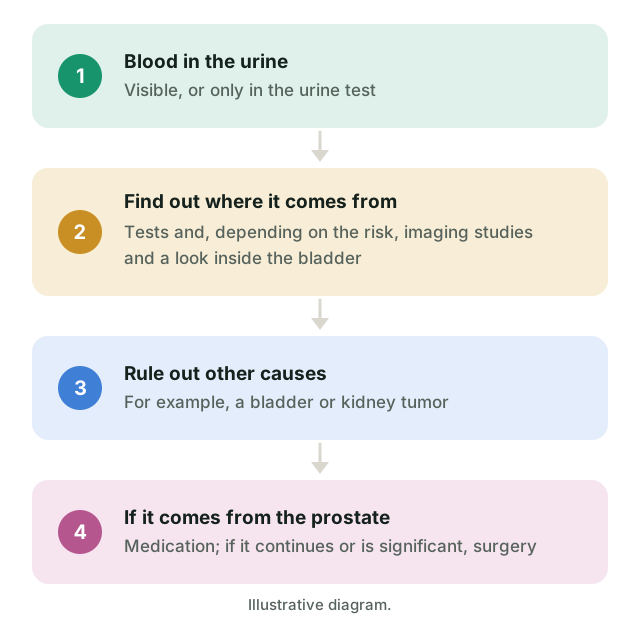
Before the bleeding is attributed to the prostate, other causes always have to be ruled out.
When the blood is microscopic, how it is evaluated depends on each person's risk. The American guideline takes into account, among other things, age, sex, smoking, how much blood there is, whether it persists and whether there was visible blood before [3]. Depending on that risk, and deciding together with the patient, the inside of the bladder is examined with a thin camera (cystoscopy) and imaging studies of the kidneys and ureters are done [3]. Having seen blood with the naked eye is one of the strongest reasons for a thorough evaluation [1, 3].
Is there medication for blood that comes from the prostate?
There may be. When other causes have already been ruled out and the blood that does not let up probably comes from the prostate, the American guideline, based on the opinion of its experts, notes that a group of prostate medications, the 5-alpha reductase inhibitors (such as finasteride and dutasteride), can be an effective alternative [2].
One of the effects of finasteride inside the prostate is to slow down a substance that stimulates the formation of blood vessels [2]. In follow-up studies, many men with bleeding from the prostate, once other causes had been ruled out, bled less or stopped bleeding with finasteride, and the bleeding was less likely to come back [2]. Like any medication, it has side effects, and your doctor should explain them to you [2].
When is prostate surgery done for blood in the urine?
When visible blood from the prostate keeps coming back or is significant, the guidelines include surgery among the treatments [2, 4]. The American guideline puts medication first: if the blood persists despite it, the next step is to remove the prostate tissue that is bleeding [2]. Doing so often solves the underlying problem. The European guideline refers to blood from the prostate that does not respond to treatment [4].
Surgery is not always possible. The American guideline acknowledges that surgery may not be the best option if the person cannot stop their blood thinners or is very frail [2]. For those cases, other options are being studied, such as blocking the arteries that carry blood to the prostate (embolization) [2].
When should I see a doctor for blood in the urine?
Talk to your doctor as soon as:
- you see blood in your urine, even if it happened only once;
- you are told that your urine test showed blood;
- the blood comes back after having gone away.
If you pass a lot of blood or clots in your urine and cannot urinate, or your lower belly hurts, get care right away. If you have fever and chills with blood in your urine, get care that same day.
An enlarged prostate can also form bladder stones, which sometimes bleed: I explain it in Bladder stones caused by the prostate. And if urinary tract infections keep coming back, in Recurrent urinary tract infections in men.
Key takeaways
- Blood in the urine is never ignored: it always has to be checked, even if it went away on its own.
- It can come from the kidneys, the ureters, the bladder or the prostate, and sometimes the cause is a tumor.
- An enlarged prostate has more vessels, and more fragile ones, that can break and bleed on and off.
- Only after other causes are ruled out is it attributed to the prostate; then some medications can reduce the bleeding.
- If blood from the prostate continues despite medication, the next step is surgery.
Frequently asked questions
Does blood in the urine mean I have prostate cancer? Not necessarily. In the international study of almost 11,000 people, the most common cancer was bladder cancer; prostate cancer appeared in fewer than 2 out of every 100 [1]. That is why the whole urinary tract has to be checked, not just the prostate.
The blood went away on its own. Do I still need to be checked? Yes. Blood in the urine can come and go, and the fact that it disappears does not mean the cause has gone away. You always have to find out where it came from.