
In short: for the symptoms of an enlarged prostate, the European guideline considers finasteride and dutasteride equally effective [1]. In a large study that compared them head to head, with more than 1,600 men, they shrank the prostate and reduced symptoms equally, with similar side effects [2]. They differ in how they act: dutasteride blocks both types of the enzyme and lowers DHT, the hormone that makes the prostate grow, more in the blood, although inside the prostate the difference narrows a lot [1]. In addition, the blood clears finasteride in hours and dutasteride in weeks [3]. And in prostates of 30 to 40 mL there is more evidence of benefit with dutasteride than with finasteride [1].
If you were prescribed one of the two, or you are thinking about switching, it is natural to wonder which one is better. They are first cousins: they do the same thing in a very similar way. But they are not identical, and it is worth knowing how they differ.
What is the difference between finasteride and dutasteride?
First, two words you will see a lot. Testosterone is the male hormone. Inside the prostate, an enzyme (a kind of tool the body uses to turn one substance into another) called 5-alpha reductase converts it into another, more potent hormone: DHT, or dihydrotestosterone. DHT is the fuel that makes the prostate grow.
Finasteride and dutasteride block that enzyme: DHT goes down and, without its fuel, the prostate shrinks little by little. If you want to understand this mechanism well, I explain it in How do finasteride and dutasteride work?.
The difference is in the details:
| Finasteride | Dutasteride | |
|---|---|---|
| Dose for the prostate | 5 mg a day | 0.5 mg a day |
| Which type of enzyme it blocks | Type 2 | Types 1 and 2 |
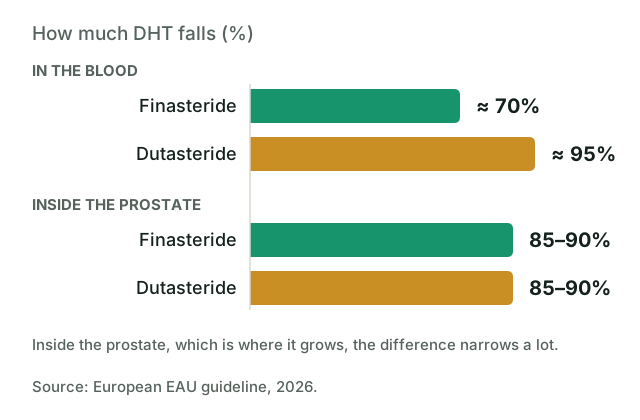
| How much it lowers DHT in the blood | About 70% | About 95% |
| How much it lowers DHT inside the prostate | 85% to 90% | 85% to 90% |
| Half-life in the blood (time for the level to fall by half) | 6 to 8 hours | About 5 weeks |
Sources: enzyme and DHT, European EAU guideline [1]; dose, EPICS study [2]; half-life, American AUA guideline [3].
Imagine the enzyme has two workers, the type 1 worker and the type 2 worker. Finasteride stops the type 2 worker, which is the main one inside the prostate. Dutasteride stops both.
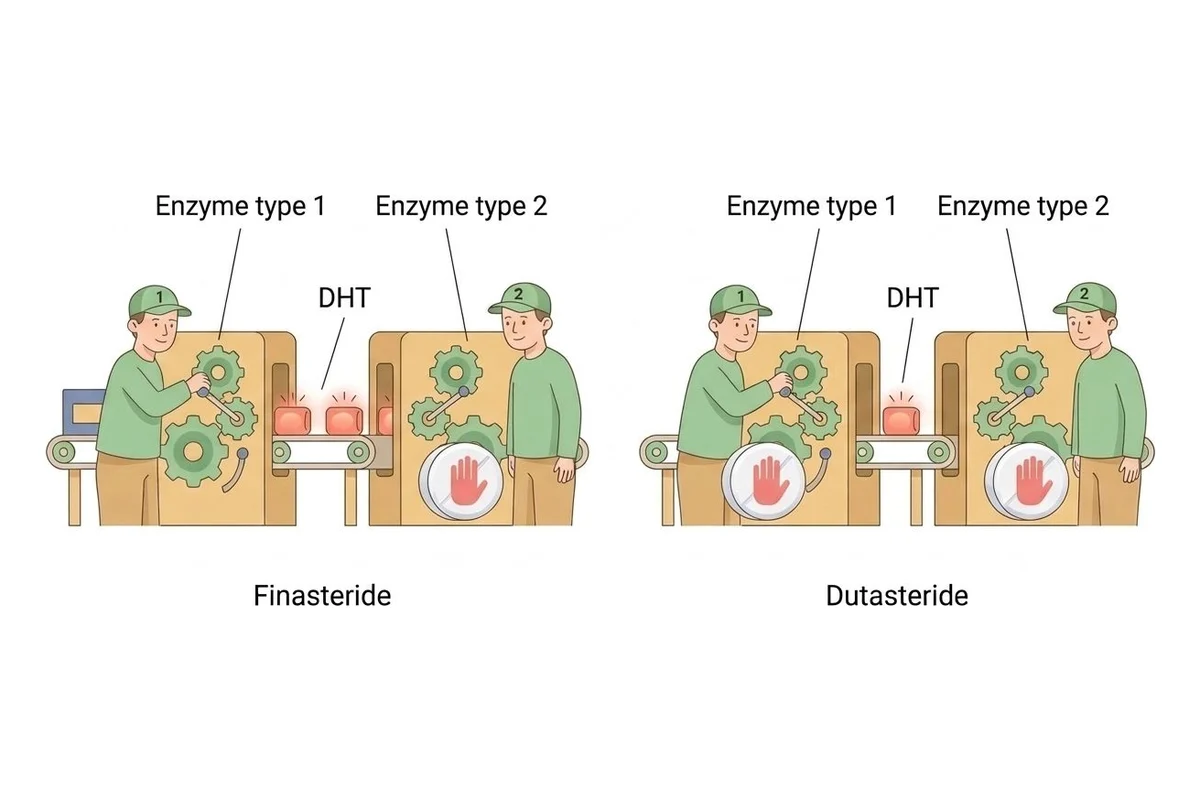
That is why dutasteride lowers DHT more in the blood. But inside the prostate, which is where it grows, the difference narrows a lot: according to the European guideline, both lower it by 85% to 90% [1]; according to the American guideline, by about 80% with finasteride and 94% with dutasteride [3].
Which works better for the prostate, finasteride or dutasteride?
In practice, they work almost the same. That is the conclusion of the European guideline [1], and what the studies that put them head to head showed:
- The EPICS study compared 813 men on dutasteride and 817 on finasteride for one year. Both shrank the prostate with no difference between them, and they improved symptoms and stream strength equally [2].
- A meta-analysis (a study that pools the results of several trials) of 8 trials, with 2,116 patients, found no difference in symptoms, prostate size, PSA (prostate-specific antigen, the prostate blood test), or quality of life; dutasteride improved stream strength a little more [4].
- Another meta-analysis of 6 studies, with 2,041 participants, found that dutasteride lowered symptoms and PSA a little more, with no difference in size or stream [5].
Both meta-analyses include EPICS and smaller trials, and they don't agree on which detail comes out slightly in favor of dutasteride. That says something important: if there are differences, they are small and don't always show up.
Does dutasteride prevent more prostate surgeries than finasteride?
It is not clear. What matters most to a patient is not ending up with a catheter or in the operating room, and here there are only real-world studies, which compare men who were already taking one or the other:
- In the Netherlands, with 11,822 men on dutasteride and 5,781 on finasteride, dutasteride was linked to somewhat less prostate surgery (about 25% less), a difference at the borderline of what is considered significant and one that did not appear in every patient group analyzed. There was no difference in urinary retention [6].
- In the United States, among men taking the pill together with an alpha-blocker (a medication that relaxes the prostate, such as tamsulosin), there were no clear differences in urinary retention, surgery, or progression of the problem [7].
This type of study cannot prove that one pill is better than the other: the men who received each one may have been different from the start. What is clear is that this group of medications, unlike tamsulosin, lowers the long-term risk of retention and surgery [1]. I explain it in Can the prostate shrink without surgery? Finasteride and dutasteride.
Finasteride or dutasteride if your prostate isn't that large?
Here there may be a difference. These pills work by shrinking the prostate, so they help mainly when it is truly enlarged: the European guideline recommends them, for example, with a prostate larger than 40 mL and moderate or severe symptoms [1]. The larger the prostate at the start, the more symptoms improve [1].
With intermediate-sized prostates, the guideline notes that:
- finasteride might work no better than a placebo (a pill with no medication) with a prostate smaller than 40 mL [1];
- dutasteride seems to improve symptoms, size, and the risk of retention even with prostates of 30 to 40 mL [1].
Each of those findings comes from studies against placebo, not from comparing the two with each other. Prostate size is measured in milliliters (mL). To give you an idea, a young man's prostate measures about 20 mL. Your doctor can measure yours with an ultrasound.
Do finasteride and dutasteride have the same side effects?
Yes, they are the same. The studies that compared them found no clear difference in side effects [4, 5], including sex drive and erections [5]. The most common ones have to do with sex life: lower sex drive, erection problems and, less often, changes in ejaculation [1].
And if you take finasteride and notice low mood, depression, or suicidal thoughts, the European Medicines Agency advises stopping it and seeking medical care [1].
What does it mean that dutasteride stays in the body for weeks?
The blood clears finasteride in hours and dutasteride in weeks [3]. Note: that is not how long the effect on the prostate takes, which is slow with both. The American guideline notes that this difference could affect how well people stick with treatment and mean that, if you stop dutasteride, its side effects take longer to go away [3].
But that doesn't change the essentials: both are taken once a day [2], and both take months to work [1]. If you stop them, the prostate grows back. I explain it in How long do finasteride and dutasteride take to work, and what happens if you stop?.
So which is the better choice: finasteride or dutasteride?
Both are good options, and for most men with a clearly enlarged prostate, the difference is small. The choice is made with your doctor, taking into account:
- the size of your prostate: with a prostate of 30 to 40 mL there is more evidence of benefit with dutasteride than with finasteride, although it does not come from studies that compared them directly [1];
- whether you also take tamsulosin: there is a capsule that contains dutasteride and tamsulosin together [1]. I explain it in Tamsulosin and finasteride together: when combination therapy makes sense;
- how you feel on the one you already take and how much it costs you.
One practical point: if you take either of them, mention it when your PSA is measured, because they lower it by roughly half [1]. I explain it in Finasteride, dutasteride, and PSA.
When should you see a doctor if you take finasteride or dutasteride?
Talk to your doctor if:
- you have been on treatment for more than six months and are still urinating just as poorly;
- you want to switch from one pill to the other or stop it;
- you notice side effects that bother you, or low mood;
- you are going to have your PSA measured (mention that you take it).
Don't wait if you suddenly cannot urinate at all, if you see blood in your urine, if you keep getting urinary tract infections, or if you feel you never empty completely. Any of these signs deserves a prompt evaluation.
Key takeaways
- For the symptoms of an enlarged prostate, finasteride and dutasteride are equally effective according to the European guideline.
- Head to head, they shrank the prostate and reduced symptoms equally, with similar side effects.
- Dutasteride blocks both types of the enzyme and lowers DHT more in the blood; inside the prostate the difference narrows a lot.
- With prostates of 30 to 40 mL there is more evidence of benefit with dutasteride than with finasteride.
- It has not been shown that one prevents more surgeries than the other; both lower the long-term risk of retention and surgery.
Frequently asked questions
Is dutasteride stronger than finasteride? It lowers DHT more in the blood, but inside the prostate the difference narrows a lot [1, 3]. That is why, for symptoms and prostate size, the results are very similar [2].
Can I switch from finasteride to dutasteride? It is possible, but do it with your doctor. Both take months to work [1], so switching doesn't give an immediate result.
Does dutasteride have more side effects than finasteride? The studies that compared them found no clear difference, including in sex drive and erections [4, 5].