
In short: combination therapy means taking, at the same time, a pill that relieves, such as tamsulosin, and a pill that protects, such as finasteride or dutasteride. At four years, the combination worked better for symptoms than either one alone, and compared with tamsulosin alone it lowered the risk of urinary retention by 68% and the risk of surgery by 71% [1]. It is meant for men with moderate or severe symptoms and a truly enlarged prostate, and for use longer than a year [1]. The trade-off is that you get the side effects of both [1]. And over time, tamsulosin can sometimes be stopped, but not the one that protects.
If your doctor prescribed two prostate pills, or a single capsule that contains two medications, you are probably on combination therapy. And it is very common not to know what each one is for, or which one you should not let go of.
What is combination therapy for the prostate?
It means using two medications at the same time, one from each family:
- Those that relieve (alpha-blockers), such as tamsulosin. They relax the smooth muscle of the prostate and lower its tension [1]. You urinate better almost right away, but they do not change the size of the prostate or prevent urinary retention in the long run [1].
- Those that protect (5-alpha reductase inhibitors): finasteride and dutasteride. They shrink the prostate little by little and lower the risk that the problem will progress. They are slow.
Each one covers the other's weak spot. If you want to understand how finasteride and dutasteride shrink the prostate, I explain it in Can the prostate shrink without surgery? Finasteride and dutasteride.
Why are tamsulosin and finasteride combined?
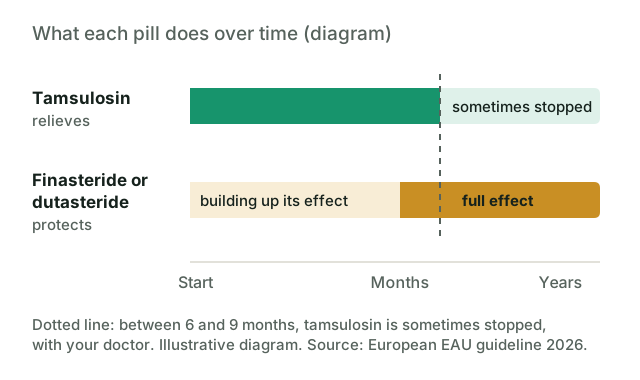
Because one is very fast and the other is slow. The alpha-blocker works in hours or days; finasteride or dutasteride need several months to reach their full effect [1].
Picture a man who urinates poorly, struggling every day, and you give him only finasteride: "All right, now wait a few months for it to work." He is going to have a hard time during those months. Combination therapy fills that gap: tamsulosin brings relief from the start, while finasteride or dutasteride quietly shrink the prostate.
A tight shoe explains it well. Imagine wearing a shoe that is too small; that is the prostate squeezing the tube that carries urine:
- Tamsulosin is like sprinkling in some powder or loosening the laces: your foot slides in comfortably right away, but the shoe stays the same size.
- Finasteride or dutasteride are like sending the shoe to be stretched on a shoe tree, little by little: it takes time, but the shoe really gets bigger.
- The combination is using the powder while the shoe tree does its work. You walk comfortably from day one, and in the meantime the shoe really stretches.
What did studies of combination therapy show?
At first, short studies of 6 to 12 months found no advantage for the combination over the alpha-blocker alone [1]. That makes sense: the protective pill was only just starting to work. The difference showed up in the long, four-year studies [1]:
| Study | What it compared | What it found |
|---|---|---|
| MTOPS | Doxazosin, finasteride, both together, or placebo, 4 years | Together they lowered the risk of the problem progressing by 66% compared with placebo, mainly through worsening symptoms; more than finasteride alone (34%) or doxazosin alone (39%). Finasteride, alone or combined, reduced retention and surgery; doxazosin alone did not [1] |
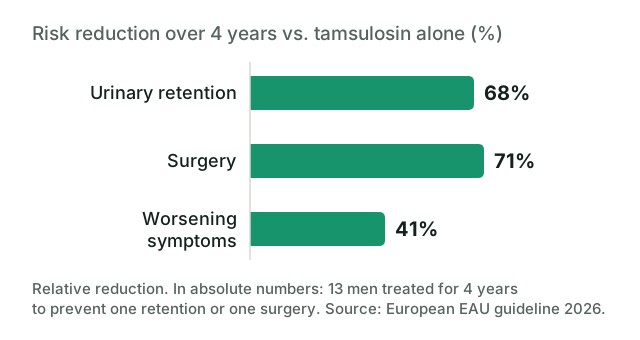
| CombAT | Tamsulosin and dutasteride together vs. each one alone, 4 years | Compared with tamsulosin alone: 68% less retention, 71% less surgery, and 41% less worsening of symptoms [1] |
| CONDUCT | Capsule with dutasteride and tamsulosin vs. watchful waiting, adding tamsulosin if needed, 2 years | 43% lower risk of the problem progressing, mainly through worsening symptoms [1] |
One detail: finasteride was studied together with doxazosin and other alpha-blockers, and tamsulosin was studied with dutasteride. The guidelines talk about the combination by drug family [1].
A 2025 analysis that pooled 8 studies with 8,793 patients reached the same conclusion: compared with tamsulosin alone, the combination with dutasteride reduced urinary retention or surgery and disease progression, but it increased treatment side effects [2].
What does that 70% less surgery mean?
Imagine ten men who, taking only tamsulosin, would end up with urinary retention or in the operating room. With both pills together, about seven of those ten would avoid it.
Looking at all the men treated, and not just the ones who would have had a complication, the math is this: in the CombAT trial, 13 men had to be treated for four years to prevent one retention or one surgery, an absolute difference of 7.7% [1]. It is real protection, but it builds over the years: in that trial, the advantage for retention and surgery started to show after 8 months, and for symptoms, from month 9 on [1].
If you have already had urinary retention, I explain what comes next in I can't urinate: what to do and what happens after the catheter.
Who needs to take tamsulosin and finasteride together?
Not every man with urinary symptoms. The combination makes sense when two things are present at once: symptoms worth relieving now, and a prostate that may keep growing and cause complications.
The European guideline recommends it for men with moderate or severe symptoms and a risk that the problem will progress, for example with a prostate larger than 40 mL [1]. The signs of that risk are [1]:
- a larger prostate;
- a higher PSA;
- older age;
- a lot of urine left in the bladder after you finish;
- a weaker stream.
The American guideline reserves it for men with a proven enlarged prostate: larger than 30 g on an imaging test, a PSA above 1.5 ng/mL, or a prostate that feels enlarged on exam [3].
And there is one more condition: it only makes sense if treatment will last longer than a year [1]. The protective pill needs time; taking it for a few months and stopping makes no sense.
If your prostate is not truly enlarged, finasteride or dutasteride add little, and the combination would only add side effects. I explain it in Can the prostate shrink without surgery? Finasteride and dutasteride.
Is there a single pill with tamsulosin and dutasteride?
Yes. Combination therapy can be two separate pills, one for each medication, or a single capsule that already contains both: dutasteride and tamsulosin at a fixed dose [1]. Finasteride was tested in studies together with other alpha-blockers (alfuzosin, terazosin, or doxazosin) [1].
So if you take a single capsule and think you are on just one medication, check the box. You could be taking both without knowing it. And that matters for two reasons:
- PSA. Dutasteride lowers your PSA by about half [1], even when it comes inside the combination capsule. Always mention that you take it; I explain it in Finasteride, dutasteride, and PSA: why it has to be multiplied by two.
- Cataract surgery. Tamsulosin can complicate that operation, as you will see below.
Can tamsulosin be stopped during combination therapy?
Sometimes, yes. And here is what confuses almost everyone: the one that can sometimes be stopped is tamsulosin, the relief pill. The protective one, finasteride or dutasteride, usually stays, because it is the one that keeps the prostate in check.
This is what we know:
- Two studies tested stopping the alpha-blocker after 6 to 9 months of combination therapy [1].
- In the one that combined tamsulosin and dutasteride, almost three out of four men did not get worse when they stopped tamsulosin at six months [1].
- Those who started with very severe symptoms might benefit from staying on both for longer [1].
- In the other study, when men stayed on finasteride alone, the improvement held at 3 and at 9 months [1].
- These are short studies, with little follow-up after tamsulosin was stopped [1].
The logic is simple: since the prostate is now smaller and squeezes less, quick relief is no longer as necessary. The shoe has already stretched; you no longer need the powder.
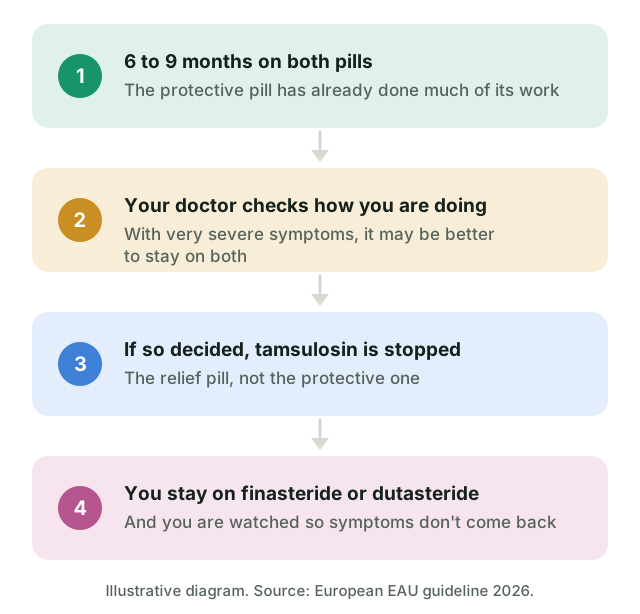
Whether it can be stopped or not depends on each case, and it is a decision you make with your doctor. What you should not do is what many people do: keep the one they can "feel" and drop the other. Often the right move is exactly the opposite.
What are the side effects of combination therapy?
When you take both, you get the side effects of both [1]:
- Side effects are more frequent with the combination than with either medication alone; in one large study, they were more frequent during the first year of treatment [1].
- Ejaculation problems are about three times more frequent with the combination than with either one alone [1].
Those of tamsulosin:
- dizziness, tiredness, and low blood pressure when you stand up [1];
- it does not affect sex drive or erections, but it can change ejaculation: less semen comes out, or none [1];
- cataract surgery: it can cause a problem with the iris during that operation, more with tamsulosin than with other alpha-blockers. Tell your eye surgeon that you take it, and if you already have cataract surgery scheduled, it is better not to start it beforehand [1].
Those of finasteride and dutasteride, such as lower sex drive or erection problems [1], I summarize in Can the prostate shrink without surgery? Finasteride and dutasteride. It is not a magic or harmless treatment: it is a treatment with real benefits and with things to consider, and it is decided with your doctor.
When should you see a doctor if you take tamsulosin and finasteride?
Talk to your doctor if:
- you have been on both for 6 to 9 months and want to know whether you can stop tamsulosin;
- you want to stop either one on your own;
- after several months on both you are still urinating just as poorly: in some men, part of the prostate pushes into the bladder and the pills help less; I explain it in When prostate medication stops working;
- you feel dizzy when you stand up or notice side effects that bother you;
- you notice low mood or thoughts of harming yourself while taking finasteride: stop it and seek care promptly [1];
- you are going to have cataract surgery.
Don't wait if you suddenly cannot urinate at all, if you see blood in your urine, if you keep getting urinary tract infections, or if you feel you never empty completely. Any of these signs deserves a prompt evaluation.
Key takeaways
- Combination therapy pairs a pill that relieves quickly (tamsulosin) with one that protects in the long run (finasteride or dutasteride).
- At four years, it protects more than either one alone: compared with tamsulosin alone, 68% less retention and 71% less surgery.
- It is for moderate or severe symptoms with a truly enlarged prostate, and for use longer than a year.
- It adds up the side effects of both; tell your eye surgeon if you take tamsulosin.
- Over time, tamsulosin is sometimes stopped; the protective pill usually stays. Always with your doctor.
Frequently asked questions
I've been on both for a month and don't notice a difference compared with tamsulosin alone. Why keep taking the other one? That is normal: finasteride or dutasteride need several months [1], and in the CombAT trial their advantage showed up from 8 to 9 months on [1]. Don't stop it for that reason.
Can I stop finasteride and stay on tamsulosin alone? That is the opposite of what is usually recommended: tamsulosin relieves, but it does not shrink the prostate or prevent retention in the long run [1]. If you want to change something, talk it over with your doctor.
Is the capsule that combines dutasteride and tamsulosin as effective as taking both separately? It contains the same two medications. In the CONDUCT study, the capsule reduced the risk of the problem progressing by 43%, mainly through worsening symptoms, compared with watchful waiting and adding tamsulosin if needed [1].