
In short: being unable to urinate with a full bladder is called acute urinary retention, and it is an emergency: the bladder has to be emptied with a catheter. Afterward, the American guideline recommends taking a medication that relaxes the prostate (an alpha-blocker) for at least three days before trying to remove it [1]. In a study of more than 6,000 men, 61 out of every 100 were able to urinate on their own again when the catheter was removed [2]. Even so, the risk of another retention remains [1]. If attempts fail again and again and the cause is the prostate, surgery is the main treatment [1], because living with a catheter does not correct the blockage.
If you are reading this with a catheter in, or you just got back from the emergency room because you could not urinate, it is normal to have a lot of questions: why it happened, how long you will have the catheter, whether you will be able to urinate on your own again and whether this can happen again.
I can't urinate and my lower belly hurts: what should I do?
Get medical care right away, at the emergency room.
When the bladder is full and simply nothing comes out, it is acute urinary retention. The problem is no longer urinating poorly: it is not being able to urinate at all. The bladder stretches, the lower belly hurts and, no matter how hard you try, urine does not come out.
This is where the prostate stops being a nuisance and becomes an emergency. A catheter has to be placed to empty the bladder. At that moment, the catheter is not optional: it is necessary.
Why can the prostate block the flow of urine?
The prostate sits just below the bladder and surrounds the urethra, the tube urine flows out through. Picture it as a donut with a drinking straw through it: the donut is the prostate and the straw is the urethra.
Over the years, the prostate tends to grow. If the donut gets thicker, the straw gets squeezed. When the blockage is so significant that the bladder can no longer overcome it on its own, urine stops coming out.
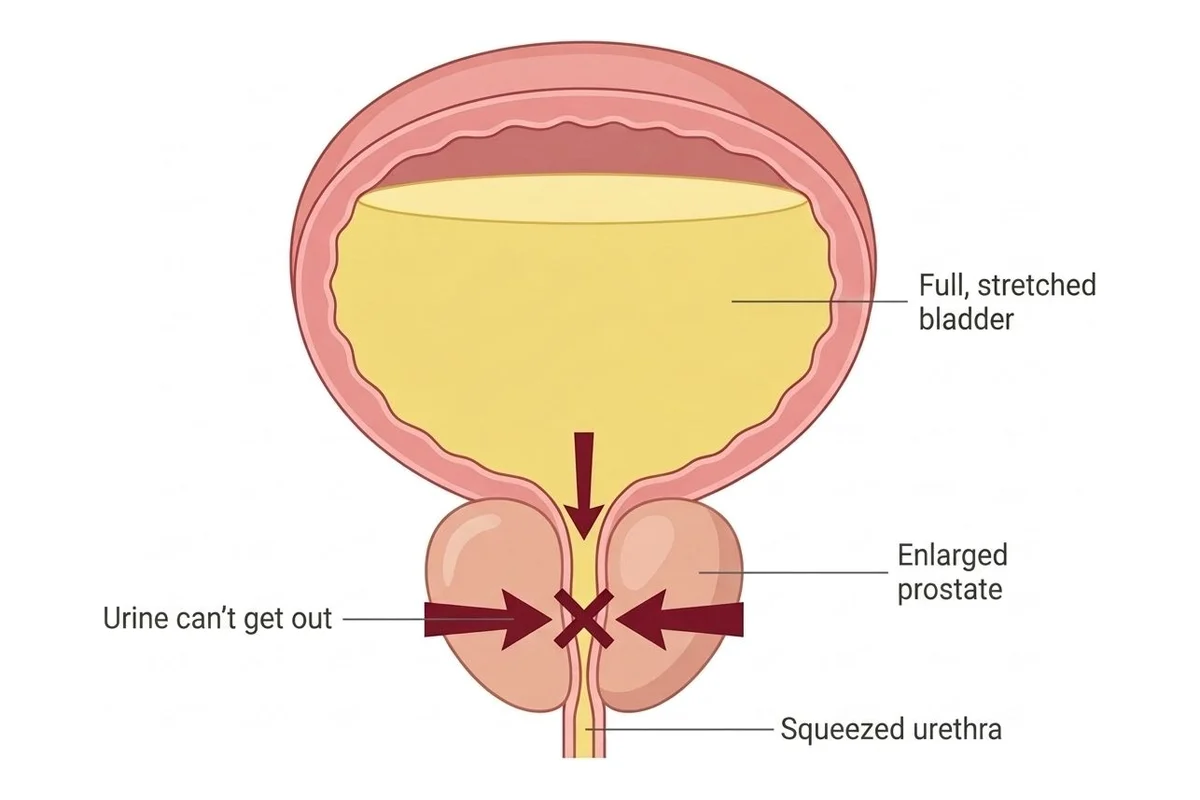
It is often the first sign. In an international study of more than 6,000 men treated for urinary retention, in 44 out of every 100 it was the retention that revealed they had an enlarged prostate [2].
What can suddenly make me unable to urinate?
In that same study, about 7 out of every 10 retentions appeared without a clear trigger. The other 3 out of 10 had one, mainly anesthesia (for example, for another surgery) or drinking too much alcohol [2].
Medications can also cause it: it is estimated that up to 10 out of every 100 retentions could be due to them [3]. It has been described with [3]:
- medications with an anticholinergic effect, such as some antidepressants, antipsychotics and inhalers for the airways;
- opioid painkillers and anesthesia;
- medications that stimulate alpha receptors, such as some decongestants in cold medicines;
- benzodiazepines (some sedatives and sleeping pills);
- medications to relax the bladder;
- some blood pressure medications, called calcium channel blockers.
Older men are at higher risk of a medication causing retention, because many already have an enlarged prostate or take several medications at once [3]. When a medication caused it, in addition to the catheter, the medication responsible is stopped or its dose is lowered [3]. That decision is made by your doctor: do not stop a medication you take for another condition on your own.
Who is at higher risk of urinary retention?
A study followed more than 2,000 men from a community in the United States for four years [4]. The risk rose with age and, above all, when there were also urinary symptoms. These are the retentions per 1,000 men per year [4]:
| Age | No symptoms or mild symptoms | Moderate or severe symptoms |
|---|---|---|
| 40 to 49 years | 2.6 | 3.0 |
| 70 to 79 years | 9.3 | 34.7 |
In other words, among men aged 70 to 79 with moderate or severe symptoms, about 35 out of every 1,000 had a retention each year. A weak stream and a large prostate also increased the risk [4].
What is a urinary catheter like, and what is the balloon for?
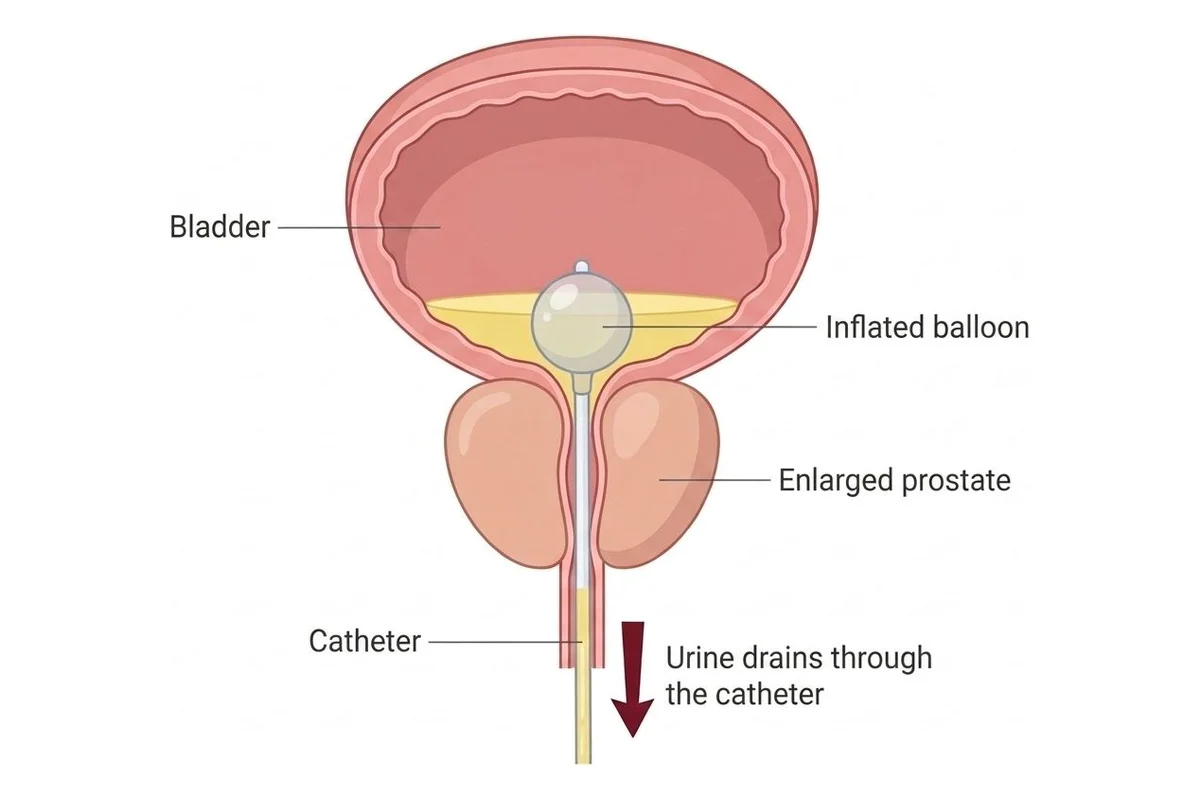
A urinary catheter is a thin, flexible tube. It is almost always placed through the urethra: that is how it was done in 9 out of 10 men in the international study [2]. It goes up the urethra, passes through the prostate and reaches the bladder. There, a small inflated balloon holds it in place so it does not slip out, and urine drains through the catheter.
How long do I have to keep the urinary catheter in?
Usually, a few days. The American guideline recommends:
- Starting an alpha-blocker, a medication that relaxes the prostate, such as tamsulosin or alfuzosin [1].
- Taking it for at least three days before trying to remove the catheter [1].
- If you have an active urinary tract infection, considering waiting until it is cured before the attempt [1].
In the international study, removal was usually attempted about 5 days after the catheter was placed [2]. Leaving it in for more than 3 days did not increase the chances of urinating on your own, but it was linked to more complications and longer hospital stays [2]. That is why it should not be kept in longer than necessary.
What are the chances of urinating on my own when the urinary catheter is removed?
In the international study, 61 out of every 100 men were able to urinate on their own again when it was removed [2]. Those who took the alpha-blocker before the attempt succeeded more often: according to the study's analysis, it almost doubled their chances [2].
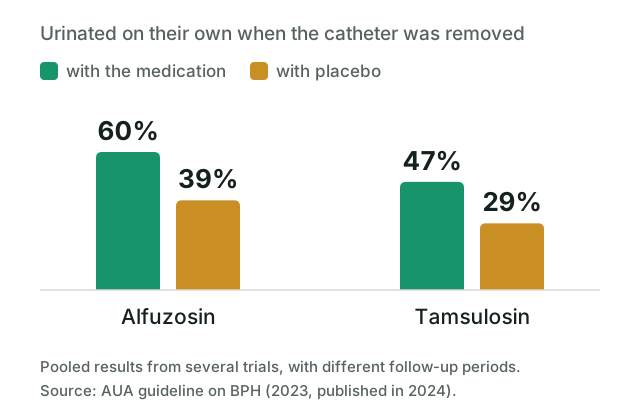
The trials gathered by the American guideline show the same: with alfuzosin, 60 out of every 100 men urinated on their own, compared with 39 with placebo; with tamsulosin, 47 compared with 29 [1].
There are situations in which the attempt is more likely to fail [2]:
- being 70 or older;
- a prostate of 50 grams or more;
- severe symptoms before the retention;
- a liter of urine or more coming out when the catheter was placed;
- the retention appearing without a trigger.
What does it mean that the prostate "pushes into" the bladder?
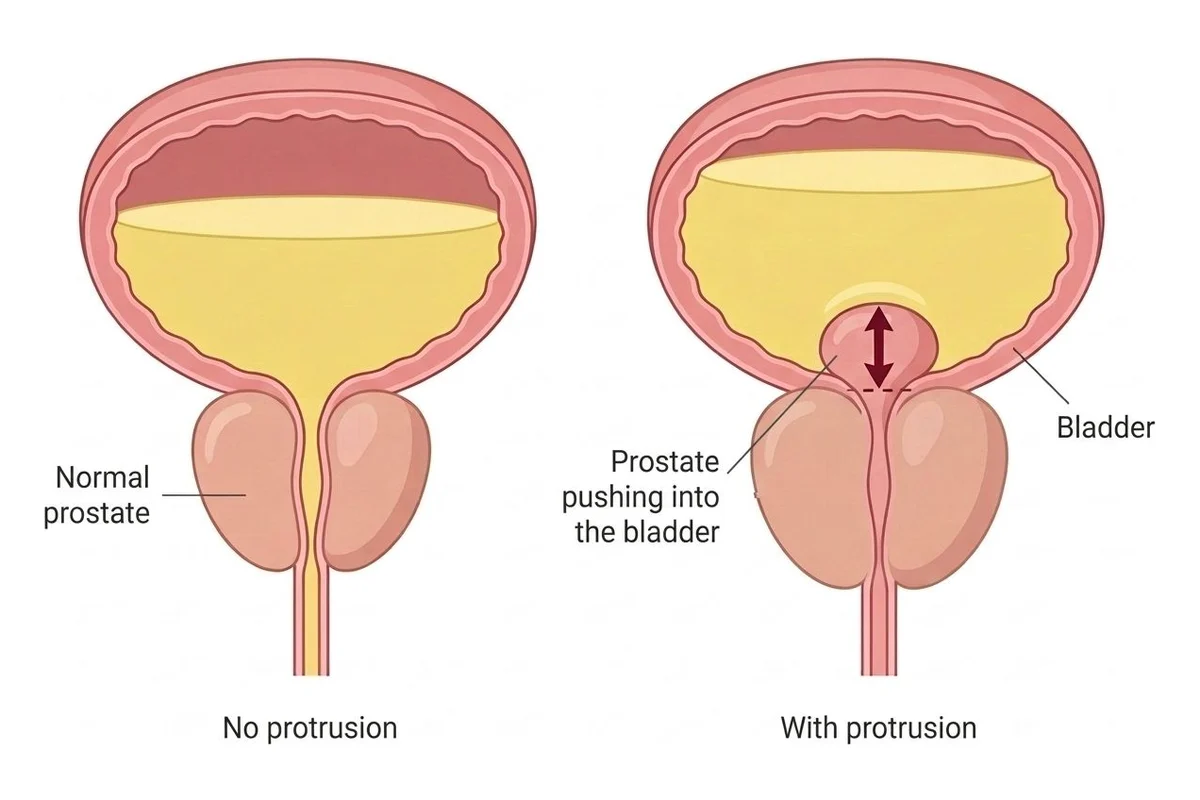
Sometimes the prostate grows not only sideways but also upward, and part of it pokes into the bladder, right above the outlet. It can be seen on ultrasound and is called intravesical prostatic protrusion.
That measurement gives a clue about the catheter:
- The European guideline notes that protrusion seems to predict whether the catheter can be removed [5].
- A review pooled two studies: when the prostate sticks out more than 10 millimeters into the bladder, only 13 and 18 out of every 100 men managed to urinate without a catheter, compared with about 80 out of every 100 when it sticks out less [6].
- That is why its authors recommend talking with these men about the high likelihood of needing surgery [6].
The studies differ from one another, and it is still not known how much the measurement changes depending on who does the ultrasound [5, 6]. It is a useful clue, not a verdict.
If my urinary catheter was removed, is the problem over?
Not completely.
The catheter coming out successfully does not mean the cause has gone away. The American guideline asks that patients be told that, even if they manage to urinate, they are still at higher risk of another retention [1]. In all the studies, a significant share of men had retention or symptoms again days or months later and needed another catheter or surgery [1].
After a first episode, if the underlying cause is not corrected, each episode can make the next one easier. That is why, even if you are urinating well today, it is a good idea to follow up with your doctor.
Medication can also help afterward. In a trial of men who had already been able to urinate on their own again after a first retention, continuing alfuzosin reduced the need for surgery in the first months [7]. At six months, the difference (17 out of every 100 compared with 24 with placebo) was no longer conclusive [7]. In both groups, the main reason for those surgeries was that the retention came back [7].
What happens if I can't urinate when the urinary catheter is removed?
The bladder fills up again and another catheter has to be placed: it is the same emergency as at the start, so get care right away. In the international study, when the first attempt failed, about half of the men went back to the catheter and had surgery; others made a second attempt, and only 3 out of 10 succeeded [2].
When the cycle repeats (catheter, removal, catheter, removal), it is called refractory urinary retention. Put simply, the blockage is so significant that the bladder can no longer overcome it on its own, even with medication and even after several attempts. The outlet is still too narrow.
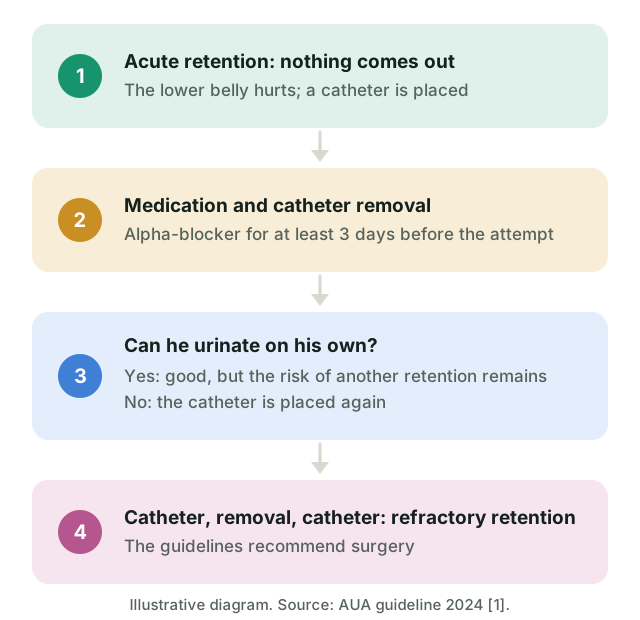
At that point, the recommendation for surgery is firm. The American guideline puts it this way: when refractory retention is due to the prostate, and not to other causes such as a narrowing of the urethra or a problem with the bladder's nerves, surgery is the main treatment [1]. The European guideline also includes it among the reasons that usually make surgery necessary [5].
It is not about convenience or preference, but because continuing to depend on catheters does not solve the underlying problem. The surgery is scheduled: it is not done on the spot.
Is it bad to live with a urinary catheter for a long time?
The catheter keeps urine draining, but it does not correct the blockage. It is a temporary measure, not a permanent solution.
And the longer it is used, or the more times it is placed and removed, the greater the risk of:
- urinary tract infections;
- bleeding;
- persistent discomfort;
- injuries to the urethra from repeated handling.
The urethra is a delicate tube. If it is injured again and again, it can scar and narrow: this is urethral stricture. And a stricture can become a new problem, even one independent of the prostate. In other words, fixing the blockage late can end up creating a different problem.
If for some reason surgery is not possible, the catheter may have to stay in for a long time, with the risks I just explained. That is something discussed case by case.
Urinary retention: when should I go back to the doctor or to the emergency room?
Talk to your doctor about options to correct the blockage if:
- you have had a catheter placed more than once;
- it was removed and, days or weeks later, you had trouble urinating again;
- you were told on an ultrasound that your prostate "pushes into" the bladder;
- you have had the catheter in for weeks or months.
If you cannot urinate at all and your lower belly hurts, get care right away. If you have a catheter and you develop fever and chills, if it stops draining and your lower belly hurts, or if it bleeds heavily with clots, get care that same day.
If you want to know what happens when urine builds up for months without causing pain, I explain it in Can an enlarged prostate damage the kidneys?.
Key takeaways
- Being unable to urinate with a full bladder is an emergency: the catheter is necessary to empty it.
- Anesthesia, too much alcohol and some medications can trigger it when the prostate is already enlarged.
- Before the catheter is removed, an alpha-blocker for at least three days is recommended; about 6 out of 10 men are able to urinate on their own again.
- Even if you can urinate again, the risk of another retention remains if the cause is not corrected.
- If the cycle of catheter, removal, catheter repeats, surgery is the main treatment: living with a catheter does not solve the blockage.
Frequently asked questions
Is urinary retention always caused by the prostate? No. In men, about two out of every three retentions are due to an enlarged prostate [8]. It can also be due, for example, to a narrowing of the urethra or a problem with the bladder's nerves [1], or to a medication [3]. That is why the cause has to be investigated before deciding on treatment.
Can the catheter be removed if I have an infection? The American guideline suggests considering waiting until the infection clears before trying to remove it [1].
I urinated fine after the catheter. Is there anything that lowers the risk of it happening again? In addition to the alpha-blocker [7], in men with an enlarged prostate and symptoms, finasteride and dutasteride lower the risk of developing retention [1]. Those studies were not done in men who had already had one; whether they are right for you is something your doctor decides.