
In short: yes, though it is uncommon. When an enlarged prostate narrows the urine outlet for a long time, the bladder stops emptying well and urine backs up toward the kidneys: they swell (hydronephrosis) and can lose function [1]. The most treacherous part is that it often does not hurt. If the damage is caught in time, the kidney can improve once the blockage is removed; if the blockage lasts too long, it may not fully recover. That is why, when the prostate is already affecting the kidneys, the guidelines recommend surgery [1,2].
If you were told you have an enlarged prostate, you probably think about a weak stream or getting up at night to go to the bathroom. Almost no one thinks about the kidneys. This is not meant to alarm you: it does not happen to most men. But it is a real possibility, and it is worth knowing the signs.
How can the prostate damage the kidneys if it is so far away?
It is a very common question: "How, if the prostate is down below and the kidneys are up above?"
Picture the urinary tract as one continuous pipe:
- the kidneys clean the blood and make urine;
- the ureters, two thin tubes, carry it down;
- the bladder stores it;
- and the urethra is the way out. Just below the bladder, the urethra passes right through the middle of the prostate.
Picture the prostate as a donut with a drinking straw through it: the donut is the prostate and the straw is the urethra. Over the years the prostate grows, and if it grows inward, the straw gets squeezed and urine no longer flows out easily.
When the outlet narrows:
- First, the bladder has to push harder to empty.
- Then, some urine starts to stay inside every time you urinate.
- If the blockage is significant and lasts a long time, the bladder overfills and urine backs up: it travels up the ureters and reaches the kidneys.
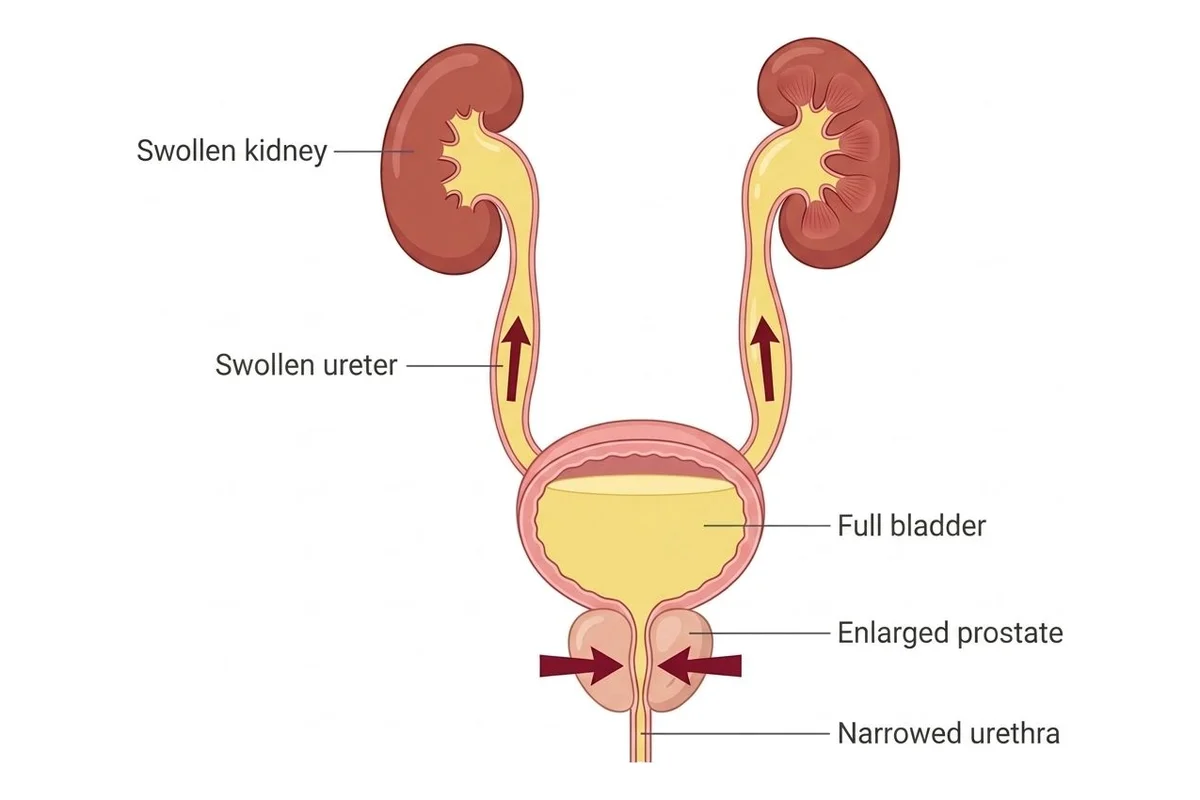
The American guideline describes it the same way: a long-standing blockage can lead to the bladder not emptying completely, to swelling of the ureters and kidneys on both sides and, in the end, to kidney failure, acute or chronic [1].
What is hydronephrosis?
It is the medical name for a kidney swollen with urine that cannot get out.
Inside each kidney there are two parts: the tissue that filters the blood and makes urine, and a small "funnel" in the center that collects it and sends it to the ureter. If there is a blockage further down, urine builds up in that funnel and gradually inflates it.
It is like leaving the faucet on with the end of the hose kinked: water keeps coming out of the faucet, but it builds up before the kink. The kidney keeps making urine, but since it cannot drain it, it gradually "inflates."
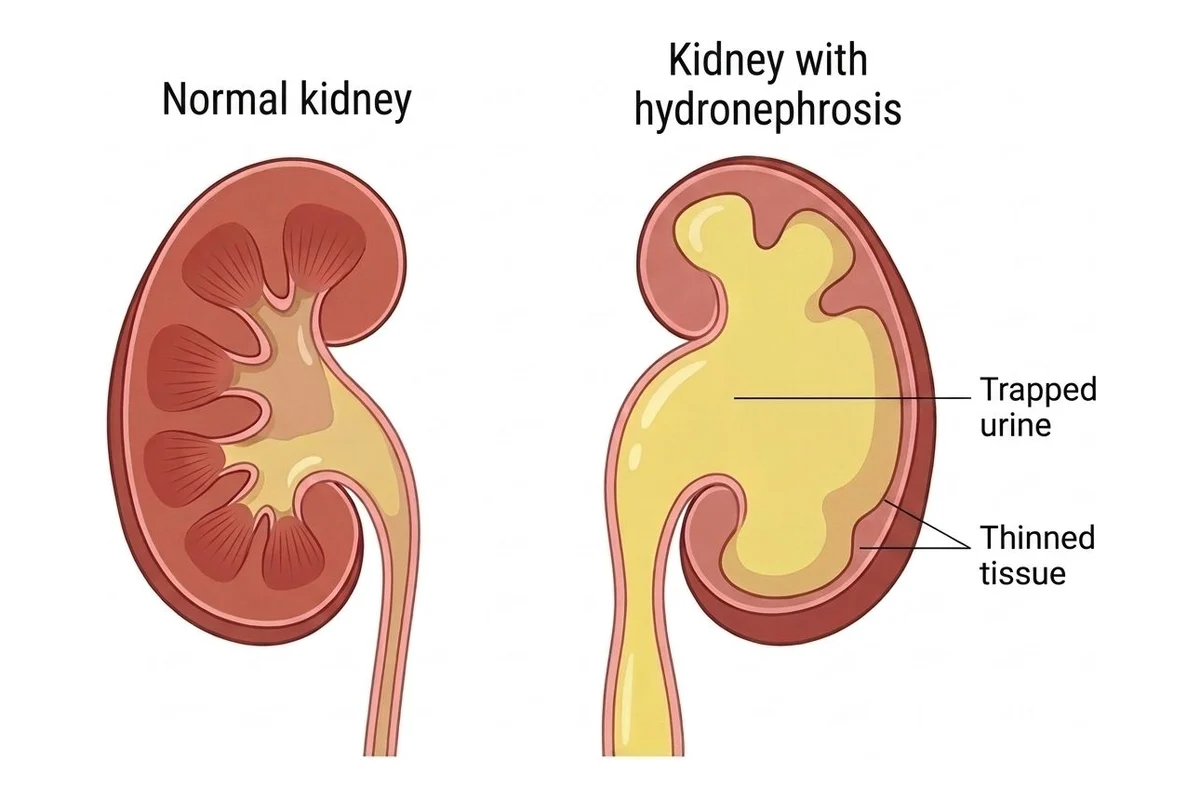
The problem is that this tissue is delicate. It is not made to be compressed for a long time. If the kidney stays swollen, the tissue thins, loses its ability to filter and, over time, can be permanently damaged.
In blood tests this shows up as a rise in creatinine, a waste product that the kidney normally removes. If it builds up in the blood, it is because the kidneys are no longer filtering well.
How common is it for the prostate to damage the kidneys?
Uncommon, and it is worth saying so to avoid unnecessary fear:
- The European guideline notes that, when symptoms are not bothersome, few men progress to complications such as kidney failure or stones [2].
- In a study of more than a million emergency department visits for urinary symptoms in men in the United States, hydronephrosis appeared in 1.2 out of every 100 visits and acute kidney failure in 0.1 out of every 100 [3].
Who should it be a concern for? Men who chronically have a lot of urine left in the bladder. A review of studies found that chronic retention with a large amount of residual urine, more than 300 milliliters (more than a large glass), together with other bladder changes, was associated with chronic kidney failure; in that review, exactly how strong that link is was not known [4].
What symptoms does kidney damage from the prostate cause?
Often, none. The damage usually progresses slowly and without pain. There is no clear signal to warn you, and it is often discovered only on a blood test or an ultrasound.
But there is one clue worth knowing: starting to wet the bed at night again as an adult. It can be the only symptom of "high-pressure" chronic urinary retention: the bladder is always full and tense, and at night, while you sleep, urine leaks out on its own. Recognizing it in time makes it possible to keep the kidneys from being damaged further [5].
Other signs that the bladder is not emptying well are feeling that you never finish emptying it, or being told on an ultrasound that a lot of urine is left after you urinate.
A consensus document from the American Urological Association defines chronic urinary retention as having more than 300 milliliters left in the bladder after urinating for at least six months, measured on two or more occasions. It considers it high risk when there are swollen kidneys, moderate chronic kidney disease or confirmed repeated urinary tract infections [6].
Does the kidney recover if the prostate blockage is removed?
It can improve. A review of studies found that kidney function improved after prostate surgery, although in many cases it was not known whether the damage was recent or long-standing [4]. In a small study of men with chronic retention and kidney damage, after surgery they were able to urinate without a catheter and their kidney function stabilized [7].
But there is something worth knowing: kidney damage is not always reversible. When the blockage has lasted a long time, even if it is corrected, the kidney may not regain normal function. That is why it matters so much to catch it in time and not wait for the damage to progress.
How is kidney damage from the prostate treated?
The goal is to get urine flowing out again, so the kidneys are no longer under pressure.
First, the bladder is emptied. Usually with a catheter, which, if needed, allows kidney function to stabilize before surgery [1,8]. After it is emptied, some men start passing a very large amount of urine through the catheter: this is post-obstructive diuresis. The kidneys, freed from the pressure, suddenly get rid of the fluid that had built up. It has to be watched closely to avoid complications, for example with the body's fluids and salts [9].
Then, the cause is corrected. When the prostate is already affecting the kidneys, surgery is no longer about improving the stream: it is about protecting your kidneys and keeping the damage from continuing or becoming irreversible. The two leading international guidelines include it among the reasons for surgery: the American one, when there is kidney failure caused by the prostate [1]; the European one, when the blockage makes the kidneys swell, whether or not there is kidney failure [2].
Also, when there is already kidney failure, complications after surgery are more likely [2].
Signs that the prostate may be affecting your kidneys
Having an enlarged prostate does not mean your kidneys are in danger. That said, ask yourself these questions:
- Have you started wetting the bed at night again, as an adult?
- Do you feel that you never finish emptying your bladder?
- Were you told on an ultrasound that a lot of urine stays in your bladder, or that your kidneys are swollen?
- Were you told on a blood test that your kidneys are not working well, for example that your creatinine is high?
- Have you needed a catheter to urinate?
If you answered yes to any of them, bring it up with your doctor soon; do not wait for your next routine checkup.
If one day you cannot urinate at all and your lower belly hurts, get care right away. If, after the blockage was removed, you are passing a very large amount of urine and you feel dizzy, very weak or very thirsty, get care that same day.
If one day you cannot urinate, in Can't urinate: what to do and what happens after the catheter I explain what comes after the catheter.
Key takeaways
- An enlarged prostate can damage the kidneys when it narrows the urine outlet for a long time: urine backs up and the kidney swells (hydronephrosis).
- It is uncommon, but it often does not hurt. Wetting the bed at night as an adult or feeling that the bladder never empties are signs to bring up with your doctor soon.
- If it is caught in time, the kidney can improve once the blockage is removed; if the blockage lasts too long, it may not fully recover.
- When the prostate is already affecting the kidneys, the bladder is first emptied with a catheter, and then the guidelines recommend surgery to protect them.
Frequently asked questions
Does a bigger prostate damage the kidneys more? Not necessarily. Kidney disease has been linked to signs of blockage, such as a weak stream, and not to the size of the prostate [2]. What matters is whether the prostate narrows the urine outlet, and that does not depend on its size alone. If you are curious about why it grows, I explain it in Why does the prostate grow with age?.
Is having urine left in my bladder enough reason for surgery? Not on its own. The American guideline clarifies that a high residual urine volume is not, by itself, a formal indication for surgery; first, it is checked whether there is kidney damage or infections [1]. Even so, surgery can be considered in some men: each case is individualized with your doctor.
Why am I urinating so much after they put in the catheter? It may be post-obstructive diuresis: once the pressure is relieved, the kidneys suddenly get rid of the fluid that had built up [9]. That is why it is a good idea to monitor the amount of urine and correct the body's fluids and salts if needed.