
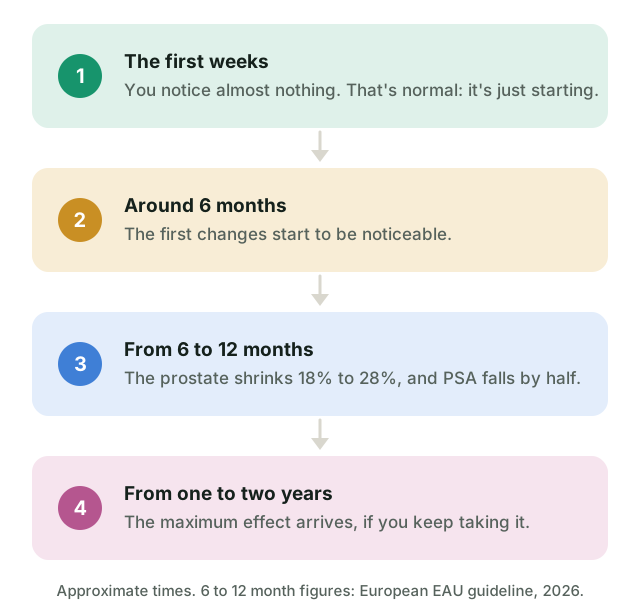
In short: finasteride and dutasteride don't work in days: the first changes show up around six months, and the maximum effect arrives between one and two years. Between 6 and 12 months, the prostate shrinks by 18% to 28% [1]. And they don't cure the prostate: they control it. If you stop them, it grows back; in one study, a year after stopping, the prostate had grown by about 20% and symptoms had gotten worse [2]. That is why they are a treatment for years [1]: patience to get started and consistency to keep going.
If you were prescribed finasteride or dutasteride for your prostate, there are two questions worth being clear about: how long does it take to work? And what happens the day you stop it? Almost nobody is clear on them, and that is why many men give up on treatment too early or drop it just when it was working best.
One clarification before we start: here I am talking about finasteride for the prostate. The 1 mg dose used for hair loss is a different dose and a different topic [3].
How long do finasteride and dutasteride take to work for the prostate?
Months, not days. The first changes start to show up around six months, and the full effect, the maximum benefit, is seen between one and two years of taking it. The same goes for dutasteride.
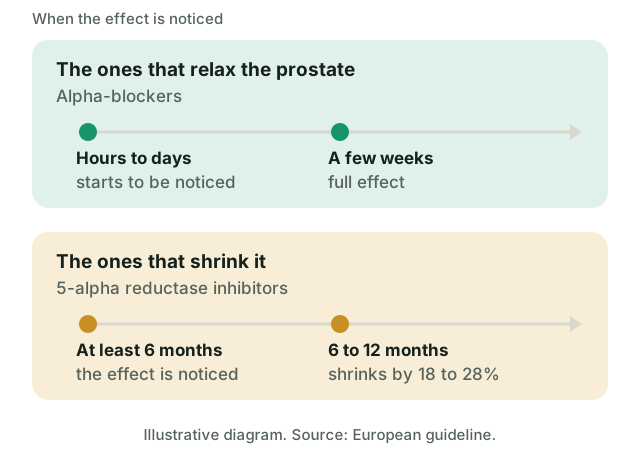
The European guidelines say the same: the difference compared with placebo is seen after at least six months of treatment [1], and the reduction in prostate size and PSA can be even greater with long-term treatment [1].
Why do finasteride and dutasteride take so long to work?
Because they don't relax anything or open any gates right away. What they do is shrink the prostate little by little by cutting off its fuel: the hormone that makes it grow.
Without that fuel, the cells in the glandular part of the prostate die off in a programmed way [1]. And shrinking an organ takes time. That is why, between 6 and 12 months, the prostate shrinks by 18% to 28% and PSA falls by roughly half [1].
Tamsulosin, on the other hand, works differently: it relaxes the prostate, you notice it within hours or days, and it reaches its full effect in a few weeks [1]. That is why it is common to be prescribed both together, one that relieves while the other shrinks. I explain it in Tamsulosin and finasteride together: when combination therapy makes sense.
Finasteride or dutasteride isn't working for me: should I stop it?
If you have only been on it a few weeks, no. This is where most men get lost: a man starts the pill, three weeks go by, he doesn't feel anything different and concludes, "This doesn't work, it's a scam." And he stops it. He gave up on exactly the treatment that was going to protect him most, before giving it a chance to work.
Think of it like losing weight with a diet. If you start a diet today, you don't wake up thin tomorrow. In fact, the first week you see almost nothing in the mirror. But if you stick with it, after a few months the change is real. The prostate is the same: the change builds over months, not days. Not feeling anything at first doesn't mean nothing is happening; it means it is just getting started.
Besides, the most valuable thing about these pills is something you can't feel: they lower the risk that one day you won't be able to urinate and will need a catheter, or that you will need surgery. Only finasteride and dutasteride provide that long-term benefit, not tamsulosin [1].
It is a different story if more than six months have gone by and you are still urinating just as poorly. That does deserve a review with your doctor: in some men the pill is not enough, and I explain it in When prostate medication stops working.
What happens if I stop taking finasteride or dutasteride?
The prostate grows back. These pills don't cure the prostate: they control it. While you take them, you keep the fuel that makes it grow cut off. The day you stop them, that fuel comes back.
Picture the patient who actually was patient. He took his pill for a year, two years, and it went wonderfully: his prostate shrank and he urinates well. One day he thinks, quite logically: "I'm fine now, I'm cured, why keep taking this?" And he stops it.
Think of your large prostate as an overinflated ball that gets in the way. The pill is like a valve that lets the air out little by little, until the ball deflates and stops bothering you. The problem is that your body has its own air pump, always on, always trying to inflate it again. While you take the pill, the pump is blocked. The day you let go of it, you unblock the pump, and the ball inflates again on its own.
So if you are doing well, it is thanks to the pill. Stopping it is not staying the way you are: it is giving your prostate permission to grow again.
How quickly does the prostate grow back after stopping finasteride or dutasteride?
Within months the prostate starts to regain its size, and in about a year it can get close to where it was before you started. The studies that measured it point in that direction:
- In a trial in Korea with 120 men who were also taking an alpha-blocker, one year of finasteride shrank the prostate by 24.5%, and one year of dutasteride by 26.1%. One year after stopping, it had grown back by 20.7% and 18.6%, and symptoms had gotten worse [2].
- In another trial, with 230 men in Taiwan who had been on dutasteride plus an alpha-blocker (doxazosin) for two years, half of those who stopped dutasteride (51%) went back to taking both pills within the following year, on average at 8 months. Among those who stopped the alpha-blocker and stayed on dutasteride, it was 31%. And surgery was twice as frequent after stopping dutasteride: 15 out of 100 men, compared with 7 out of 100 [4].
- PSA also rises when it is stopped, along with prostate size and symptoms [5].
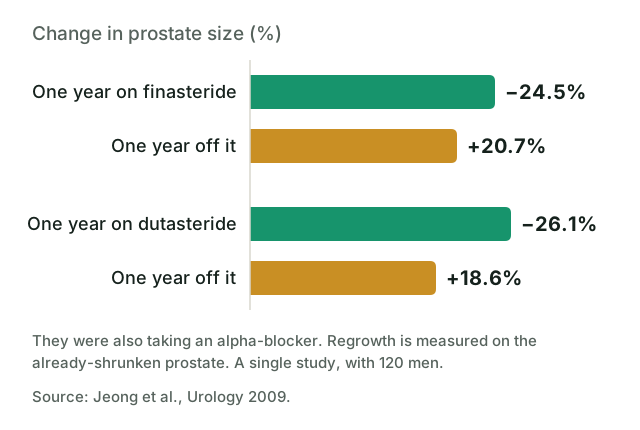
These are studies in Asian men who were taking the pill together with an alpha-blocker. And it doesn't happen the same way to everyone: how much the prostate grows back varies from one man to another [6], and in the second study almost half of those who stopped it did not go back to taking it that year [4]. Even so, the trend is clear: the authors of the first study propose considering taking it for life [2]. That is why the decision is individual and is made with your doctor.
How long are finasteride or dutasteride taken for the prostate?
There is no set time after which they can be stopped. As we saw, they control prostate growth but don't cure it: while you take them, they keep the prostate smaller, and if you stop them it can grow back [2]. That is why they are a treatment for years [1, 2].
They are very effective: finasteride and dutasteride are the only prostate medications that lower the long-term risk of urinary retention and surgery; tamsulosin does not [1]. But, like any serious medication, they can also have side effects. The most common ones have to do with sex life: lower sex drive, erection problems and, less often, changes in ejaculation [1]. And if you notice low mood, depression, or suicidal thoughts while taking finasteride, the European Medicines Agency advises stopping it and seeking medical care [1]. That is why the decision to take it for years is talked over with your doctor, weighing what you gain against what you risk. More details in Can the prostate shrink without surgery? Finasteride and dutasteride.
How do you stop finasteride or dutasteride if you are thinking about it?
Don't stop it on your own. If you want to stop it, because of side effects or because you already feel well, talk it over with your doctor first:
- There may be another option. If you take both together, sometimes what is stopped after 6 to 9 months is tamsulosin; almost 3 out of 4 men did not get worse when they stopped it [1]. The one that shrinks the prostate stays.
- Your PSA will change. On the pill, PSA falls by half, and a new baseline value is taken at six months [1]. When you stop it, it goes back up [5], and your doctor needs to know that to read it correctly. I explain it in Finasteride, dutasteride, and PSA.
- It is a good idea to keep an eye on how you urinate and on your PSA, whether you continue or stop [5].
When should you see a doctor if you take finasteride or dutasteride?
Talk to your doctor if:
- you have been on treatment for more than six months and are still urinating just as poorly;
- you want to stop the pill or switch it;
- you stopped it and notice that you are urinating worse again;
- you are going to have your PSA measured (mention that you take it or used to take it);
- you notice side effects that bother you, or low mood.
Don't wait if you suddenly cannot urinate at all, if you see blood in your urine, if you keep getting urinary tract infections, or if you feel you never empty completely. Any of these signs deserves a prompt evaluation.
Key takeaways
- Finasteride and dutasteride take time: the first changes show up around six months, and the maximum effect between one and two years.
- Not feeling anything in the first weeks is normal; don't stop it because of that.
- They don't cure the prostate, they control it: if you stop them, it grows back and symptoms can get worse within months.
- That is why they are a treatment for years; any change is talked over with your doctor first.
- If you stop them, your PSA goes back up: always mention that you take them or used to take them.
Frequently asked questions
Can I take finasteride or dutasteride for just a few months and then stop? It doesn't work that way. Their effect compared with placebo is seen after at least six months, and because they are slow they are a treatment for years [1]. If you stop, what you gained is gradually lost [2].
If I stop finasteride or dutasteride, will I end up worse than before I started? In the studies, a year after stopping, the prostate had grown back and symptoms had gotten worse [2]. Ending up worse than when you started has not been described, but you do lose much of what you had gained with the pill.
Does anything change if I take dutasteride instead of finasteride? Not in this respect. Both take months to work [1], and when dutasteride is stopped, the prostate also grows back [2, 4].