
In short: most men with an enlarged prostate who seek treatment start with medication [1], and for many it works well for years. Before deciding it is not working, you have to give it time: the ones that relax the prostate are noticed within days, but the ones that shrink it need at least six months [2]. A larger prostate, a higher PSA, more symptoms and a lot of urine left in the bladder are linked to a poorer response or to the problem progressing [2, 3]. Shape matters too: when part of the prostate pushes into the bladder (intravesical protrusion), medication seems to work less well [3]. If it is no longer enough, surgery is the next step, and it is decided together.
Do you still have to strain to urinate? Is your stream still weak, stop-and-start or slow to get going, despite taking prostate medication? There comes a point when medications are no longer enough. And you do not have to resign yourself to living like this.
What medications are used for an enlarged prostate?
The usual approach is to start with lifestyle changes and medications. There are two main groups:
- The ones that relax the prostate (alpha-blockers), such as tamsulosin.
- The ones that shrink it a little (5-alpha reductase inhibitors), such as finasteride and dutasteride.
Sometimes they are combined. The vast majority of men who seek treatment choose medications first [1], and for many they work very well for years. But for some, despite well-managed treatment, symptoms stay the same or even get worse.
How long does prostate medication take to work?
It depends on the group, and it is worth knowing before deciding it does not work:
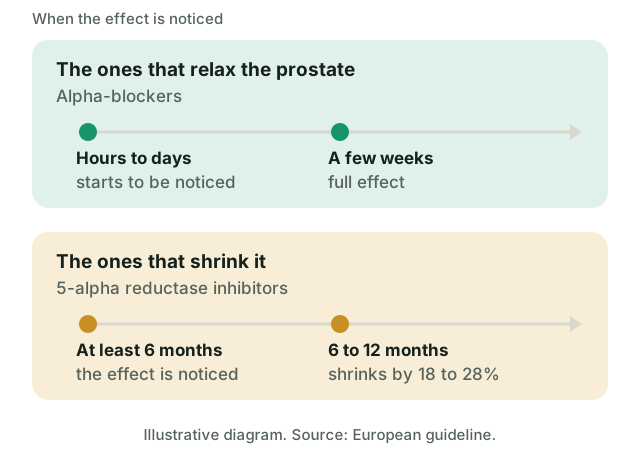
- The ones that relax the prostate start to be noticed within hours or days, and reach their full effect in a few weeks [2]. In studies, they lower the symptom score by about 30% to 40%, although those who took placebo also improved quite a bit [2].
- The ones that shrink it are slow: their effect is noticed after at least six months, and in six to twelve months the prostate shrinks by 18% to 28% [2]. That is why they are meant for treatment lasting years [2].
Two more facts help explain why they sometimes "do not work." The ones that relax the prostate relieve symptoms, but they do not prevent urinary retention or the need for surgery [2]. And with a prostate smaller than 40 mL, finasteride might not work better than a placebo [2].
Why doesn't prostate medication work for some men?
One of the reasons is that it is not only how much the prostate grows that matters, but in which direction it grows. If it grows outward, it can become very large without squeezing the urethra, the tube urine flows out through. If it grows inward, even if it is not that large, it can narrow the tube. And when that blockage is significant, there comes a point when it can no longer be offset with pills alone.
Studies have looked for what predicts how each man will respond to medication. The classic predictors are prostate size, PSA and the symptom score [3]. In recent years, one more has been added that has to do precisely with shape: intravesical protrusion.
What is intravesical prostatic protrusion?
It is when the central part of the prostate, the so-called middle lobe, grows upward and pushes into the bladder, right at the urine outlet. It is measured with an ultrasound over the abdomen and classified into three grades, depending on how many millimeters it sticks out [2].
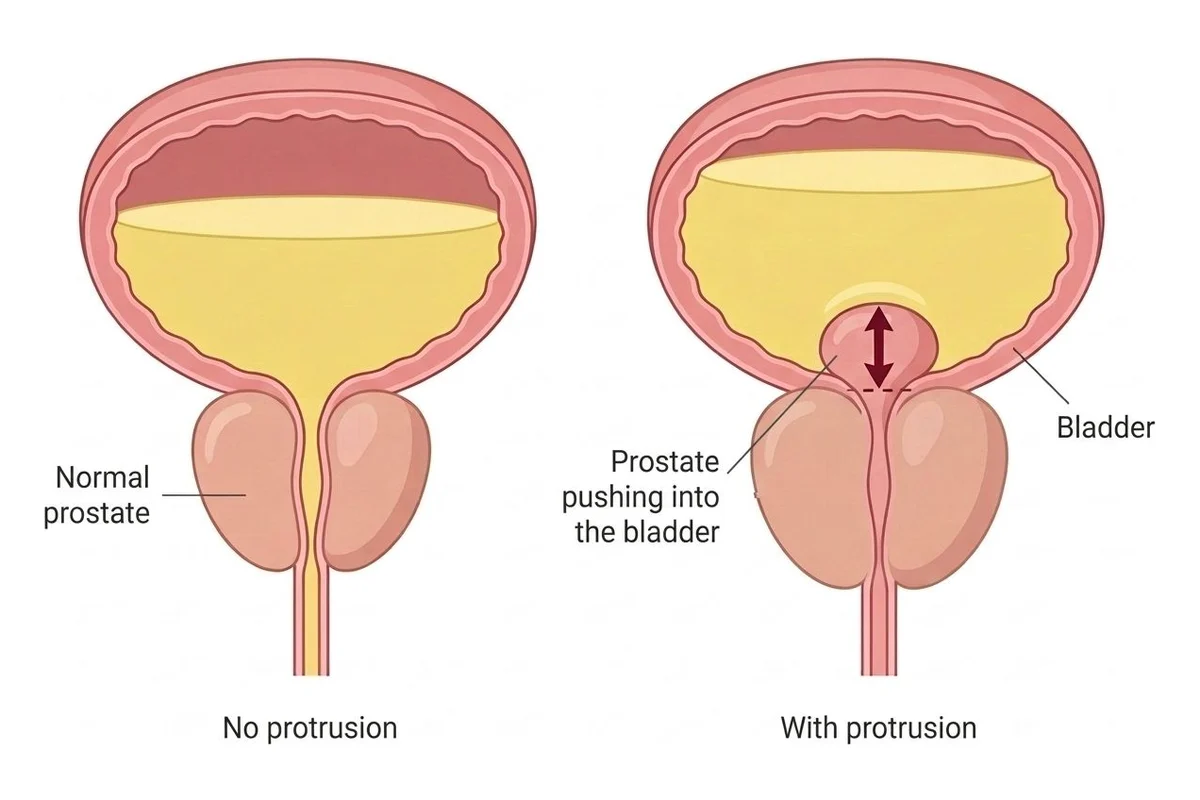
With protrusion, medication seems to work less well, although the studies are few and differ from one another [3]. With more than 10 mm, the improvement with medications that relax the prostate seems clearly smaller, and with the ones that shrink it, having protrusion was linked to more treatment failure, more urinary retention and more surgery [3].
I explain what the grades mean, why the pill shrinks the prostate but not the protrusion, and what is done, in Intravesical prostatic protrusion: the sign that prostate pills may not be enough.
What other signs suggest that an enlarged prostate may get worse?
The European guideline points to others, although not all of them measure the same thing:
- A lot of urine left in the bladder. It does not rule out taking medication, but it may point to a poorer response; there is still no cutoff value on which to base the decision [2].
- A higher PSA. In untreated men, it was linked to a higher risk of urinary retention and surgery [2]. Here PSA is used as a sign of prostate growth, not of cancer.
- A larger prostate. It predicts that symptoms will progress and a higher risk of complications [2].
In men with moderate or severe symptoms and these risk signs, the European guideline prefers combining the two groups of medications, at the cost of more side effects and only if treatment is going to last more than a year [2].
What tests are done when prostate medication stops working?
Before deciding on a procedure, the American guideline recommends reviewing or considering these tests [1]:
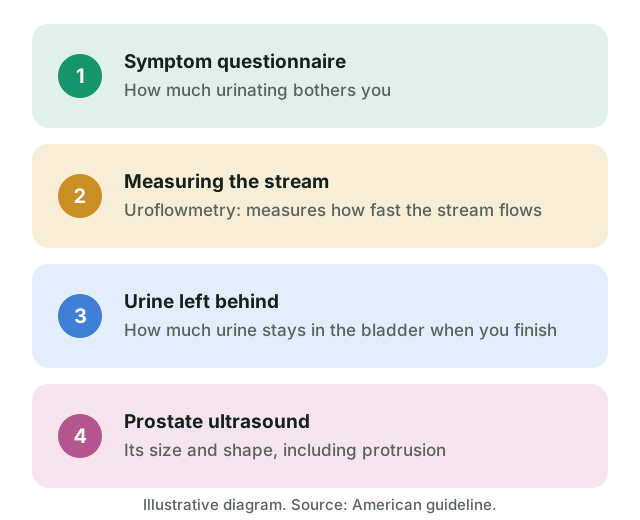
Added to that are how you responded to medications and the risks and benefits of each option, explained for your case [1]. The decision is always shared.
When is prostate surgery done if medication does not work?
Surgery is not a punishment for "failing" the medication. It is another step in treatment, when the blockage can no longer be offset with pills alone. The European guideline considers surgery when medications do not provide enough relief [2].
Many men end up normalizing living poorly: sleeping in fits and starts, planning routes around where the bathrooms are, avoiding long trips, giving up activities. That should not be the norm.
Nor do you have to wait for the medication to fail completely. Some men get tired of taking pills for years, do not tolerate them well or prefer a solution that removes the underlying blockage. The guidelines also include them among those who can have surgery [1, 2].
When should I see a doctor if prostate medication is not working?
Talk to your doctor if:
- you have been on medication for months and still have to strain, have a weak stream or get up several times at night;
- your symptoms bother you more and more;
- you were told that your prostate pushes into the bladder, or that a lot of urine stays behind after you urinate;
- you have ever needed a catheter.
If one day you cannot urinate at all and your lower belly hurts, get care right away.
If it already happened to you and a catheter was placed, in Can't urinate: what to do and what happens after the catheter I explain what comes next. And if you are worried about your kidneys, in Can an enlarged prostate damage the kidneys? I explain how they are checked.
Key takeaways
- Medication is the first step for most men and works well for years in many of them.
- You have to give it time: the ones that relax the prostate are noticed within days; the ones that shrink it, after at least six months.
- A lot of urine left behind may point to a poorer response; a large prostate and a high PSA, to a higher risk of the problem progressing.
- When the prostate pushes into the bladder (intravesical protrusion), medication seems to work less well.
- If medication is no longer enough, surgery is the next step, and it is decided together.
Frequently asked questions
I have been on finasteride for two months and I do not notice anything. Is it not working? It may be too soon. Its effect is noticed after at least six months of treatment [2]. Talk it over with your doctor before stopping it.
How do I know if I have intravesical protrusion? It can be seen on an ultrasound of the prostate and bladder done over the abdomen [2]. Ask your doctor whether it was measured on your ultrasound.
If I have protrusion, is there no point in taking the medication? Not necessarily. It is linked to a poorer response, but the studies are few [3] and do not allow it to be predicted with certainty for each man.