
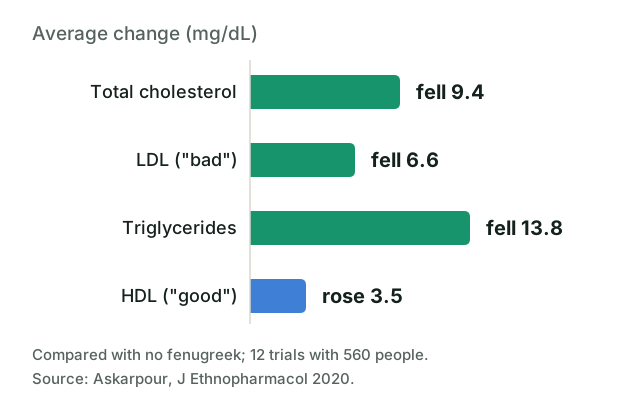
In short: fenugreek moves blood fats in the right direction, but only a little. When 12 trials with 560 people were pooled, it lowered total cholesterol by 9.4 mg/dL on average, LDL ("bad cholesterol") by 6.6 mg/dL, and triglycerides by 13.8 mg/dL, and it raised HDL ("good cholesterol") by 3.5 mg/dL [1]. For blood pressure, it lowered the systolic pressure (the top number) by about 3.5 mmHg, but not the diastolic pressure (the bottom number) [2, 3]. In people with diabetes, a larger effect has been seen on triglycerides and HDL [4]; for LDL, the studies do not agree [5, 6]. It does not replace any medication.
If you have been told your cholesterol or triglycerides are high, or your blood pressure is a little elevated, someone has probably recommended fenugreek to you.
What is fenugreek, and why is it talked about for cholesterol?
Fenugreek (Trigonella foenum-graecum) is a plant whose seeds are used as a spice and as a traditional remedy. Today it is sold as a powder, capsules, or extracts as a dietary supplement, not as a medication, so quality and concentration can vary a lot from one brand to another.
It is best known for its effect on blood sugar, which I explain in Fenugreek for diabetes: does it really lower blood sugar?, and for the promise of raising testosterone, in Fenugreek and testosterone: what the science says. Here we look at what happens with blood fats and blood pressure.
How was fenugreek's effect on cholesterol studied?
The best answer comes from a meta-analysis: a study that pools the results of many trials to reach a more solid conclusion. The researchers searched several scientific databases for all the trials that used fenugreek to see what happened to blood fats. In the end, 12 randomized clinical trials remained, with 560 people in total [1].
They all compared a group that took fenugreek with another that did not, with blood tests before and after. That way you can separate what fenugreek does from what would have happened anyway.
How much does fenugreek lower total cholesterol and LDL cholesterol?
- Total cholesterol: fell by 9.4 mg/dL on average [1]. If someone had 210 mg/dL, they could end up at around 200.
- LDL cholesterol, the "bad" one: fell by 6.6 mg/dL on average [1]. If someone had 160 mg/dL, they could end up at around 153.
These are not spectacular changes, but they are changes that can be measured. One analysis found that in people with diabetes the drop in LDL was larger [4], although two others, done only in people with diabetes or prediabetes, did not find that LDL went down [5, 6].
Does fenugreek raise good cholesterol (HDL)?
Yes, a little. HDL, the cholesterol that protects you, did not go down: on the contrary, it rose by 3.5 mg/dL on average [1]. If someone had an HDL of 38 mg/dL, it could rise to around 41.
Another meta-analysis, of 29 trials that measured the components of metabolic syndrome, found almost the same thing: HDL rose by 3.6 mg/dL [2]. In other words, fenugreek lowers the bad cholesterol without lowering the good one.
How much does fenugreek lower triglycerides?
Triglycerides are another type of fat in the blood. With fenugreek they fell by 13.8 mg/dL on average [1]. If someone had 220 mg/dL, they could end up at around 206.
In the analysis of 29 trials, the drop was somewhat larger, 20 mg/dL [2], and in people with diabetes they also fell more [4].
| Blood fat | Average change with fenugreek | Example |
|---|---|---|
| Total cholesterol | Fell 9.4 mg/dL [1] | From 210 to ~200 mg/dL |
| LDL cholesterol ("bad") | Fell 6.6 mg/dL [1] | From 160 to ~153 mg/dL |
| HDL cholesterol ("good") | Rose 3.5 mg/dL [1] | From 38 to ~41 mg/dL |
| Triglycerides | Fell 13.8 mg/dL [1] | From 220 to ~206 mg/dL |
Why might fenugreek lower cholesterol?
The studies propose several explanations:
- it has soluble fiber, which traps some of the fat in the intestine;
- it improves the body's response to insulin;
- it reduces fat production in the liver;
- it increases the elimination of cholesterol.
These are proposed explanations, not proven one by one. What was measured is the end result in the blood tests.
Does fenugreek lower blood pressure?
Before looking at the results, a quick clarification. When your blood pressure is taken and you are told, for example, "120 over 80," those two numbers are not the same:
- Systolic pressure, the top number: the pressure when the heart contracts and pumps blood. Normal is around 120 mmHg; 140 or higher is high blood pressure (hypertension).
- Diastolic pressure, the bottom number: the pressure when the heart relaxes between beats. Normal is around 80 mmHg; 90 or higher is hypertension.
A meta-analysis searched the main medical databases and, of 137 studies found, only 6 trials with 373 people met its criteria [3]. They all compared fenugreek with not taking it. This was the result:
- Systolic pressure fell by 3.46 mmHg on average, a small change but a real one in statistical terms [3]. If someone had 145 mmHg, they could end up at around 141 or 142.
- Diastolic pressure did not fall reliably: the change was not significant and the studies varied enormously from one another [3].
Another meta-analysis, which largely includes the same trials, gave an almost identical result: systolic pressure fell by 3.45 mmHg and diastolic pressure did not change [2].
| Blood pressure | What happened with fenugreek | Example |
|---|---|---|
| Systolic (top number) | Fell 3.5 mmHg [2, 3] | From 145 to ~141 mmHg |
| Diastolic (bottom number) | No reliable change [2, 3] | — |
In subgroup analyses, with 15 grams of seed a day or more, or with treatments of 12 weeks or less, both systolic and diastolic pressure fell [3]. These are partial analyses of few studies, and the authors call for more research to know whether this effect really matters for health [3]. Fenugreek touches blood pressure with a fine brush, not a broad one.
Who sees more of fenugreek's effect on cholesterol?
Mainly people with diabetes: in one analysis, fenugreek lowered triglycerides and LDL more and raised HDL more in them [4]. However, two other analyses done only in people with diabetes or prediabetes did not find that LDL went down [5, 6]. On the other hand, studies done specifically in people with high cholesterol are lacking [1].
Fenugreek did not change body weight or body mass index [1], so its effect on blood fats is not because people lost weight.
What we still don't know about fenugreek, cholesterol, and blood pressure
- LDL does not always go down. In two meta-analyses in people with diabetes or prediabetes, LDL did not change significantly [5, 6]. In one of them, neither did triglycerides or HDL; only total cholesterol fell [6].
- Better-quality studies are needed to confirm the effect [4].
- We do not know whether it prevents heart attacks or strokes. The studies measured blood tests and blood pressure, not those events.
- There is no recommended dose. The studies used different products and amounts; in the blood pressure studies, for example, powdered seed [3].
Can I take fenugreek instead of my cholesterol or blood pressure medications?
No. Fenugreek moves cholesterol, triglycerides, and blood pressure in the right direction, but:
- it does not replace cholesterol or blood pressure medications;
- it has not been shown to prevent heart attacks or strokes;
- it does not replace follow-up with your doctor.
If you take anticoagulants (medications that thin the blood), such as warfarin, be careful: fenugreek can interact with them and cause bleeding [7, 8]. And if you take diabetes medications, fenugreek can add to their effect and lower your blood sugar too much [9].
In the studies in people with diabetes, no liver or kidney damage was found [6]. In the trials reviewed in men there were no serious side effects, but they were short, so we do not know what happens when it is taken for a long time [10]. There are also isolated reports of liver damage, mostly with herbal mixtures [7].
No supplement should be used to stop a medical treatment. Fenugreek can add a little support, but it is not a treatment for cholesterol or high blood pressure.
When should you see a doctor about cholesterol, triglycerides, or high blood pressure?
Talk to your doctor if:
- your tests show high cholesterol, LDL, or triglycerides, or low HDL;
- your blood pressure reads 140 or higher on top, or 90 or higher on the bottom;
- you want to try fenugreek and take medications for cholesterol, blood pressure, diabetes, or anticoagulants;
- you are thinking about stopping a medication because "you already take something natural."
Key takeaways
- In 12 trials, fenugreek lowered total cholesterol by 9.4 mg/dL on average, LDL by 6.6, and triglycerides by 13.8, and raised HDL by 3.5.
- It lowered systolic blood pressure by about 3.5 mmHg, but not diastolic pressure reliably.
- In people with diabetes, a larger effect has been seen on triglycerides and HDL; for LDL, the studies do not agree.
- These are small changes: it does not replace any medication and it can interact with anticoagulants.
Frequently asked questions
Does fenugreek lower cholesterol as much as a medication? No. The changes were a few mg/dL on average [1]; it does not replace the treatment your doctor prescribes.
Does fenugreek help me lose weight? In the blood fat studies, it did not change body weight or body mass index [1].
Can I take fenugreek if I take blood pressure medications? Talk to your doctor first. Its effect on blood pressure is small and it does not replace your medication [3].