
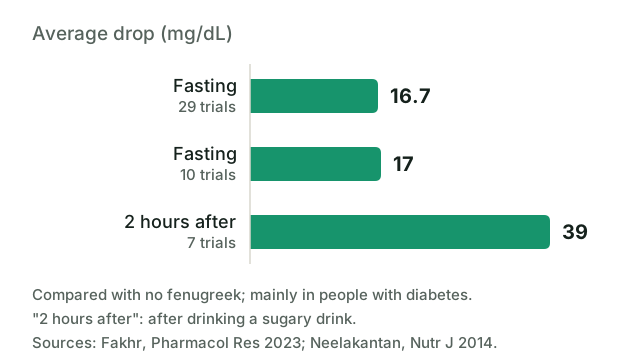
In short: yes, but only a little, and mostly in people with diabetes. When 29 clinical trials were pooled, fenugreek lowered fasting glucose by about 17 mg/dL on average [1]. In another analysis, glucose two hours after a sugar load fell by about 39 mg/dL and hemoglobin A1c (the average of your blood sugar over the last three months) fell by 0.85 points, although the latter came from only 3 trials [2]. The effect was seen mainly with medium or high doses in people with diabetes, and most of the studies are of low quality [2]. It does not replace your treatment, and if you take it together with diabetes medications it can lower your blood sugar too much [3].
If you have diabetes or prediabetes, someone has surely recommended a natural remedy "for blood sugar." Fenugreek is one of the most studied, so it is worth looking at what it does and what it does not do.
What is fenugreek, and why is it used for diabetes?
Fenugreek (Trigonella foenum-graecum) is a plant whose seeds are widely used in cooking and as a traditional remedy, especially in Asia [2]. Today it is sold as a powder, capsules, or extracts, as a dietary supplement, not as a medication. That means quality, concentration, and purity can vary a lot from one brand to another.
It is also promoted to raise testosterone in men; I cover that in Fenugreek and testosterone: what the science says. Here we focus on blood sugar.
What do fasting glucose, glucose after eating, and hemoglobin A1c measure?
To know whether something improves blood sugar, in medicine we use three measurements, and each one tells you something different:
- Fasting glucose: blood sugar after 8 to 12 hours without eating. Below 100 mg/dL is normal; 100 to 125 is prediabetes, and 126 or higher means diabetes.
- Glucose after eating (postprandial): measured one or two hours after eating, or two hours after drinking a sugary drink in a lab test. It shows how high your blood sugar spikes, and that is often where the problem starts.
- Hemoglobin A1c (HbA1c): reflects the average of your blood sugar over the last three months. It does not drop with one good day or one week of behaving well; that is why it is the most important long-term measurement.
How much does fenugreek lower fasting glucose?
A meta-analysis is a study that pools the results of many trials to reach a more solid conclusion. One of the largest on fenugreek brought together 29 randomized clinical trials (studies in which chance decides who gets fenugreek and who does not) in people with metabolic disorders, and found that fenugreek lowered fasting glucose by 16.7 mg/dL on average [1].
Another meta-analysis, of 10 trials, arrived at a similar number: about 17 mg/dL lower [2]. That said, a third analysis did not find a clear drop, as you will see below [4].
What does that mean in real life? A person with a fasting glucose of 140 mg/dL could go down to around 123 mg/dL. It will not take you out of diabetes, but it is a change that shows up in your lab results.
How much does fenugreek lower glucose after eating?
Here the effect was larger. The studies measured it with the glucose tolerance test: you drink a sugary drink and your glucose is measured two hours later. In 7 trials, that value fell by about 39 mg/dL with fenugreek [2]. Another analysis, which used a different statistical measure, also found that this was its largest effect [5].
If someone reached 210 mg/dL at two hours on that test, they could end up at around 170 mg/dL. It is an approximate average: the studies varied a lot from one another [2]. It does not give you permission to eat badly, but it does soften the spike.
Does fenugreek lower hemoglobin A1c?
Yes, in the studies that measured it. In 3 trials it fell by 0.85 points [2], and in another meta-analysis (of 14 trials in total) it also fell, by 0.88 points [4]. A person with a hemoglobin A1c of 8.2% could go down to around 7.4%.
This is the most interesting result, because a drop like that in hemoglobin A1c can change how well diabetes is controlled. But it is also the one with the fewest studies behind it, so it should be taken with caution.
| Measurement | How much it fell with fenugreek | Example |
|---|---|---|
| Fasting glucose | 16.7 to 17 mg/dL [1, 2] | From 140 to ~123 mg/dL |
| Glucose 2 hours after a sugary drink | 39 mg/dL [2] | From 210 to ~170 mg/dL |
| Hemoglobin A1c | 0.85 to 0.88 points [2, 4] | From 8.2% to ~7.4% |
Why does fenugreek lower blood sugar?
One proposed explanation is its soluble fiber. Fenugreek seeds have a lot of it, and that fiber makes the carbohydrates in food absorb more slowly: sugar enters the blood little by little, rises more slowly, and does not rise as high.
Picture a funnel: if you pour the water in all at once, it overflows; if the funnel is narrower, the same water gets through, but without spilling. That would fit with its largest effect being seen after taking sugar.
Who does fenugreek work for when it comes to blood sugar?
Mainly people with diabetes. When researchers looked at which studies showed the effect, they found that the drop in fasting glucose and glucose after eating only appeared when medium or high doses were given to people with diabetes [2]. Another meta-analysis, of 10 trials in people with type 2 diabetes or prediabetes, also found that it lowered fasting glucose, two-hour glucose, and hemoglobin A1c [6].
In people without diabetes, the studies did not show a clear effect [2], and whether it prevents diabetes has not been studied. And in any case, no supplement replaces habits: diet, exercise, and sleep.
What we still don't know about fenugreek and diabetes
- The quality of the studies is low. Most of the trials have flaws in how they were done [2].
- The results do not always agree. A meta-analysis of 14 trials did not find a clear drop in fasting glucose or glucose after eating, although it did in hemoglobin A1c [4]. Its authors note that the quality of the studies and how different they are from one another remain a problem [4].
- There is no established dose. Each study used a different product, amount, and duration, and trials with a well-defined preparation at a sufficient dose are needed [2].
- The studies measured blood sugar, not the complications of diabetes, such as kidney or heart damage.
So blood sugar is fenugreek's most studied effect, but it does not replace any treatment.
Can I take fenugreek with metformin or other diabetes medications?
Do not do it without talking to your doctor first. Many natural products lower blood sugar, and if they are added to diabetes medications, the effect adds up too and can lower your blood sugar too much, which is called hypoglycemia [3].
In the diabetes studies, fenugreek did not damage the liver or kidneys, and there were no serious side effects; some people had mild digestive discomfort [6]. But the studies were short, so we do not know what happens when it is taken for a long time [7], and there are isolated reports of liver damage, mostly with herbal mixtures [8].
No supplement should be used to stop a medical treatment. If you have diabetes, fenugreek adds a little at most; it does not run your treatment.
When should you see a doctor if you have high blood sugar and want to try fenugreek?
Talk to your doctor if:
- you have diabetes or prediabetes and want to try fenugreek or any other supplement;
- you take diabetes medications, because the effect adds up and your blood sugar can drop too low;
- you started fenugreek and feel unwell or your blood sugar readings are lower than usual;
- your fasting glucose comes back at 100 mg/dL or higher on a lab test, even if you feel fine: it needs to be confirmed and followed up.
Key takeaways
- Fenugreek lowered fasting glucose by about 17 mg/dL on average in people with blood sugar problems.
- Its largest effect was seen two hours after a sugary drink, and it also lowered hemoglobin A1c in the few studies that measured it.
- It works mainly in people with diabetes and at medium or high doses; the studies are of low quality and do not always agree.
- It does not replace any treatment, and together with diabetes medications it can lower blood sugar too much.
Frequently asked questions
Does fenugreek cure diabetes? No. In the studies it lowered blood sugar a little, but it does not cure diabetes or replace treatment [1, 2].
Does fenugreek help if I don't have diabetes? In people without diabetes the studies did not show a clear effect, and whether it prevents diabetes has not been studied [2].
Can I cook with fenugreek if I have diabetes? As a spice, in cooking amounts, no significant effect is expected: the effect on blood sugar is described at about 25 grams a day or more [8].