
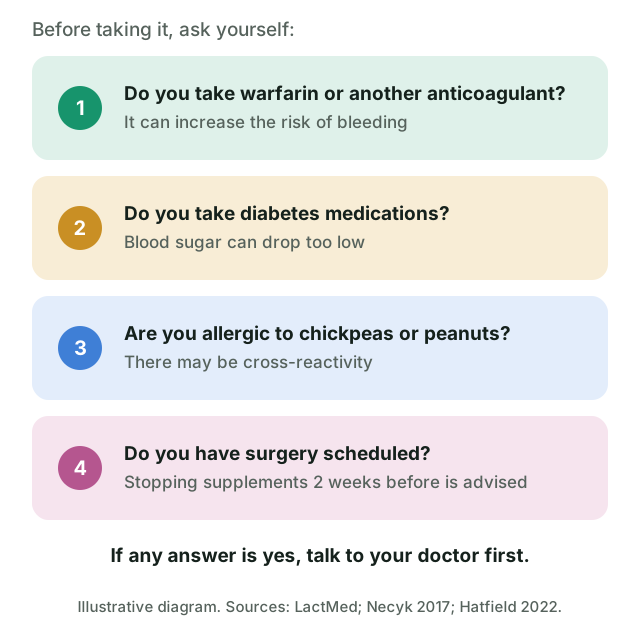
In short: in general, fenugreek is well tolerated, but it can cause digestive upset such as diarrhea, gas, or nausea [1]. It can also cause allergies, and people who are allergic to chickpeas, peanuts, or other legumes may also react to fenugreek [1]. The two interactions described are with warfarin and other anticoagulants, because it can increase the risk of bleeding [1, 2], and with diabetes medications, because it can lower blood sugar too much [3]. In the trials there were no serious side effects, but they were short: its long-term safety is unknown [4, 5].
If you are thinking of taking it for testosterone, blood sugar, or cholesterol, it is worth knowing beforehand what effects it can have and what not to mix it with.
What is fenugreek, and why does it matter that it is a supplement?
Fenugreek (Trigonella foenum-graecum) is a plant whose seeds are used as a spice and as a remedy. As a spice, the U.S. Food and Drug Administration (FDA) considers it safe [1]. But in capsules, powder, or extracts it is sold as a dietary supplement, not as a medication: that is how the FDA classifies it, and so does COFEPRIS in Mexico.
That has two practical consequences:
- In the United States, no one has to prove that it is safe or that it works before selling it. The manufacturer is responsible for its safety, but does not need to prove it [1].
- Each product is different. The studies used different extracts, doses, and preparations, so "fenugreek" is not a single thing [4]. Quality, concentration, and purity can vary a lot from one brand to another.
What are the side effects of fenugreek?
The most common ones are digestive [1]:
- diarrhea;
- gas;
- nausea;
- vomiting.
In the meta-analyses of people with diabetes or prediabetes, mild digestive discomfort was the main side effect, and there were no serious side effects [5, 6]. Allergic reactions, asthma attacks, and a drop in blood potassium have also been reported [1].
Why does fenugreek make urine smell like maple syrup?
It is its most curious effect. Fenugreek contains a substance called sotolon, which gives urine, sweat, and stool a smell similar to maple syrup [1].
Can fenugreek cause an allergy?
Yes. Allergic reactions and worsening of asthma have been reported [1]. In addition, there can be cross-reactivity with chickpeas, peanuts, and other legumes [1]. If you are allergic to any of them, mention it before taking fenugreek.
Can I take fenugreek if I take warfarin or other anticoagulants?
It is one of the best-described interactions. Anticoagulants are medications that make the blood take longer to clot, to prevent clots; warfarin is one of them. Fenugreek can interact with warfarin and cause bleeding [1].
A case was published of a patient who was taking warfarin and several natural products, including boldo and fenugreek. Her INR (a clotting test) went up. When she stopped the boldo and fenugreek, it returned to normal within a week, and when she restarted them it went up again [7]. She did not have any bleeding [7]. It is a single case, with several products at the same time, but the link was considered probable [7].
A review of supplements and bleeding found that, in people who take anticoagulants, fenugreek is associated with a risk of bleeding [2]. Its recommendations [2]:
- always tell your doctor about the supplements you take;
- stop any supplements that are not essential 2 weeks before surgery.
Can I take fenugreek with diabetes medications?
Carefully, and only after talking to your doctor. Fenugreek lowers blood sugar a little [5], as I explain in Fenugreek for diabetes: does it really lower blood sugar?. If it is added to diabetes medications, the effect adds up too and blood sugar can drop too low, which is called hypoglycemia [3]. So if you have diabetes, the decision to take it is made with your doctor [3].
Does fenugreek damage the liver or kidneys?
The sources do not say exactly the same thing:
- In the meta-analyses of people with diabetes or prediabetes, no liver or kidney damage was found [5, 6].
- The U.S. government database on drug-induced liver injury (LiverTox) says fenugreek has not been linked to liver injury [8].
- Another database from the same government (LactMed) reports isolated cases of liver damage, with fenugreek alone or in herbal mixtures [1].
In short: in the studies it did not damage the liver, but there are isolated reports, mostly with herbal mixtures. If you have liver disease, talk to your doctor before taking it.
Does fenugreek affect male fertility?
We do not know. In laboratory and animal experiments, some studies found protective effects, and others, with high doses of diosgenin (a substance in fenugreek) or certain products, found negative effects on hormones, sperm, or fertility [4]. Those results depend on the model, the dose, and the product, and cannot be applied directly to people [4].
Another important point: even if fenugreek raises testosterone a little, that does not mean it improves semen quality or fertility [4]. I cover its effect on testosterone in Fenugreek and testosterone: what the science says.
What is known about the long-term safety of fenugreek?
Not much. A 2026 meta-analysis that reviewed 13 trials in men found that no study reported a serious side effect attributable to fenugreek [4]. But:
- the studies were short and had few participants [4];
- the way side effects were reported was inconsistent [4];
- so no firm conclusions can be drawn about its long-term safety [4].
In people with diabetes or prediabetes, no liver or kidney damage was seen either [6]. What is known about its effect on blood fats is in Fenugreek for cholesterol, triglycerides, and blood pressure.
No supplement should be used to stop a medical treatment. Supplements can add something, but they should not run your treatment.
When should you see a doctor before or after taking fenugreek?
Talk to your doctor before taking it if:
- you take warfarin or another anticoagulant;
- you take diabetes medications;
- you are allergic to chickpeas, peanuts, or other legumes, or you have asthma;
- you have surgery scheduled (stopping non-essential supplements 2 weeks before is recommended);
- you have liver disease.
And see a doctor after starting it if you notice unusual bleeding, if your blood sugar readings are lower than usual, or if you have an allergic reaction. If you are short of breath or have a strong skin reaction, seek care right away [1].
Key takeaways
- Fenugreek is usually well tolerated; digestive upset is the most common effect, and it can cause allergies, including in people allergic to chickpeas or peanuts.
- It can increase the risk of bleeding if you take warfarin or other anticoagulants. Before surgery, stopping non-essential supplements 2 weeks before and telling your doctor is recommended.
- With diabetes medications, it can lower blood sugar too much.
- In the trials there were no serious side effects, but they were short: its long-term safety and its effect on fertility are unknown.
Frequently asked questions
Is it normal for urine to smell like maple syrup with fenugreek? Yes: it is a known effect, caused by the sotolon in fenugreek [1].
Is fenugreek safe as a spice in food? As a flavoring, the FDA considers it safe [1]. The risks in this article refer mainly to supplements.
How long before surgery should I stop fenugreek? Stopping non-essential supplements 2 weeks before surgery is recommended [2].