
In short: there is no clear gain in muscle. In men who were training, those who took fenugreek ended up, on average, with about 5 kg more on the bench press and 1.4 points less body fat than those who trained the same way with a placebo [1]. But there are few trials, they are small, and another meta-analysis did not find a clear change in fat [2]. Muscle mass and leg strength did not change clearly [1, 2]. It has not been shown to build muscle like an anabolic [2].
Why is fenugreek used at the gym?
Fenugreek (Trigonella foenum-graecum) is a plant that contains diosgenin, a substance from the plant steroid family [2]. That is why its extracts have become popular in sports, with the idea that they help build strength and muscle [2]. They are sold as supplements, and the products are not all the same [1].
What did the studies find about fenugreek, muscle, and strength?
There are two meta-analyses, that is, studies that pool the results of several trials:
- The 2023 one brought together 7 studies with 449 participants (378 men and 71 women); its results are for the male athletes [2].
- The 2026 one brought together 13 trials in adult men; four of them were done alongside a training program, in resistance-trained or active men [1].
This is what they found, always compared with a placebo:
| Measurement | What happened with fenugreek | How solid it is |
|---|---|---|
| Bench press (maximum weight in one repetition) | Rose 4.9 kg [1] | In favor, with few small trials |
| Body fat | Fell 1.4 percentage points [1] | In favor in the 2026 one; inconclusive in the 2023 one [1, 2] |
| Muscle mass (lean or fat-free mass) | No stable result [1, 2] | Inconclusive |
| Leg strength (leg press) | No stable result [1, 2] | Inconclusive |
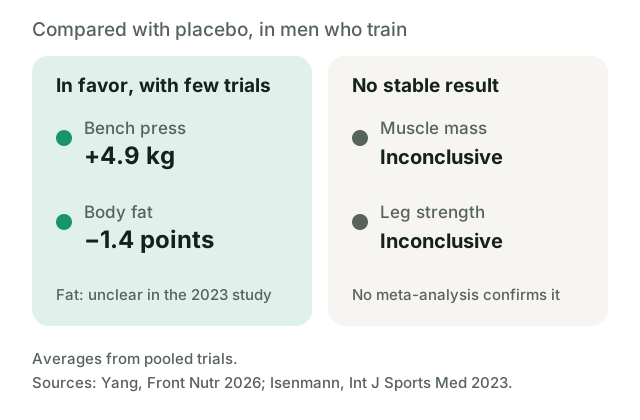
To put it in perspective: if two people train the same way, the one who took fenugreek ended up, on average, about 5 kg higher on the bench press. And in body fat, on average, 1.4 points lower than someone who trained without it; for example, 18.6% instead of 20%. These are small differences, on top of what training already gives you.
Does fenugreek work like an anabolic?
That has not been shown. The 2023 meta-analysis concluded that fenugreek has an "anabolic" and performance-enhancing effect in male athletes [2]. But in its own results for lean mass, fat, and leg strength, the margin of error includes the possibility of no effect at all [2]. The authors describe all those effects as small [2].
That is why it is best not to call it an anabolic: at most, it might give a small boost. And that study does not allow any conclusions about women who train [2].
Does fenugreek raise testosterone in men who train?
A little, according to the studies, but with a lot of uncertainty. In athletes, the 2023 meta-analysis found a small effect on total testosterone, and on free testosterone another small effect whose margin of error includes zero [2]. The 2026 one, in adult men in general (not just athletes), found something similar and rated the certainty of the evidence as very low [1].
Also, getting better at the gym does not prove that testosterone went up: the authors of the 2026 meta-analysis warn that an improvement in performance or body composition should not be read as proof that free testosterone went up [1]. I explain it in Fenugreek and testosterone: what the science says.
What dose of fenugreek was used in the studies?
Most trials in the 2026 meta-analysis used 500 to 600 mg a day of extract for 8 to 12 weeks [1]. But each product is different, so you cannot assume that the dose of one works for another [1].
How reliable are the studies on fenugreek at the gym?
Not very, for several reasons:
- They are few and small, and the muscle and strength results are not stable [1, 2].
- The company that makes or sells the product was often involved [1].
- They were done in men who were following a training program, so we do not know what happens if you do not train [1].
Is it safe to take fenugreek if you train?
In the trials in men there were no serious side effects, but they were short, so we do not know what happens when it is taken for a long time [1]. It can interact with warfarin and cause bleeding [3], and together with diabetes medications it can lower blood sugar too much [4]. People who are allergic to chickpeas or peanuts may also react to fenugreek [3]. I explain it in Is fenugreek safe? Side effects and interactions.
No supplement replaces training, diet, and rest. If fenugreek helps, it is with a small boost.
When should you see a doctor before taking fenugreek for the gym?
Talk to your doctor if:
- you take anticoagulants or diabetes medications;
- you are allergic to chickpeas, peanuts, or other legumes;
- you think your testosterone is low: the diagnosis is made from your symptoms, a physical exam, and tests that show it is clearly and repeatedly low, not from your response to a supplement [1].
Key takeaways
- In men who were training, fenugreek gave on average about 5 kg more on the bench press and 1.4 points less fat than a placebo, with few trials.
- Muscle mass and leg strength did not change clearly.
- It has not been shown to work like an anabolic: the effects are small and the evidence is of low quality.
- It was studied in men who were training; we do not know what happens without training.
Frequently asked questions
Will fenugreek make me gain muscle? There is no clear increase in muscle mass in the studies [1, 2].
Does fenugreek work for women who train? We do not know: the 2023 meta-analysis does not allow conclusions in women [2].
How long was it taken in the studies? For 8 to 12 weeks in most of them; we do not know what happens when it is taken for longer [1].