
In short: when an enlarged prostate keeps the bladder from emptying completely, the urine that stays behind can form stones inside the bladder [1]. They can cause pain when urinating, a stream that suddenly stops, repeated infections or blood in the urine. The usual approach is to remove the stone through the urethra, without incisions, when possible [2]. But the stone is the consequence: if the blockage remains, it is more likely to form again [3, 4]. That is why, when stones keep coming back, the guidelines recommend operating on the prostate too [1].
When we hear "urinary stones," almost everyone thinks of the kidneys. But what many people do not know is that stones can also form inside the bladder, and that an enlarged prostate can have a lot to do with it.
Can stones form in the bladder?
Yes. They are less common than kidney stones: bladder stones make up about 5 out of every 100 stones in the urinary tract [2]. And most of them appear in adult men whose bladder outlet is blocked [5], as happens when the prostate grows.
Why does an enlarged prostate cause bladder stones?
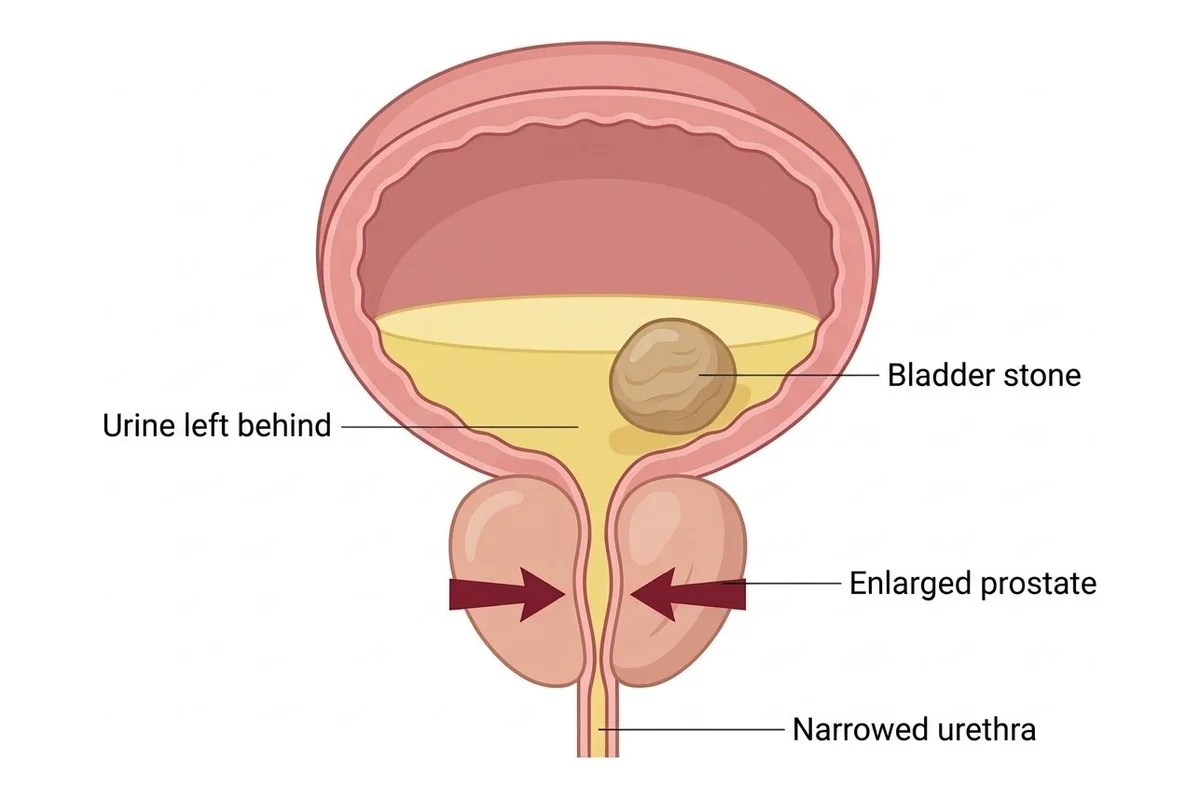
The prostate sits just below the bladder and surrounds the urethra, the tube urine flows out through. Picture it as a donut with a drinking straw through it: the donut is the prostate and the straw is the urethra. Over the years the prostate grows, and if the donut gets thicker, the straw gets squeezed.
When the outlet narrows, the bladder often cannot empty completely: a little urine always stays inside, and that urine remains there longer than it should. According to the American guideline, bladder stones that keep coming back are thought to be due to exactly that: the bladder not emptying and urine persistently staying behind [1].
How does the stone form?
You have probably seen what happens in a kettle, a coffee maker or a showerhead: over time, mineral deposits appear, thin layers that slowly build up.
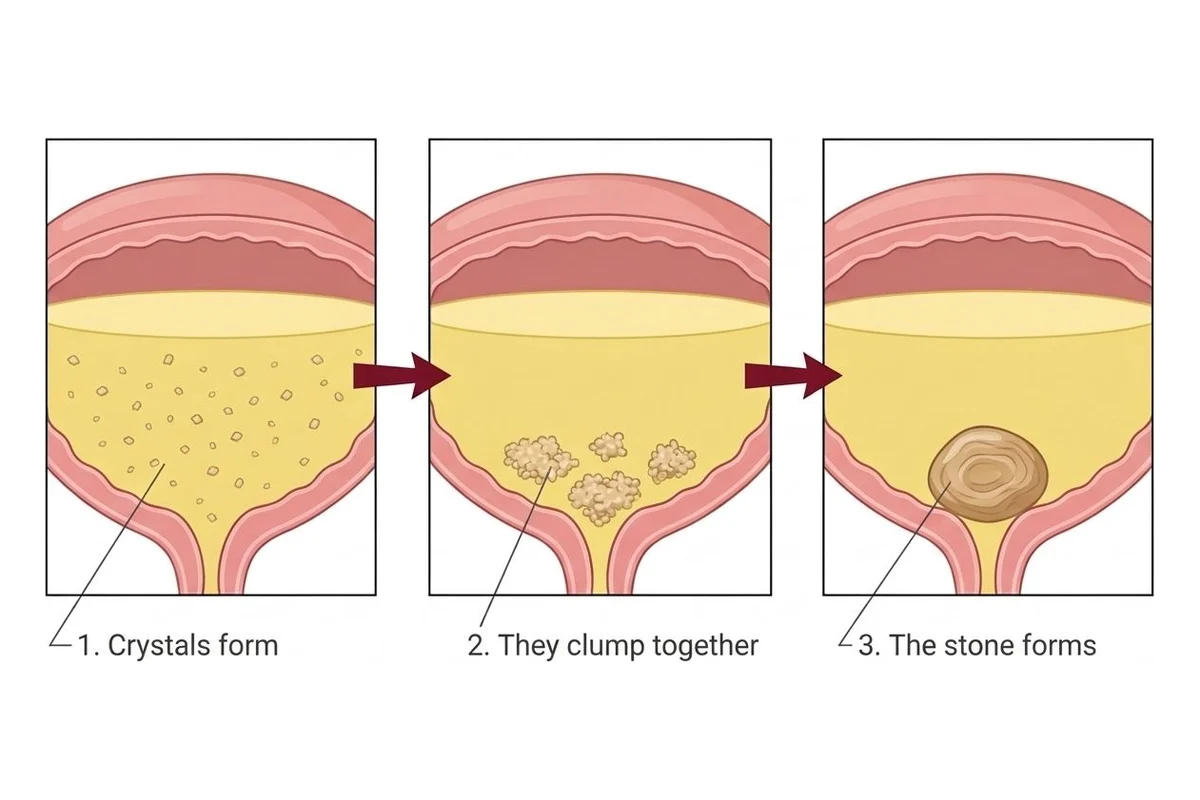
Something similar can happen in the bladder. Urine contains minerals, salts and other dissolved substances. As long as it flows in and out normally, everything stays in balance. But when it sits stagnant for a long time, those substances can start to separate out of the urine:
- First, tiny crystals form.
- Then, those crystals clump together.
- Over time, they form a stone inside the bladder.
What symptoms does a bladder stone cause?
It can cause:
- pain when urinating;
- a stream that suddenly stops;
- repeated urinary tract infections;
- blood in the urine.
Several of these symptoms can also be due to other causes, so it is a good idea to have a doctor check them.
How is a bladder stone removed?
A review by the European Association of Urology gathered the studies on the treatment of bladder stones and concluded [2]:
- The first option in adults, when possible, is to remove it through the urethra, without incisions in the skin [2].
- Treatments through the urethra or through a small puncture seem to be as effective as open surgery, and with them the time with a catheter and the recovery seem to be shorter [2].
- Breaking up the stone from outside the body with shock waves, as is sometimes done with kidney stones, seems to be less effective [2].
If the prostate also needs surgery, the stone can be removed in the same operation; its size and number influence which type of surgery is most suitable [1].
If my bladder stone is removed, can it come back?
Yes, especially if the blockage is still there. The stone is the consequence; the underlying problem is the prostate that keeps the bladder from emptying. If only the stone is removed and urine keeps staying behind, another one is more likely to form.
Two recent reviews by a European Association of Urology group gathered the available studies, almost all of them observational [3, 4]:
- When the stone was removed and the prostate was also operated on, the stone came back in 5 out of every 100 men or fewer; when only the stone was removed, in 10 to 25 out of every 100. The difference began to show after 2 or 3 years [4].
- Operating on both at the same time reduced recurrences and improved urinary symptoms more, although it had more minor complications; no difference was seen in serious ones [3].
- Of the men who had only the stone removed, between 10 and 41 out of every 100 later needed prostate surgery [3].
Do I need prostate surgery if I have a bladder stone?
It depends. The guidelines consider bladder stones a reason for prostate surgery: the American guideline recommends surgery when stones keep coming back because of the prostate [1], and the European guideline includes them among the reasons that usually make the operation necessary [6].
But the most recent studies show that not every man with a stone needs prostate surgery at that moment. Most of those who had only the stone removed did not later need prostate surgery, which is why the authors do not recommend operating on it routinely in everyone [4]. Surgery for both is recommended in selected cases, when the stone is due to the prostate and there is a blockage [3].
In practice, it is decided case by case. Factors include, for example, the size of the prostate, how much urine stays in the bladder and what you prefer [4]. If stones come back, the recommendation for surgery is clear [1].
When should I see a doctor about a bladder stone?
Talk to your doctor if:
- you see blood in your urine;
- your stream suddenly stops while you are urinating;
- you have urinary tract infections that keep coming back;
- you were told that urine stays in your bladder after you urinate.
If you cannot urinate at all and your lower belly hurts, get care right away. If you have fever and chills with discomfort when urinating, get care that same day.
Urine that stays in the bladder also makes infections more likely: I explain it in Recurrent urinary tract infections in men: when it's the prostate. And if one day you cannot urinate, in Can't urinate: what to do and what happens after the catheter I explain what comes next.
Key takeaways
- Stones also form in the bladder, and most appear in men whose bladder outlet is blocked, as happens with an enlarged prostate.
- They form in the urine that stays behind: first crystals, then clumps and finally a stone.
- They can cause pain when urinating, a stream that suddenly stops, repeated infections or blood in the urine.
- The usual approach is to remove the stone through the urethra, without incisions.
- If the blockage remains, the stone can come back; when stones keep coming back, the guidelines recommend operating on the prostate too.
Frequently asked questions
Can the stone be removed and the prostate operated on in the same surgery? Yes. The stone can be removed in the same operation as the prostate [1]. Doing both at the same time reduces recurrences, although it has more minor complications [3].
Can it be broken up with shock waves, like kidney stones? It can, but it seems to be less effective than removing it through the urethra [2].