
In short: in men, urinary tract infections are not that common, so when they keep coming back there is almost always something behind them. Often it is the prostate: if it narrows the outlet, the bladder does not empty completely, and the urine that stays behind helps bacteria grow [1]. An antibiotic cures each infection, but it does not correct that cause. That is why, when infections keep coming back because of the prostate, the guidelines recommend surgery [1]: once the blockage is removed, the bladder can empty almost completely and the risk of new infections goes down [1].
Many men believe urinary tract infections are a women's problem. If you have already had one, and then another, you are probably wondering why it is happening to you and whether it will keep happening.
Is it normal for a man to get urinary tract infections?
They are not common. In a study from the Netherlands, there were about 6.5 urinary tract infections without fever per 1,000 men per year, and they became more frequent with age [2].
That is why, when a man starts getting infections again and again, we doctors suspect that something is not adding up. In men, urinary tract infections often appear because something in the urinary tract is making them more likely, and after age 50 one of the most common causes is an enlarged prostate [3].
At first it may be an isolated episode. But when they keep coming back (once, twice, three times in a year), it is no longer bad luck: something is making them happen.
What does the prostate have to do with urine infections?
You have probably seen a puddle that has not moved for days, or an abandoned swimming pool where the water starts to smell bad. When water stops flowing, it stagnates and goes bad. Something very similar happens in the body when a fluid cannot drain well.
Every time you urinate, the bladder empties and the stream flushes out any germs that may be there. It is like turning on the faucet and letting water run through a pipe: as long as the water flows, the pipe stays clean. But that only works if the bladder empties completely.
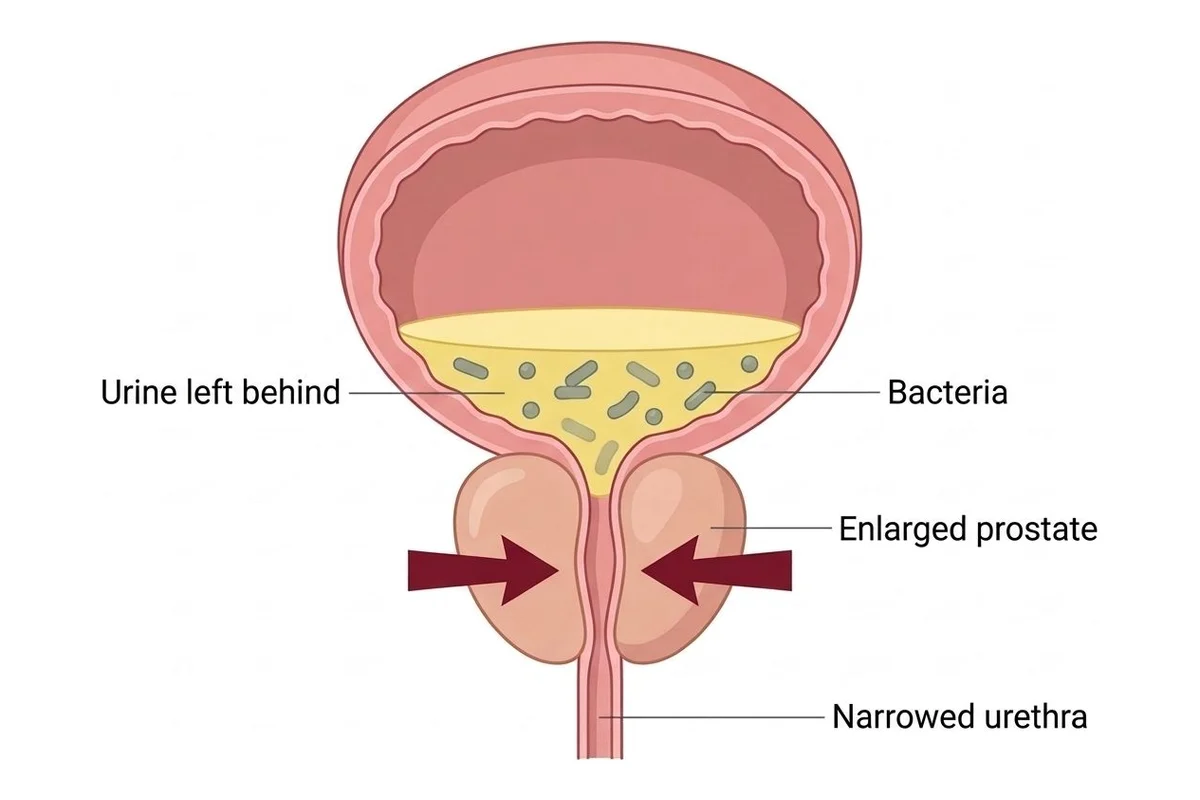
This is where the prostate comes in. It sits just below the bladder and surrounds the urethra, the tube urine flows out through. Picture it as a donut with a drinking straw through it: the donut is the prostate and the straw is the urethra. Over the years the prostate grows, and if the donut gets thicker, the straw gets squeezed.
When the outlet narrows, the bladder often cannot empty completely and a little urine always stays inside. This is called residual urine. That leftover urine becomes a breeding ground for bacteria: they are not flushed out, they stay there, they multiply and, sooner or later, an infection appears.
How much residual urine is too much?
There is no exact number. The European guideline notes that the maximum acceptable amount is not known, but that, in men who always have urine left over, more than 300 milliliters increases the risk of infection [4].
Can the prostate itself get infected?
Yes, and it is worth telling apart, because it is treated differently:
- Acute prostatitis. It is a urinary tract infection that reaches the prostate and usually causes fever or chills [5]. It is treated with antibiotics for 2 to 4 weeks [5].
- Chronic bacterial prostatitis. It is an infection that stays inside the prostate and usually causes repeated urinary tract infections with the same bacteria [5]. It needs longer treatment: at least 4 weeks of antibiotics [5].
Note: not all urinary tract infections that keep coming back in men are due to an enlarged prostate. They can also be due, for example, to bacterial prostatitis or kidney stones [1]. That is why each case has to be investigated before deciding on treatment.
What tests do I need if I have recurrent urinary tract infections?
After a urinary tract infection in a man, it is worth looking for the cause [3]. The basics are:
- a careful medical history, with questions about how you urinate and whether you have seen blood in your urine [3];
- a urinary symptom questionnaire (the IPSS) [3];
- an ultrasound of the urinary tract that measures how much urine stays in the bladder after you urinate [3].
In some cases the prostate is also checked with a digital rectal exam, but it is not always essential.
Some findings may call for more tests, for example: infections that keep coming back, more than 100 milliliters of urine left in the bladder, a past kidney infection, retention or visible blood in the urine, moderate to severe symptoms, being younger than 40, or an ultrasound that shows something abnormal [3]. That is why it is always important to be evaluated by a doctor.
An important detail: measuring prostate-specific antigen (PSA) routinely after an infection is not recommended. A prostate infection can raise it even when there is no cancer, and it can stay high for up to three months [3]. If it is measured during that time, the result could frighten you for no reason.
Why does the urinary tract infection come back after antibiotics?
Many men get caught in a frustrating cycle: infection, antibiotic, improvement. A few months go by and the infection comes back.
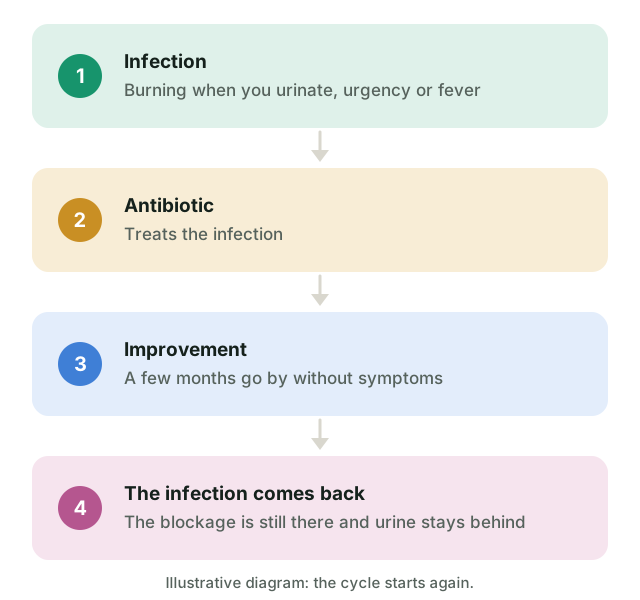
The problem is that the antibiotic treats the infection, but it does not correct what is making it happen. The prostate blockage is still there, urine keeps staying behind and bacteria once again find a place to grow.
If bacteria show up in my urine but I have no symptoms, should I take antibiotics?
Usually, no. The Infectious Diseases Society of America guideline does not recommend giving antibiotics for bacteria in the urine without symptoms in older men, or in people with diabetes or with a catheter [6]. Treating them when it is not needed helps bacteria become resistant to antibiotics [6]. The exception is before an invasive procedure on the urinary tract, such as surgery [6].
What matters are infections with symptoms: burning, urgency, fever. Those are the ones that, if they keep coming back, make it necessary to look for the cause.
When is prostate surgery done for urinary tract infections?
When infections keep coming back and the cause is the prostate, the American guideline recommends surgery [1], and the European guideline includes it among the reasons that usually make the operation necessary [4]. Not only so that the stream flows better, but to remove what is making the infections keep appearing.
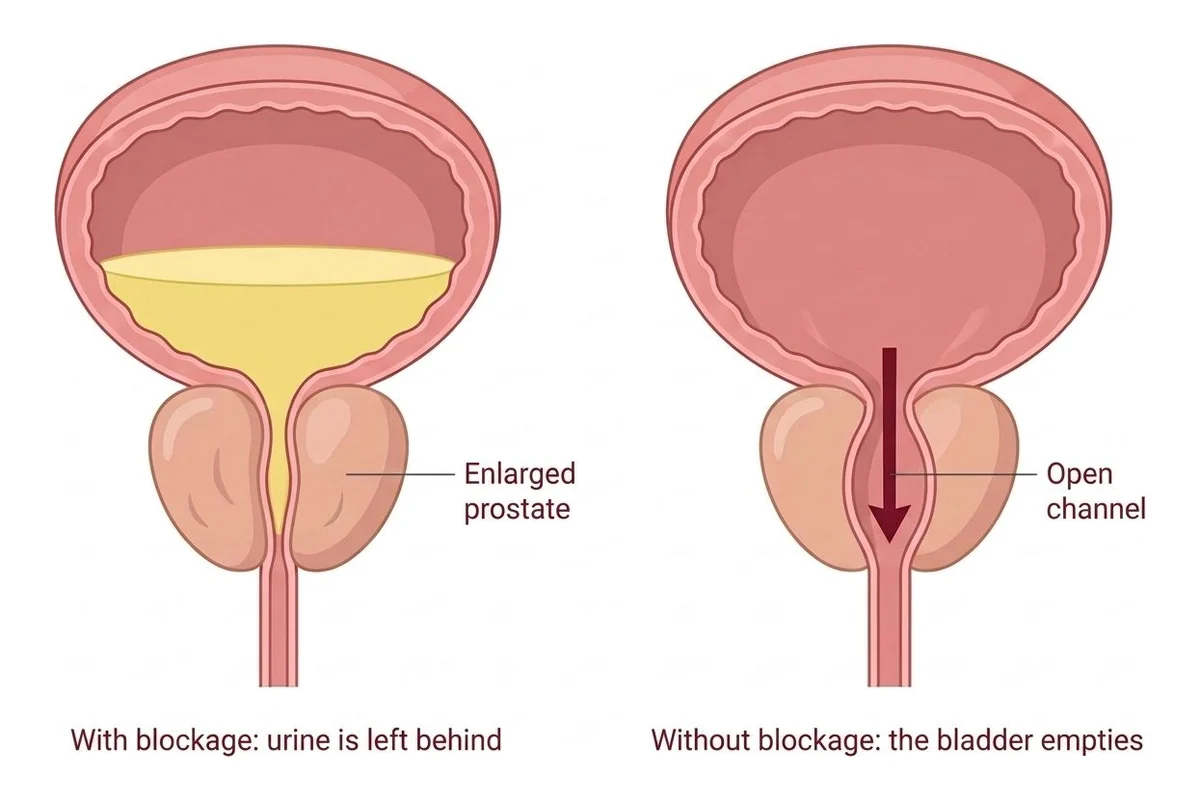
The idea is simple: once the blockage is removed, if the bladder muscle contracts well, the bladder can empty almost completely, and that lowers the risk of new infections [1].
Two clarifications:
- Having residual urine is not, by itself, a reason for surgery [1]. What tips the balance are complications, such as infections that keep coming back.
- The cause has to be confirmed first. If the infections come from something else, such as bacterial prostatitis or kidney stones, the guideline does not attribute them to the urine that stays behind [1]. Chronic bacterial prostatitis, for example, is treated with antibiotics for at least 4 weeks [5].
When should I see a doctor for a urinary tract infection?
Talk to your doctor if:
- you have had a urinary tract infection and no one has looked for the cause, or you have had more than one [3];
- you have seen blood in your urine [3];
- along with the infections, you urinate with a weak stream, have to strain or feel that you do not empty well;
- you were told that urine stays in your bladder after you urinate.
If you have a urinary tract infection with fever and chills, get care that same day. If you cannot urinate at all and your lower belly hurts, get care right away.
If you want to know what happens when the bladder fills up and nothing comes out, I explain it in Can't urinate: what to do and what happens after the catheter. And if urine stays behind for a long time, it can also affect the kidneys: I explain it in Can an enlarged prostate damage the kidneys?.
Key takeaways
- In men, urinary tract infections are not common: if they appear, the cause should be looked for, and after age 50 it is often the prostate.
- An enlarged prostate can keep the bladder from emptying completely, and bacteria can grow in the urine that stays behind.
- An antibiotic cures each infection, but it does not correct the blockage; that is why they come back.
- Bacteria in the urine without symptoms are usually not treated.
- When infections keep coming back because of the prostate, the guidelines recommend surgery so that the bladder can empty.
Frequently asked questions
Does a urinary tract infection increase the risk of prostate cancer? No link has been found between a first urinary tract infection in a man and prostate cancer [3]. What can happen is that the infection raises prostate-specific antigen, which can stay high for up to three months [3]; I explain it in PSA test: when to get it and how to read the result.
Is burning when I urinate always a urine infection? Not always. In men it can also be due to inflammation of the urethra or to prostatitis [7]. That is why it is better to have a doctor examine you instead of taking antibiotics on your own.
Is an infection with fever more serious? Yes. Fever or chills can mean the infection has reached the prostate, and in that case treatment is longer [5]. Get care that same day.