
In short: intravesical prostatic protrusion is a part of the prostate, the middle lobe, that grows upward and pushes into the bladder, right at the urine outlet. It is measured with an ultrasound over the abdomen and classified into three grades: less than 5 mm, 5 to 10 mm, and more than 10 mm [1]. It matters because it is linked to obstruction more closely than prostate size is [2, 3], because with protrusion pills seem to work less well [2], and because, after urinary retention, few men with grade III manage to urinate when the catheter is removed [2]. Pills shrink the prostate, but that part barely changes; that is why surgery is sometimes the best path.
If your ultrasound report said "grade II intravesical protrusion" or "prominent middle lobe" and you don't know what it means, here is the explanation. And also the answer to a very common question: "Doctor, the pill did shrink my prostate, so why am I still urinating just as poorly?"
What is intravesical prostatic protrusion?
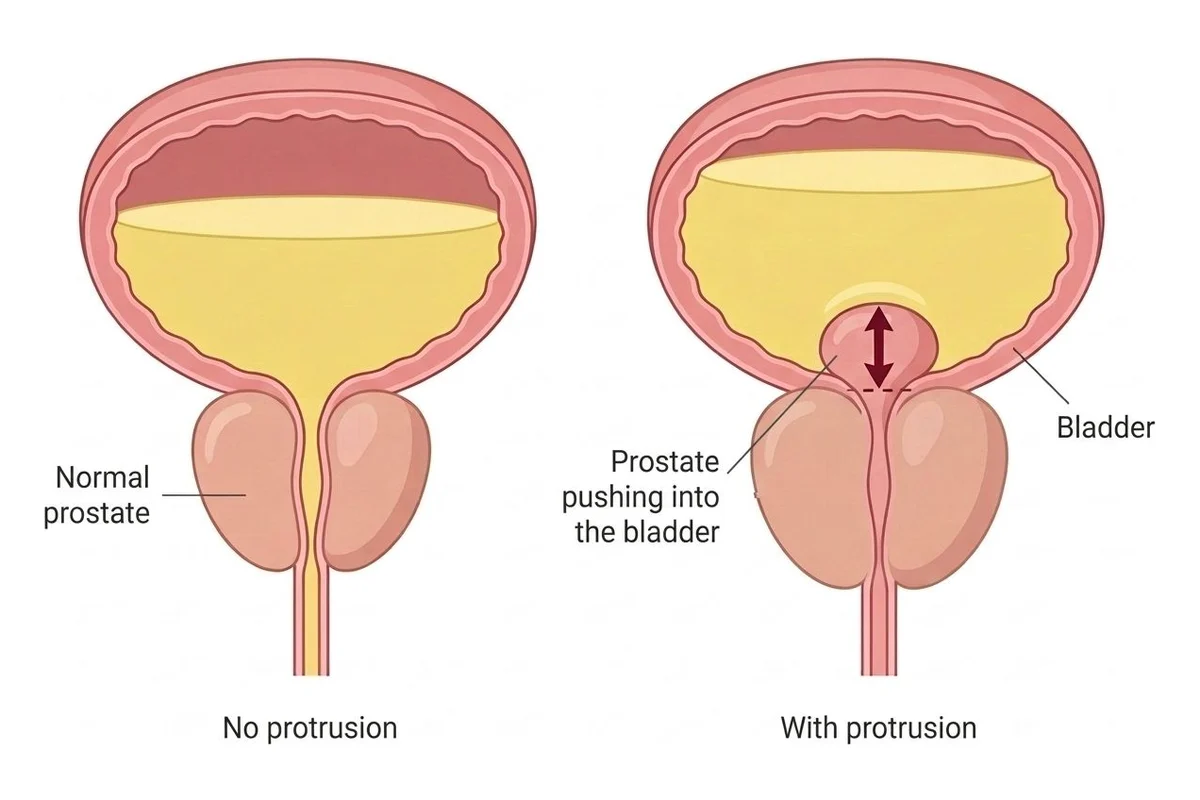
The prostate does not always grow evenly. In some men, one part grows inward, pushing into the bladder right at the urine outlet. That is called intravesical prostatic protrusion: "protrusion" because it sticks out, and "intravesical" because it ends up inside the bladder. The part that usually grows this way is the middle lobe of the prostate [1].
Imagine your bladder is a bottle and the prostate is the neck of that bottle, where the liquid comes out:
- When the prostate grows evenly, it is as if the walls of the neck got thicker: the passage narrows, but the liquid still finds a way out. This case usually responds well to pills.
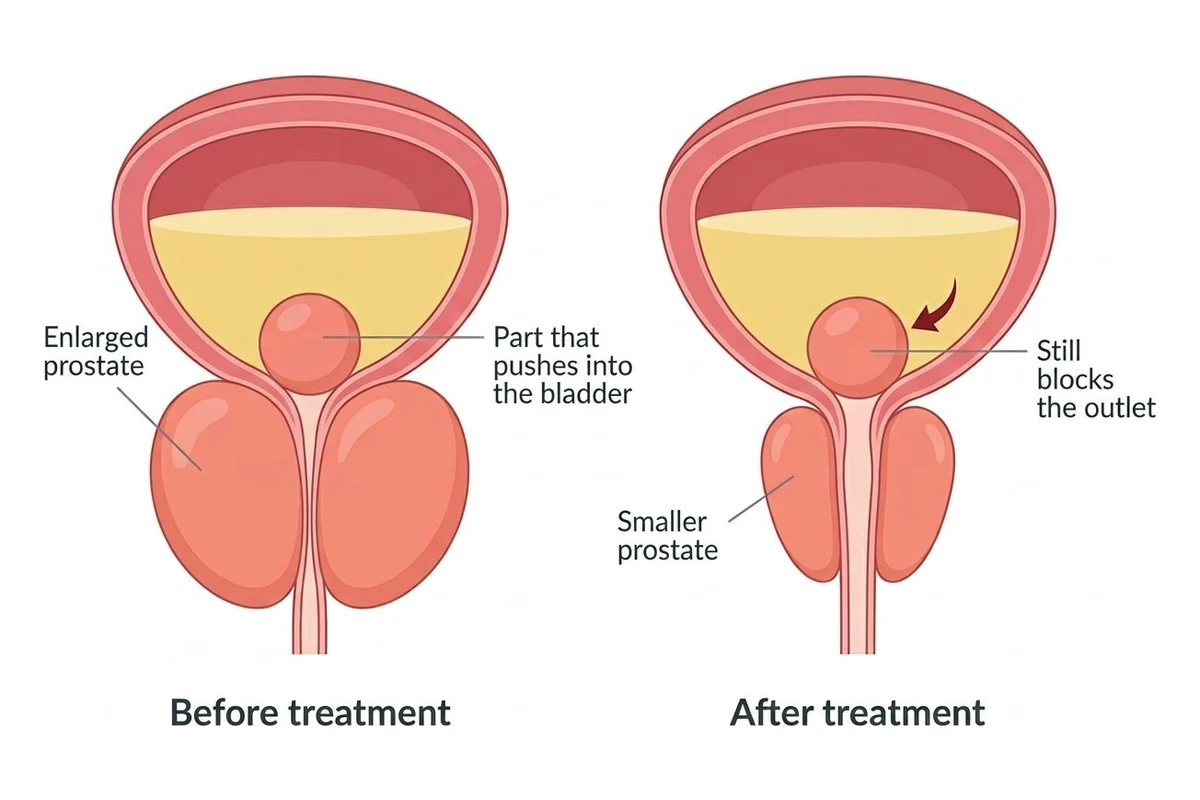
- Protrusion is something else. It is as if a piece of the prostate had turned into a cork that pushes into the bottle and sits right over the outlet hole. No matter how much you thin the walls of the neck, the cork is still there, plugging it.
How is intravesical prostatic protrusion measured?
With an ultrasound over the abdomen, with no needles or catheters [1]. The distance is measured between the tip of the part that sticks out and the bladder neck, where urine leaves the bladder [1]. In most studies it is done with the bladder half full, with about 150 to 250 mL of urine [2].
Depending on how many millimeters it sticks out, it is classified into three grades [1]:
| Grade | How far it sticks out | What it means |
|---|---|---|
| I | Less than 5 mm | Mild: it barely shows |
| II | 5 to 10 mm | Intermediate: it is starting to get in the way |
| III | More than 10 mm | Large: more than a centimeter pushed into the bladder outlet |
An honest detail: it is still not well known how much the measurement changes depending on who does the ultrasound [1]. That is why it is best assessed together with everything else.
Why does intravesical prostatic protrusion matter?
Because, in a man with an enlarged prostate, what best predicts whether the problem will get in the way is not just how big it is: it is its shape, and above all the direction it grew in.
- It is linked to obstruction. The European guideline notes that protrusion correlates well with obstruction [1], although as a test it is not perfect: some men with obstruction don't have it, and its role is still being studied [1].
- It predicts better than size. An analysis that pooled 18 studies with 4,128 men found that, in the studies that compared both, protrusion identifies who has obstruction better than prostate volume does [3].
That is why the ultrasound should not only say how many milliliters your prostate measures, but also whether there is protrusion and what grade it is.
Does prostate medication work if you have intravesical protrusion?
It seems to work less well, and protrusion really starts to get in the way from grade II on. This is what a systematic review found [2]:
- With the ones that relax the prostate (alpha-blockers), such as tamsulosin: with a protrusion of more than 10 mm, the improvement seems smaller.
- With the ones that shrink it (finasteride and dutasteride): in two studies, having protrusion was linked to more treatment failure, more urinary retention, and more surgery.
- Over time: in one study, at almost 3 years, men with grade II or III had a higher risk of the problem progressing than those with grade I.
In grade III, improvement with pills is usually smaller and it is more likely that they will not be enough. There are few studies and they differ from one another [2], so they do not allow us to know this in advance for each man.
Why does the prostate shrink with the pill but the protrusion doesn't?
This is the most confusing part, even for the man who does everything right. He takes his finasteride or dutasteride without missing a dose, for months. The ultrasound is repeated and, sure enough, the prostate has shrunk. But he is still urinating just as poorly.
The explanation lies in the type of tissue:
- Finasteride and dutasteride act on the glandular part of the prostate, the "soft" part, which shrinks when you cut off its fuel [1].
- The cork is made of something else: it has much more muscle and fibrous tissue, tougher. The medication does almost nothing to that tissue.
That is why the prostate gets smaller overall, but the plug at the outlet is still there, obstructing. In that man, the problem was not only the size of the prostate: it was also its shape. If you want to understand how these pills work, I explain it in Can the prostate shrink without surgery? Finasteride and dutasteride.
Intravesical protrusion and urinary retention: will you be able to get the catheter out?
This is where the shape of the prostate matters most. Imagine a man who one day could not urinate at all and had to have a catheter placed. The time comes to remove it to see whether he can now urinate on his own:
- With a protrusion of less than 10 mm, about 8 out of 10 managed to urinate on their own, in studies of men after a first episode of retention gathered in a review [2].
- With more than 10 mm (grade III), only 13% and 18% managed it in two studies [2]: just 1 or 2 out of 10.
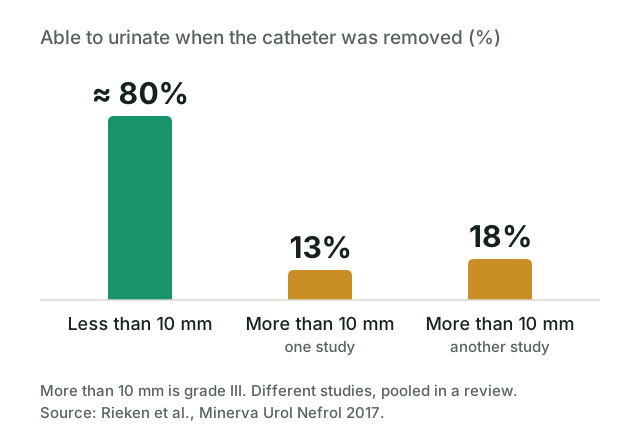
The European guideline also recognizes that protrusion seems to predict whether the catheter can be removed [1]. And the review recommends that, after retention, men with more than 10 mm be told about the high likelihood of needing surgery [2]. It is not a minor detail: it is what decides whether you get free of the catheter or stay stuck with it. If you are going through that, I explain what comes next in I can't urinate: what to do and what happens after the catheter.
What is done if you have grade III intravesical protrusion?
It is assessed calmly, together with everything else: your symptoms, how well you urinate, how much urine is left in your bladder, and how you responded to medication. Telling apart a prostate that grew evenly, which usually responds to pills, from one with a cork at the outlet is exactly what decides whether your path is medication alone or whether you will need something more.
And if you are told that the best option is surgery, don't see it as a punishment. Prostate surgery, when it is the right choice, is one of the most effective and lasting ways to relieve the obstruction: it gives many men back the ability to urinate normally after years of struggling, and it prevents more serious complications. It is not the failure of treatment; it is another tool, and often it is the one that truly solves the problem.
And what you have taken until now was not wasted: finasteride and dutasteride, taken beforehand, help the surgery done from inside the urethra bleed less [4]. I explain it in Can the prostate shrink without surgery? Finasteride and dutasteride. And if you are on combination therapy and wonder which pill is which, I explain it in Tamsulosin and finasteride together: when combination therapy makes sense.
What is still unknown about intravesical prostatic protrusion
- There are few studies, and they differ from one another: they use different designs and don't always measure protrusion the same way [2].
- The measurement depends on who does it: it is still not known how much it varies from one person to another [1, 2].
That is why protrusion is not a sentence. It is a very useful sign that helps you know what to expect from medication and not to put up with symptoms longer than necessary when it isn't working.
When should you see a doctor about intravesical prostatic protrusion?
Talk to your doctor if:
- your ultrasound says you have intravesical protrusion, especially grade II or III;
- you have been on medication for months and are still straining, with a weak stream or getting up several times at night;
- you had urinary retention and a catheter was placed;
- you were told that a lot of urine stays in your bladder after you finish.
Don't wait if you suddenly cannot urinate at all, if you see blood in your urine, if you keep getting urinary tract infections, or if you feel you never empty completely. Any of these signs deserves a prompt evaluation.
Key takeaways
- Intravesical protrusion is a part of the prostate that pushes into the bladder, right at the urine outlet, like a cork.
- It is measured with an ultrasound over the abdomen: grade I less than 5 mm, grade II 5 to 10 mm, grade III more than 10 mm.
- It is linked to obstruction more closely than prostate size, and with more protrusion pills seem to work less well.
- The pill shrinks the prostate, but the cork barely changes.
- With grade III, few men manage to get the catheter out after urinary retention; surgery is often the best path.
Frequently asked questions
Is intravesical protrusion cancer? No. It is a way the prostate grows, inward into the bladder. Having a large prostate is not the same as having cancer; I explain it in Can an enlarged prostate turn into cancer?.
Should I worry about grade I protrusion? Grade I is mild: it barely shows [1]. Studies link grades II and III to a higher risk of the problem progressing [2]. Talk it over with your doctor along with your symptoms.
Can protrusion be measured without an ultrasound? Usually not: it is measured with an ultrasound over the abdomen, which doesn't hurt and doesn't require needles [1]. Ask your doctor whether it was measured on your ultrasound.