
In short: yes. Finasteride and dutasteride are the only medications that truly reduce the size of the prostate: by 18% to 28% [1]. That's why, unlike tamsulosin, they cut the risk of urinary retention in half, and also the risk of ending up in surgery [1]. But they come with rules: they work mainly when the prostate is truly enlarged (more than about 40 mL), they take at least six months to make a difference [1], and they work only as long as you take them.
Were you told your prostate is enlarged, and are you wondering whether there's a way to avoid surgery? There's good news, and there's also fine print. These two pills can change the course of the problem, but only if you understand how they work and who they work for. For the wrong person, they do nothing at all and, on top of that, can cause side effects in exchange for zero benefit.
What do finasteride and dutasteride do to the prostate?
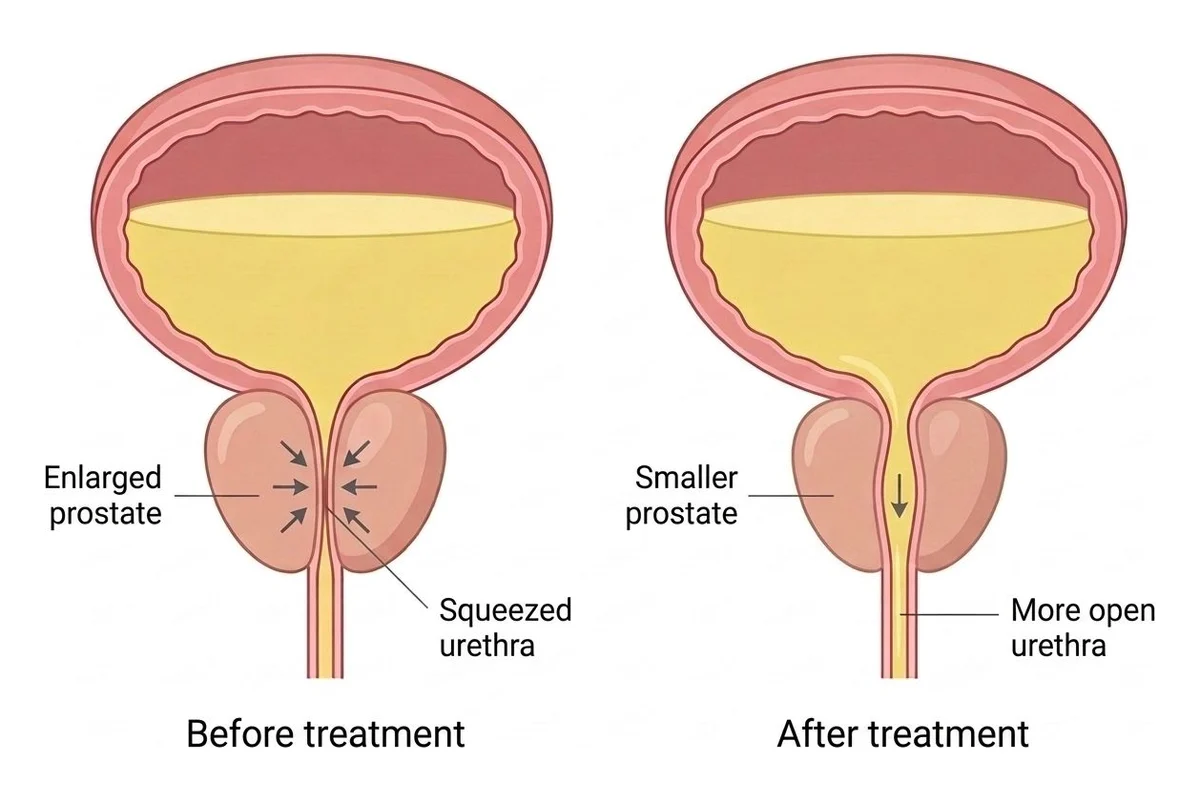
They do something the other prostate medications can't: they make it physically smaller. They don't relax it or just cover up the problem.
- In studies, the prostate shrinks by 18% to 28%: the reduction shows up after 6 to 12 months and can be even greater after years of treatment [1]. In other words, up to almost a third smaller.
- As it shrinks, it stops squeezing the urethra, the channel urine flows out through, as much.
- Less size means less obstruction, and less obstruction means less risk of a catheter and of surgery.
How much do finasteride and dutasteride lower the risk of a catheter and surgery?
Urinary retention is when the bladder fills up, you want to urinate, and nothing comes out. It's often resolved by placing a catheter: a thin tube that goes through the urethra into the bladder to empty it. If it has already happened to you, I explain what comes next in Can't urinate: what to do and what happens after the catheter.
The large studies measured it like this:
- Finasteride vs. placebo (PLESS study, 4 years): it lowered the risk of retention by 57% and the risk of surgery by 55% [1]. In absolute numbers, 10% of those who took placebo had surgery, compared with 4.5% of those who took finasteride [2].
- Tamsulosin and dutasteride together vs. tamsulosin alone (CombAT study, 4 years): the combination lowered the risk of retention by 68% and the risk of surgery by 71% [1].
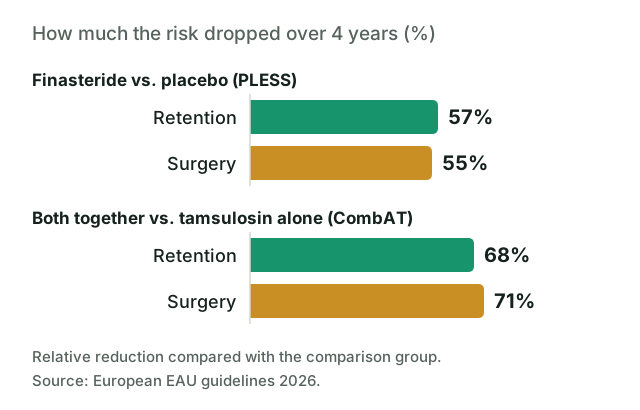
What does that "70% less surgery" mean? Imagine ten men who, taking only tamsulosin, would end up having surgery. With both pills together, about seven of those ten would avoid it. Looked at across all the men treated, and not just those who would have had surgery, the math is this: about 13 men need to be treated for four years to prevent one case of retention or surgery [1]. It's real protection that builds up over the years, not an immediate effect.
What is the difference between tamsulosin and finasteride?
Not all prostate pills do the same thing. There are two big families, and the difference worth remembering is this: one relieves and the other protects.
| Tamsulosin (and its family, the alpha-blockers) | Finasteride and dutasteride | |
|---|---|---|
| What they do | Relax the muscle of the prostate and of the bladder outlet | Reduce the size of the prostate |
| When you notice them | Within hours or days; full effect in a few weeks [1] | After at least six months [1] |
| Shrink the prostate | No | Yes, by 18% to 28% [1] |
| Lower the long-term risk of retention and surgery | No [1] | Yes [1] |
Tamsulosin helps you urinate better almost right away, and for many men it's life-changing. But it doesn't touch the size of the prostate: it makes you feel better today. Finasteride and dutasteride don't give you immediate relief, but they protect you so the problem doesn't gain ground over the years.
Can you take tamsulosin and finasteride together?
Yes, and it's one of the best medication treatments for an enlarged prostate: combination therapy. Tamsulosin brings relief from the start while finasteride or dutasteride slowly shrink the prostate, and together they protect more than either one alone [1]. It can be a single capsule that contains both medications [1]. Over time, tamsulosin is sometimes stopped; the one that protects usually stays. That decision is made with your doctor.
I explain what the studies showed, who it's for, and when tamsulosin can be stopped in Tamsulosin and finasteride together: when combination therapy makes sense.
How do finasteride and dutasteride work?
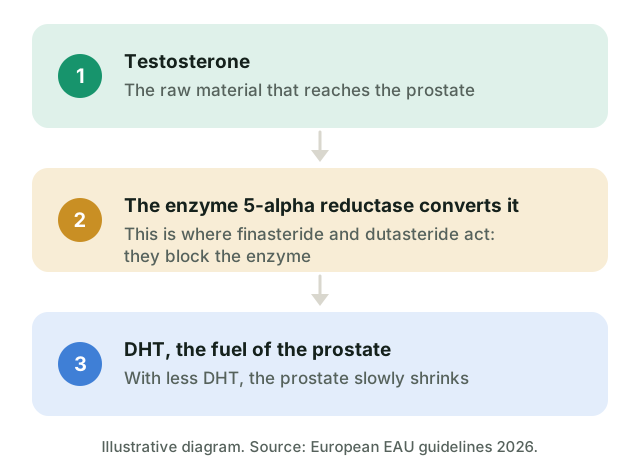
Inside the prostate, an enzyme called 5-alpha reductase converts testosterone into a more potent hormone: dihydrotestosterone, or DHT, the real fuel of prostate growth. Finasteride and dutasteride block that enzyme: DHT goes down, and the cells of the glandular part of the prostate die off in an orderly way [1]. That's why the prostate shrinks little by little.
The idea came from the Guevedoces, children in Salinas, in the Dominican Republic, who looked like girls at birth and became masculine at puberty [2]. They had an inherited defect in that enzyme, with very little DHT [3], and their prostate stayed small [2]. The full story is in How do finasteride and dutasteride work? DHT and the story of the Guevedoces.
Does finasteride lower testosterone?
No. Finasteride and dutasteride block the conversion of testosterone into DHT, but testosterone in the blood doesn't go down. Some studies saw a small increase, but when they were pooled it was neither consistent nor clear [4], and it doesn't translate into anything you'd notice.
Finasteride or dutasteride: which is better for the prostate?
For symptoms, the European guideline considers them equally effective [1]. Finasteride blocks type 2 of the enzyme, the main one in the prostate; dutasteride blocks both types and lowers DHT in the blood more [1]. Their differences, the studies that compared them, and which one makes sense depending on the size of your prostate are in Finasteride or dutasteride? The differences and which is better for the prostate.
Who do finasteride and dutasteride help?
It depends on just one thing, and it's simpler than it sounds: the size of your prostate. To shrink something, that something has to be big.
- The European guideline recommends them for men with moderate or severe symptoms and a risk that the problem will progress, for example with a prostate of more than 40 mL [1].
- With a prostate under 40 mL, finasteride may work no better than a placebo [1].
- Dutasteride seems to help even with prostates between 30 and 40 mL [1].
- To give you an idea, a young man's prostate is around 20 mL. We're talking about a gland that has already grown to double that size or more.
Imagine the urethra is a drinking straw and something is squeezing it. That something can be one of two kinds:
- An inflated balloon: the enlarged, bulging prostate. That's where finasteride and dutasteride shine, because they gradually deflate the balloon.
- A tight metal ring: a tense muscle at the bladder outlet, with a prostate that isn't that big. There's no balloon to deflate there. That man needs something that relaxes the muscle, such as tamsulosin.
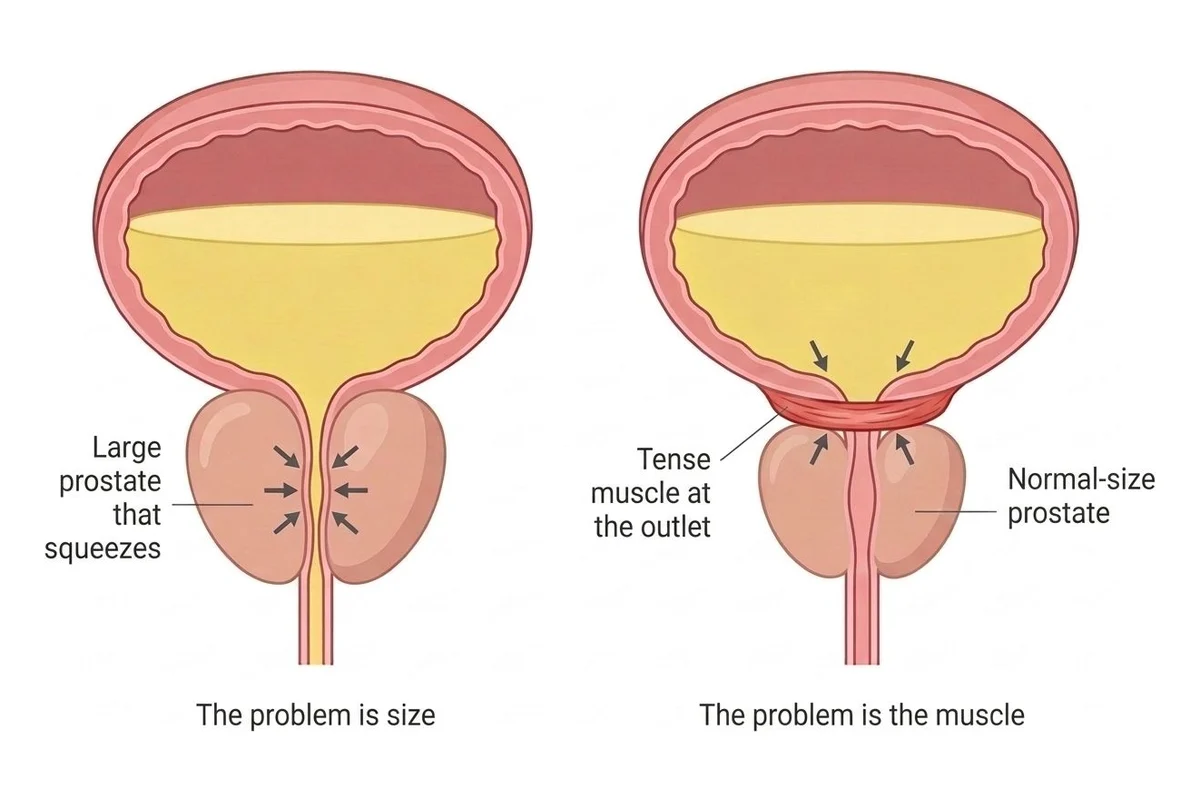
That's why one man can do great on the pill and another can get nothing from it: same pill, two different prostates.
Why does the prostate shrink with finasteride and you still urinate poorly?
Because size isn't the only thing that matters: which direction it grew in matters too. In some men, part of the prostate grows into the bladder, right at the urine outlet, like a cork plugging the neck of a bottle: this is intravesical prostatic protrusion. The pill shrinks the glandular part of the prostate [1], but that cork barely changes.
I explain what its grades mean, why the pill doesn't shrink it, and what's done about it in Intravesical prostatic protrusion: the sign that prostate pills may not be enough.
Does finasteride help before prostate surgery?
For the most common surgery, transurethral resection of the prostate (TURP), which is done from the inside, yes. Finasteride and dutasteride reduce the blood vessels of the prostate and, taken a few weeks beforehand, reduce bleeding and the need for a transfusion [5]. How much, how far ahead, and what they do when the prostate bleeds into the urine: Finasteride or dutasteride before prostate surgery: less bleeding.
So if, despite everything, you end up having surgery, the pill wasn't for nothing: it helps you get to the operating room in better shape.
Do finasteride and dutasteride affect PSA?
Yes, and it's the detail most worth knowing. PSA, or prostate-specific antigen, is a blood test that works as an early alarm for prostate cancer. These pills lower it by about half after six to twelve months [1], so your result is read multiplied by two, and any confirmed rise gets investigated [1]. Your job is simple: always tell them you take finasteride or dutasteride.
I explain how to read your result, why it's worth measuring it before you start, and what to do if it rises in Finasteride, dutasteride, and PSA: why you have to multiply it by two.
How long does finasteride take to work, and how long do you take it?
Two rules separate the man who benefits for years from the one who throws the effort away. Patience: its effect compared with placebo shows up after at least six months [1], and the maximum comes over the years; if you don't feel anything after three weeks, that's normal. Consistency: they don't cure the prostate, they control it; if you stop them, it grows back. That's why they're a treatment for years [1].
What to expect month by month, how fast the prostate grows back when you stop them, and how to stop them if you're thinking about it are in How long do finasteride and dutasteride take to work, and what happens if you stop?.
What side effects do finasteride and dutasteride have?
Like any serious medication, they have side effects. The most common ones have to do with your sex life: lower desire, erection problems and, less often, changes in ejaculation [1]. It's not a magic or harmless pill: it's a medication with big benefits and with its own considerations. That's why the decision to take it is talked over with your doctor, weighing what you gain against what you risk.
There are two more worth knowing about. In 1 to 2% of men, breast tissue grows a little or becomes tender [1]. And the European Medicines Agency warns that if you take finasteride and notice low mood, depression, or suicidal thoughts, you should stop it and seek medical care [1].
When should you see a doctor if you take finasteride or dutasteride?
Talk to your doctor if:
- you've been on treatment for more than six months and you're still urinating just as poorly;
- you want to stop the pill or the tamsulosin;
- you're going to have your PSA measured (tell them you take it);
- you notice side effects that bother you;
- you notice low mood or persistent sadness: if you have thoughts of harming yourself, stop the pill and seek care right away.
Don't wait if you suddenly can't urinate at all, if you see blood in your urine, if you keep getting urinary tract infections, or if you feel you never empty completely. Any of those signs deserves a prompt evaluation.
Key takeaways
- Finasteride and dutasteride are the only medications that shrink the prostate: by 18% to 28%.
- They lower the risk of retention and surgery; tamsulosin brings quick relief but doesn't protect in the long run. Together, they protect more.
- They work mainly when the prostate is truly enlarged (more than about 40 mL).
- They take at least six months to make a difference, and they work as long as you take them.
- They cut PSA in half: always tell them you take them.
Frequently asked questions
Is the finasteride for the prostate the same one used for hair loss? It's the same medication: DHT also plays a role in baldness, and finasteride is used at a lower dose (1 mg) to treat it [2].
Can I stop finasteride if I'm already urinating well? It's not a good idea to stop it on your own. You're urinating well thanks to it; when you stop it, the prostate grows back. Talk it over with your doctor.
Do I have to stop finasteride before prostate surgery? Quite the opposite: taking it before surgery done from the inside reduces bleeding and the need for a transfusion [5]. Your doctor will tell you what to do in your case.