
In short: prostate surgery isn't decided by the size shown on an ultrasound, but by what the blockage is doing to your body and your life. The international guidelines recommend it when the prostate damages the kidneys, when you can't urinate and the catheter can't be removed, when it causes infections, stones or bleeding that keep coming back, when medications are no longer enough, and also when you, well informed, prefer a more definitive solution [1, 2]. Outside those cases, watchful waiting or treatment with medication is usually enough.
If you were told you have a large prostate and will probably need surgery, it's normal to be full of questions. Prostate surgery isn't a bad thing: today it can greatly improve symptoms and quality of life. But to make a good decision, you first need to understand what's happening in your body.
Does having a large prostate mean I need surgery?
Not necessarily. Although, unlike other parts of the body, when it comes to the prostate, bigger isn't better.
The prostate isn't there just to keep doctors busy… or is it? It's actually a gland that makes part of the fluid in semen. It sits just below the bladder and surrounds the urethra, the tube urine flows out through. Picture it as a donut with a drinking straw through it: the donut is the prostate; the straw, the urethra. If the donut gets thicker, the straw can get squeezed.
Over the years, the prostate tends to grow (if only investments grew like that). But it's not only how much it grows that matters, but in which direction it grows:
- If it grows outward, it can become very large without squeezing the urethra. There are prostates of up to 200 grams that cause almost no symptoms.
- If it grows inward, even if it isn't that large, it narrows the tube: a weak stream, trouble starting to urinate, feeling that you don't empty well or getting up several times at night.
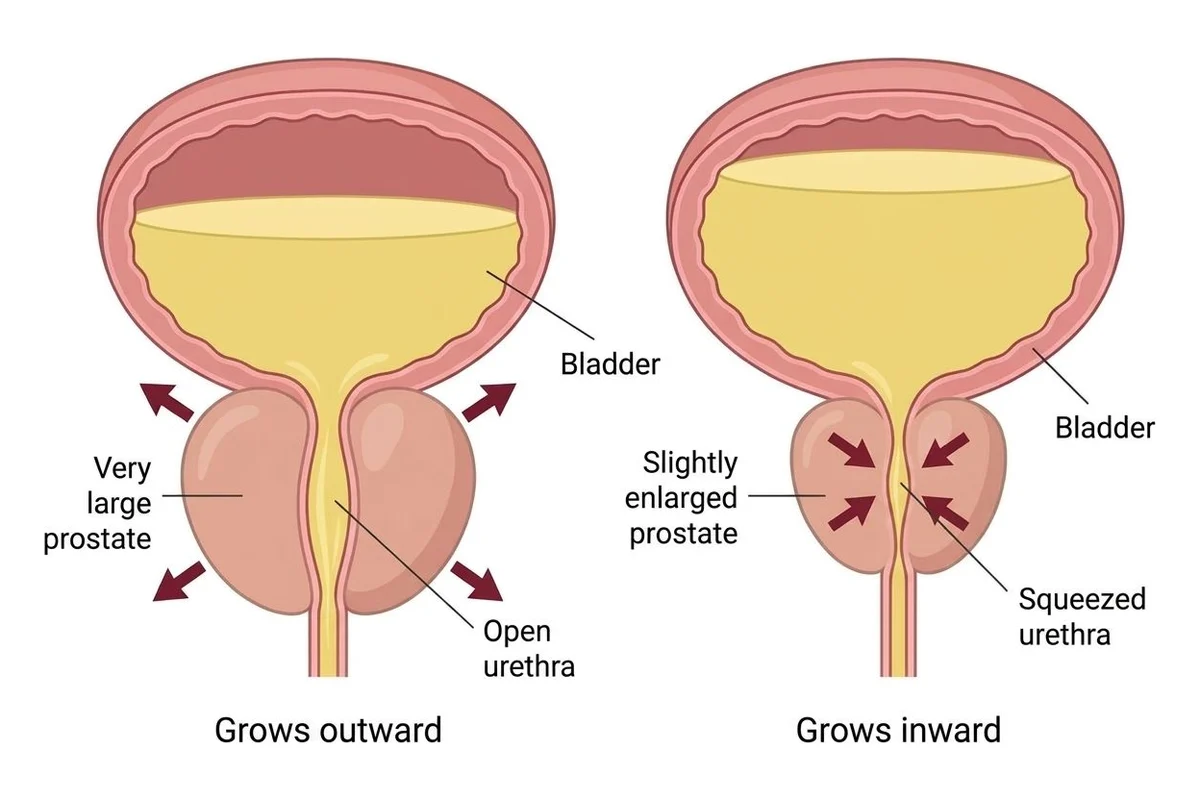
The guidelines sum it up this way: not all prostate growth makes it larger, and not every enlarged prostate blocks the flow of urine [1]. That's why size alone doesn't determine symptoms or surgery. An analysis of 18 studies with more than 4,000 men points the same way: part of the prostate pushing into the bladder was linked to blockage better than its size was [3]. I explain why it grows in Why does the prostate grow with age?
And if your symptoms don't bother you, watchful waiting, after an evaluation, is a valid option for many men: few go on to urinary retention or other complications [2].
When do the guidelines recommend prostate surgery?
This list isn't a personal opinion. It's how the two leading international guidelines, the American one [1] and the European one [2], lay it out:
| Reason for surgery | What you would notice | To learn more |
|---|---|---|
| Kidney damage from the blockage | Often nothing; it's found on a blood test or an ultrasound | The prostate and the kidneys |
| Urinary retention that keeps coming back or doesn't resolve | You can't urinate and need a catheter | Can't urinate |
| Urinary tract infections that keep coming back | Burning, fever or discomfort that returns | Recurrent urinary tract infections |
| Bladder stones, especially if they keep coming back | Pain, a stream that stops suddenly, or blood | Bladder stones |
| Visible blood from the prostate that keeps coming back or doesn't stop with medication | Pink or red urine, or urine with clots | Blood in the urine |
| Symptoms that don't improve with medication | You still strain, have a weak stream or get up at night | When medication stops working |
| Your decision, well informed | You prefer not to continue with other treatments | Further down, in this article |
The European guideline adds two situations: overflow incontinence, when the bladder is so full that urine leaks out on its own, and diverticula, pouches that form in the bladder wall [2]. A diverticulum that causes no symptoms isn't, by itself, a reason for surgery, although it's worth considering whether there's a blockage [1].
Guidelines are just that: guides. They don't replace clinical judgment or your particular situation. But they give a clear map, which we'll go through step by step.
Why is the prostate operated on when it damages the kidneys?
"How, if the prostate is down below and the kidneys are up above?" Think of the urinary tract as one continuous pipe: the kidneys make urine, the ureters carry it, the bladder stores it and the urethra is the way out. If the outlet narrows a lot and for a long time, urine backs up and the kidney swells. This is called hydronephrosis.
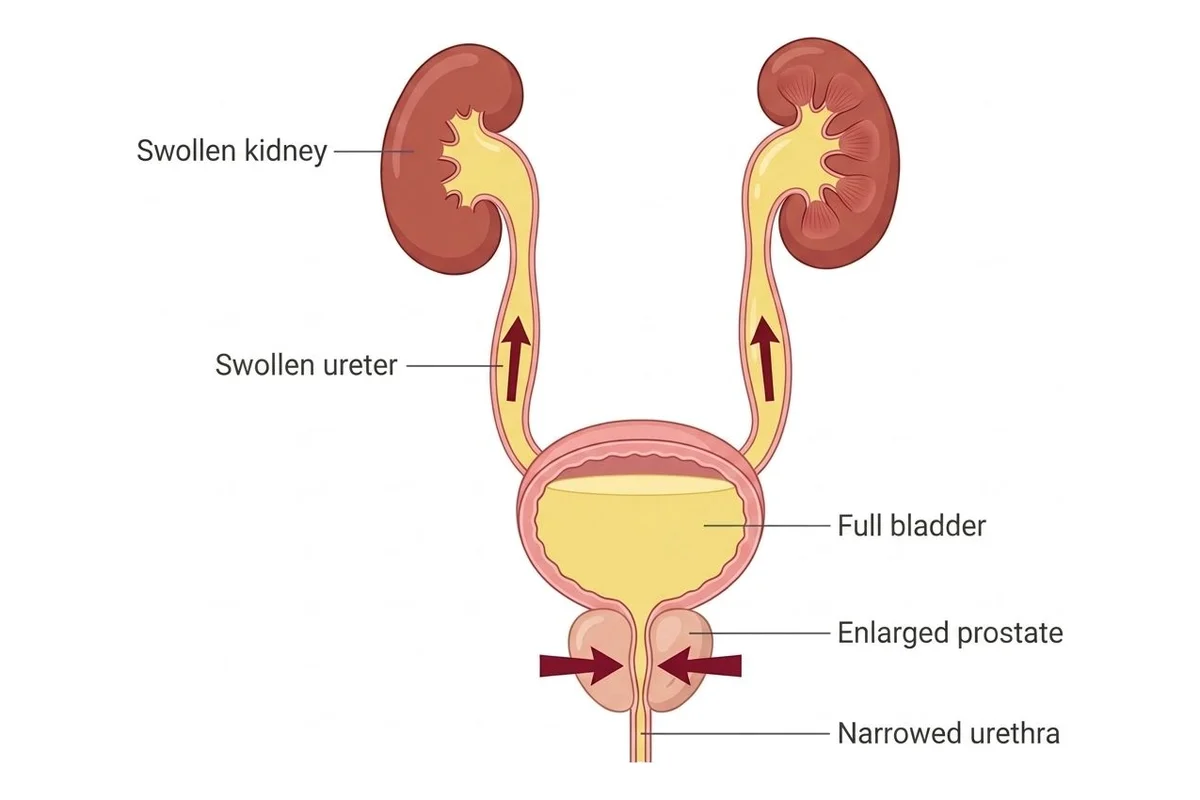
The key point is that this often doesn't hurt. That's why kidney function is measured, with creatinine or glomerular filtration rate, if kidney damage is suspected, if an ultrasound shows swelling, or before surgery [2]. Here surgery is no longer about improving the stream: it's about protecting the kidneys. And in studies, kidney function improved significantly after prostate surgery [4]. Also, when there's already kidney failure, complications after surgery are more likely [2]. I explain it in depth in Can an enlarged prostate damage the kidneys?
Why is the prostate operated on after urinary retention?
Acute urinary retention is not being able to urinate at all: the bladder is full, the lower belly hurts and nothing comes out. In men, two out of every three retentions are due to an enlarged prostate [5]. A catheter has to be placed to empty the bladder, and a few days later removal is attempted with the help of a medication that relaxes the prostate [1].
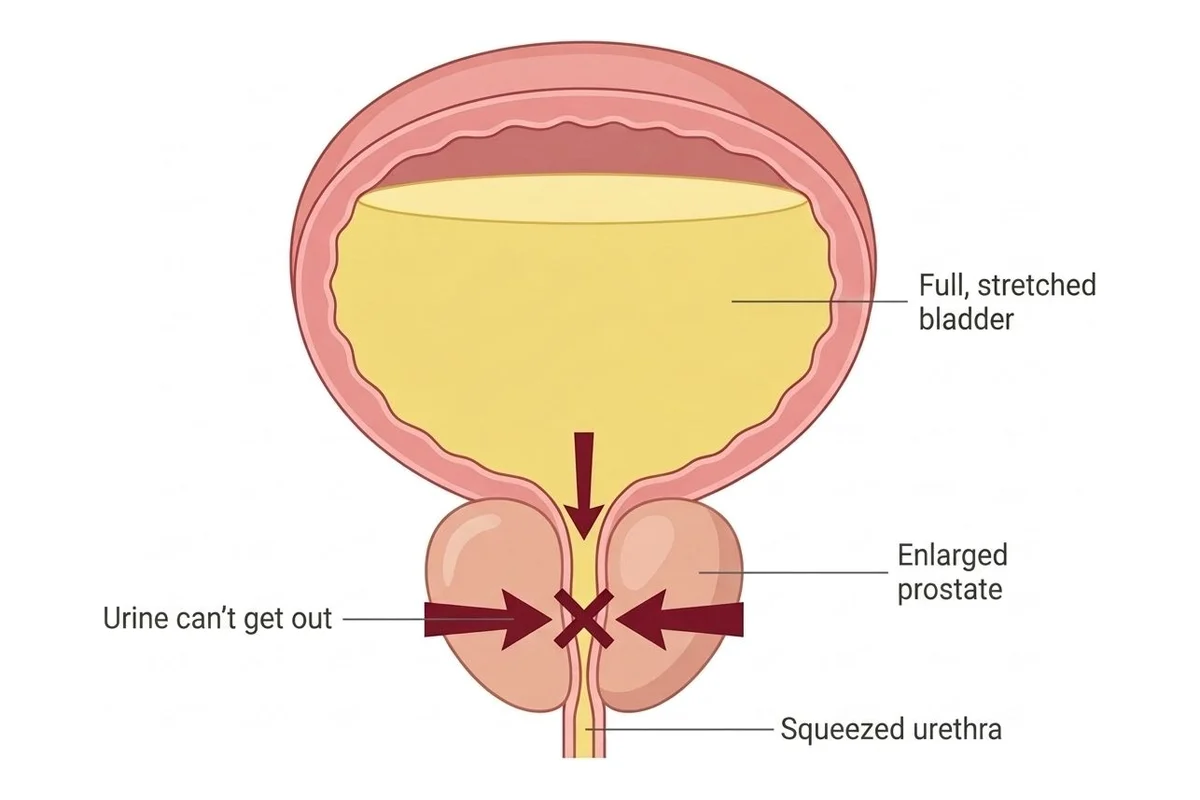
Sometimes the patient is able to urinate on his own again, but he still has a higher risk of another retention [1]. When removal fails again and again and the cause is the prostate, surgery is the main treatment [1]. Living with a catheter isn't a solution either: the longer it's used, the higher the risk of infections, bleeding, discomfort and injuries to the urethra that can narrow it. The surgery is scheduled; it isn't done on the spot: in a registry of more than 6,000 men from around the world, scheduled surgery was preferred over immediate surgery [6]. I explain what happens at each step in Can't urinate: what to do and what happens after the catheter.
Why can recurrent urinary tract infections lead to prostate surgery?
When the prostate narrows the outlet, the bladder can't always empty completely and urine stays inside. Think of a puddle that hasn't moved for days: stagnant water goes bad. That leftover urine helps bacteria grow.
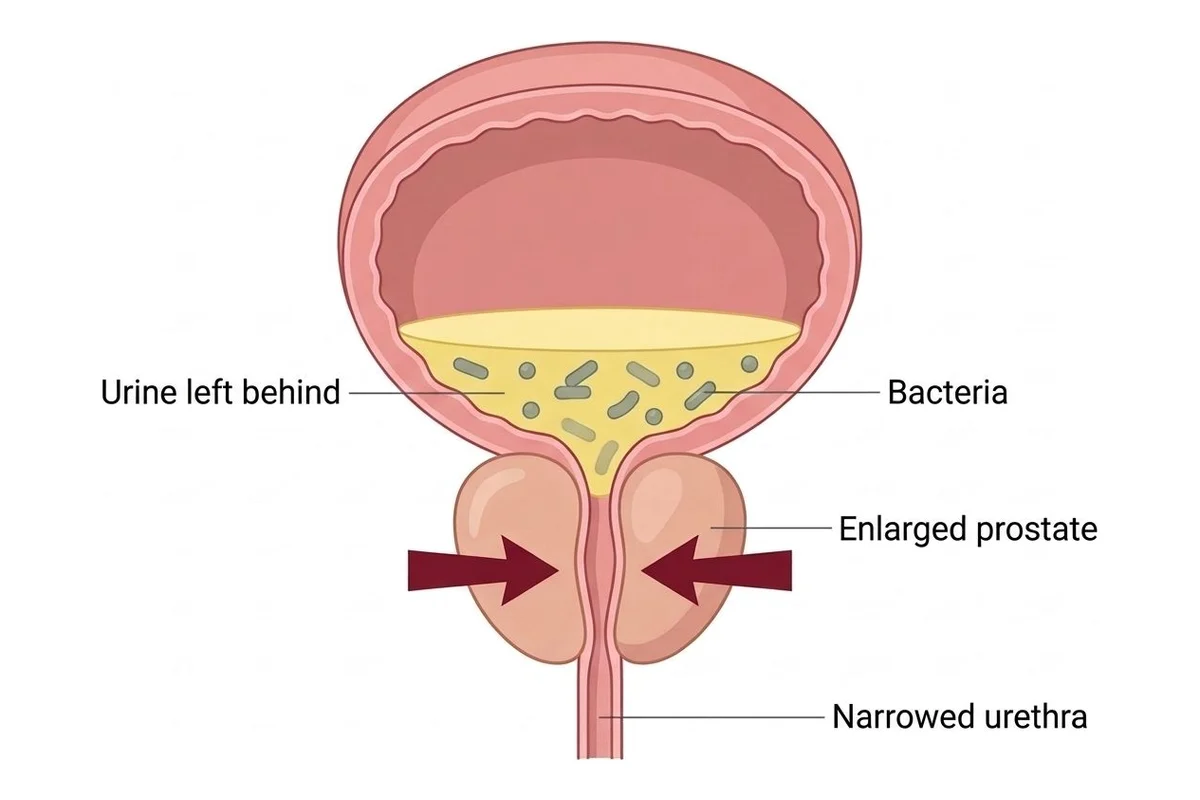
In men, urinary tract infections aren't that common, so when they keep coming back, the reason has to be investigated: they're usually due to some problem in the urinary tract [7]. Often it's the prostate, but not always, which is why each case is checked. If the cause is the blockage, a cycle sets in: infection, antibiotic, improvement… and a few months later, again. The antibiotic treats the infection, but not the blockage. I explain it in Recurrent urinary tract infections in men: when it's the prostate.
Why can bladder stones lead to prostate surgery?
The same urine that stays behind can form stones: most bladder stones appear in adult men with a blockage at the bladder outlet [8]. Think of the scale that builds up in a kettle: when urine sits still for a long time, the minerals it carries form crystals and, over time, a stone. It can cause pain, a stream that stops suddenly, infections or blood in the urine.
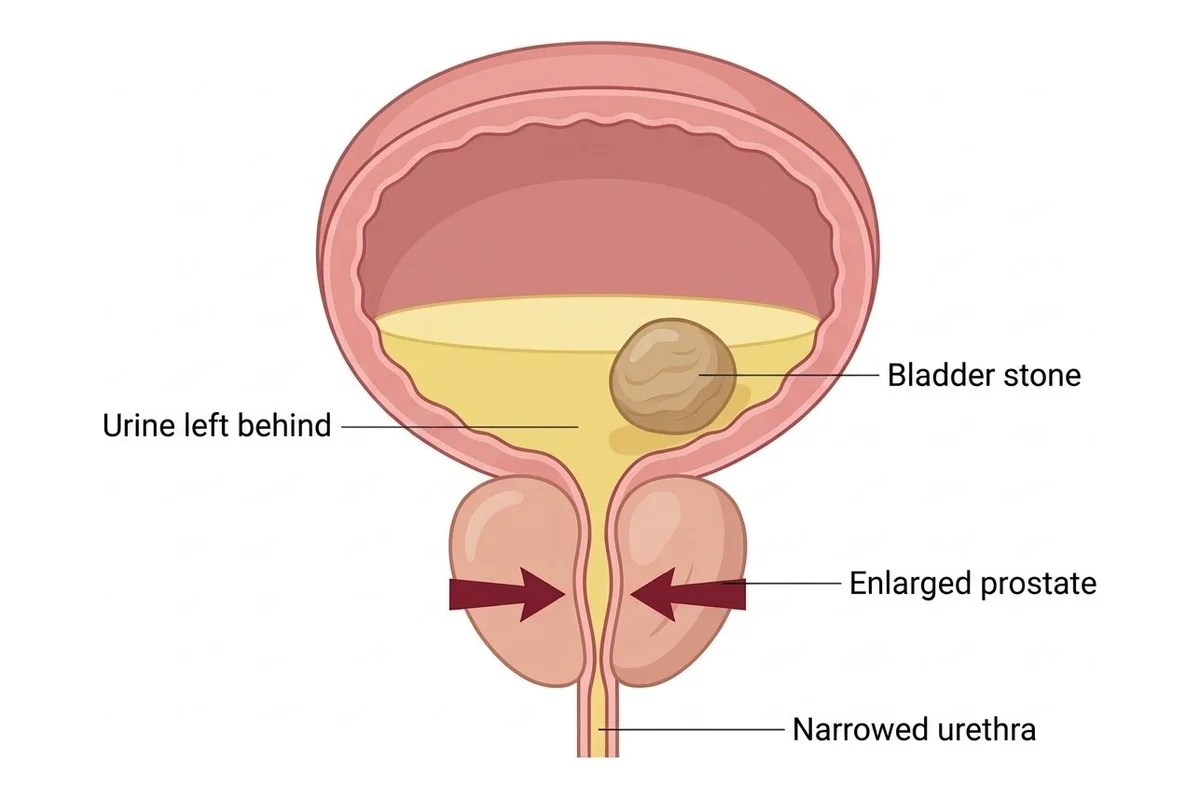
The stone is the consequence, not the cause: if only the stone is removed and the blockage remains, it's more likely to come back. In a review of published studies, it came back in 10 to 25 out of every 100 men when only the stone was removed, compared with 5 or fewer when the prostate was also operated on [9]. Even so, prostate surgery isn't mandatory for everyone: it's decided case by case [9]. I explain it in Bladder stones caused by the prostate.
When is prostate surgery done for blood in the urine?
Blood in the urine should never be ignored: it can come from the kidneys, the ureters, the bladder or the prostate, and it always has to be checked. In a study of almost 11,000 people referred to the hospital for suspected urinary tract cancer, most of them for blood in the urine, about 28 out of every 100 had cancer, mainly of the bladder [10]. When the prostate grows, its blood vessels also increase, and some become fragile and can break.
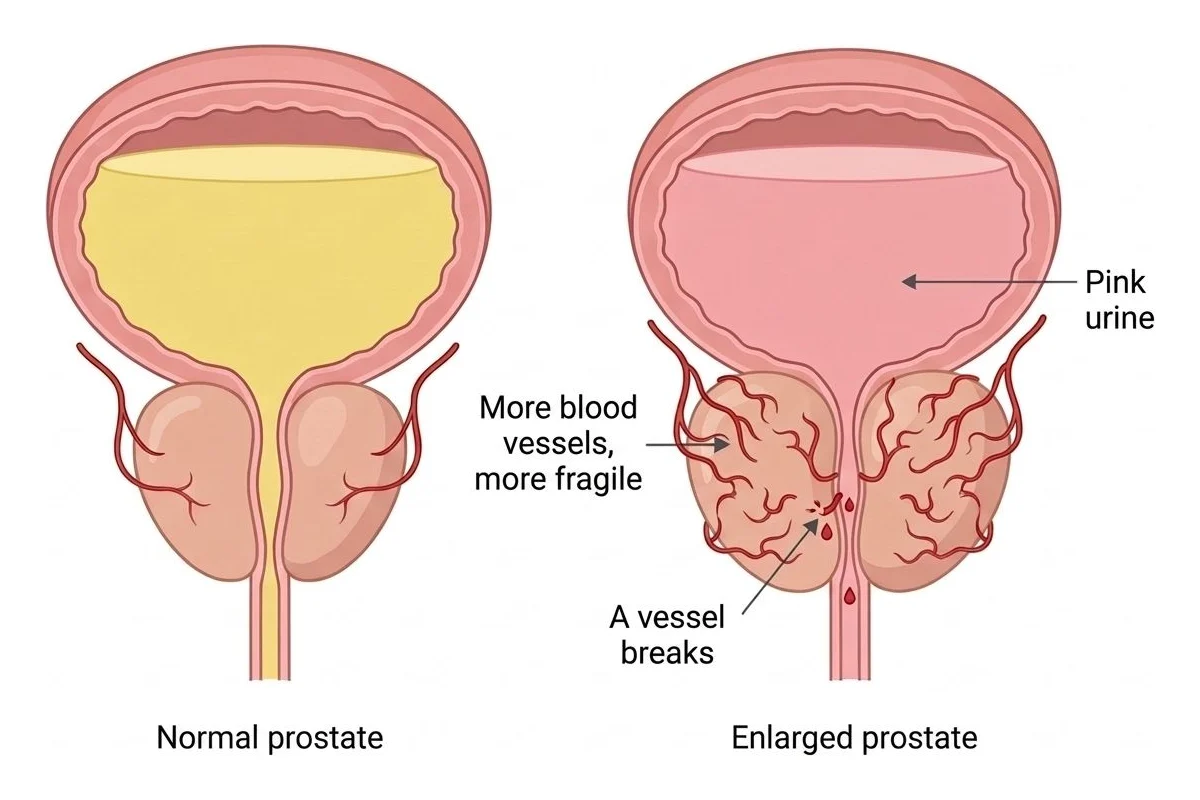
Only after other causes have been ruled out is the bleeding attributed to the prostate. Then some prostate medications can help reduce it [1], and if the bleeding continues, keeps coming back or is significant, surgery is part of the treatment [1, 2]. I explain it in Blood in the urine: when it's the prostate and what is done.
When is prostate surgery done if medication doesn't work?
Do you still have to strain to urinate? Is your stream still weak or slow to get going, despite taking prostate medication? You don't have to resign yourself to living like this.
The usual approach is to start with lifestyle changes and medications: some relax the prostate and others shrink it a little [1]. The vast majority of men who seek treatment choose medications first [1], and for many they work well for years. But the prostate grows so slowly that many men end up normalizing living poorly: sleeping in fits and starts, planning routes around where the bathrooms are, avoiding long trips. That shouldn't be the norm.
Surgery isn't a punishment for "failing" the medication. It's the next step when the blockage can no longer be offset with pills [2], even if there's no kidney damage or infection yet. I explain how long each medication takes and which signs are linked to a poorer response in When prostate medication stops working.
Can I have prostate surgery because I choose to?
Yes. Not because of an emergency or complications, but because, after learning about all the options, you prefer a more definitive solution. The guidelines allow for it: the American one includes people who don't want to continue with other treatments [1], and the European one, people who don't want to take medication and ask for active treatment [2].
Prostate medications aren't taken for a week or a month: they're often taken for years. Some men take them without any problem. Others:
- don't tolerate them well or have side effects;
- get tired of the daily prescription and the checkups;
- add up the years and notice how much the treatment has cost;
- or simply prefer to remove the underlying blockage.
In those cases, surgery can be a reasonable option, always after learning about all the alternatives.
What tests are done before prostate surgery?
Prostate surgery isn't decided lightly. Before any procedure, the American guideline recommends reviewing or considering [1]: a symptom questionnaire, measuring the stream (uroflowmetry), the urine left in the bladder, and an ultrasound of the size and shape of the prostate.
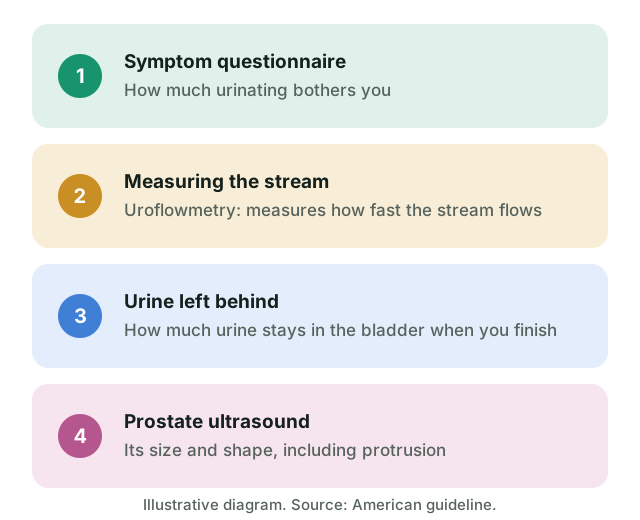
If kidney damage is suspected, or before surgery, kidney function is also measured [2]. How you responded to medications, your other health conditions and what you expect from surgery also count. The technique is chosen based on the size of the prostate, your health, whether you can receive anesthesia and your preferences [2].
What are the risks of prostate surgery?
No option is perfect. With the classic technique, transurethral resection of the prostate, long-term complications can include [2]:
- incontinence;
- urinary retention or infections;
- narrowing of the urethra or the bladder neck;
- erectile dysfunction;
- retrograde ejaculation, meaning semen goes back into the bladder instead of coming out.
Ask how often these happen with the technique you're offered. That's why the decision is shared. Modern medicine is no longer paternalistic: the doctor doesn't decide alone which treatment you'll follow. You need to know the risks and benefits of each option, for your case, so you can make an informed choice [1].
Can prostate surgery be avoided?
Sometimes it can be delayed or avoided. Medications that shrink the prostate lower the risk of developing urinary retention or needing surgery [2]. But it's worth looking at it in absolute numbers: in the two large studies of finasteride versus placebo, at four years, the difference was 2 to 4 out of every 100 men for retention and 3 to 7 out of every 100 for surgery [2]. In relative terms, the risk dropped by more than half; in absolute numbers, the benefit is small.
When should you talk to your doctor about prostate surgery?
Ask yourself these questions:
- Have you been told you have high creatinine or swollen kidneys?
- Have you needed a catheter to urinate?
- Have you had repeated urinary tract infections?
- Have you seen blood in your urine, even if only once?
- Do you still have significant symptoms despite treatment?
If you answered yes to any of them, bring it up with your doctor.
If one day you can't urinate at all and your lower belly hurts, get care right away. If you have fever with chills and burning when you urinate, get care that same day.
Key takeaways
- Prostate surgery isn't recommended because of the size shown on a test, but because of the consequences of the blockage and how it affects your life.
- The guidelines recommend it for kidney damage, retention that doesn't resolve, infections, stones or bleeding that keep coming back, symptoms that don't improve with medication, or when you prefer a more definitive solution.
- Kidney damage can progress without pain, and blood in the urine is always checked.
- The decision is shared: your tests, your symptoms and the risks of each option are reviewed.
Frequently asked questions
At what size is the prostate operated on? There's no size above which surgery is required. Surgery depends on symptoms and complications. Size does matter, but for choosing the technique [2].
Can I have prostate surgery even if I don't have complications? Yes. If your symptoms affect your quality of life and medications don't help you, or if you prefer not to keep taking them, surgery is a reasonable option to discuss calmly.